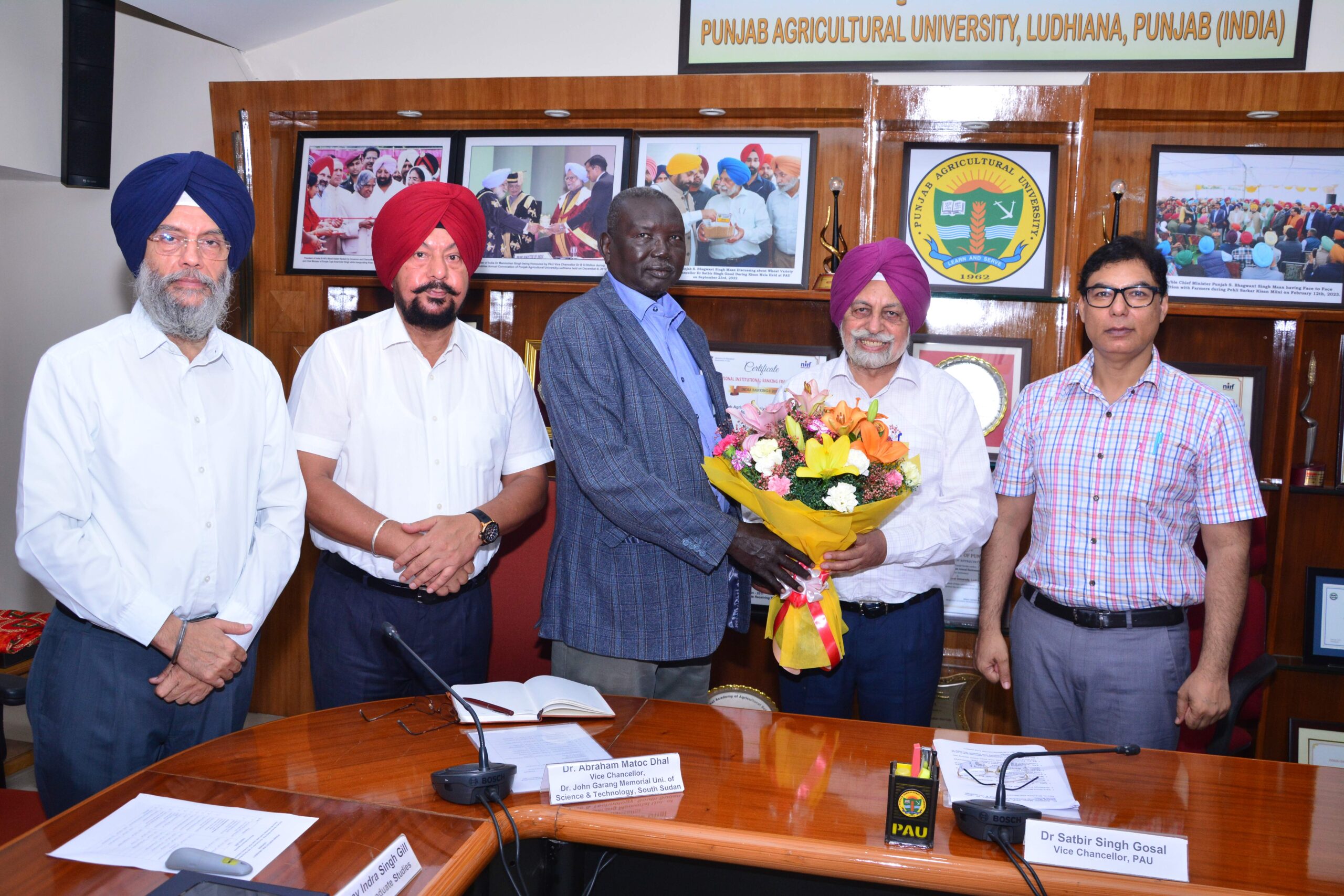
In a significant step toward strengthening international academic and technological cooperation in agriculture, Dr. Abraham Matok Dhal, Vice Chancellor of Dr. John Garang Memorial University of Science and Technology (DrJGMUST), South Sudan, visited Punjab Agricultural University (PAU), Ludhiana. His visit was part of the Academic Visitors Programme organized by the Indian Council for Cultural Relations (ICCR), and it laid the foundation for potential collaboration between India and South Sudan in agricultural research, technology exchange, and education.
Showcasing PAU’s Technological Advancements
PAU Vice Chancellor Dr. Satbir Singh Gosal welcomed Dr. Dhal and offered an insightful presentation on the university’s pivotal role in India’s Green Revolution and its ongoing contributions in areas like conservation agriculture, beekeeping, and farm mechanization. Dr. Gosal highlighted PAU’s leadership in smart and precision farming, integrating cutting-edge technologies such as drones, artificial intelligence, biosensors, blockchain, IoT, and GIS.
He also shared PAU’s recent shift from traditional grain-based agriculture towards diversified agri-business models. The university’s Integrated Farming System — which combines crop cultivation, livestock, fisheries, horticulture, and agroforestry — was presented as a sustainable model for boosting farm income, nutrition, and rural employment.
Agricultural Potential of South Sudan
Dr. Dhal provided an overview of South Sudan’s agricultural landscape, stating that over 50% of the country’s land is arable, supported by abundant water resources from the White Nile and extensive wetlands. Crops such as sorghum, millets, oilseeds, pulses, coffee, and sugarcane hold great potential in the region. With agriculture contributing 23% to the national GDP, the sector plays a key role in South Sudan’s economic recovery.
He expressed interest in leveraging PAU’s expertise for capacity building, technology transfer, and collaborative research. DrJGMUST, with faculties in agriculture, veterinary sciences, environmental studies, and computer science, aims to serve as a hub for science-led development in the region.
Knowledge Beyond Borders
Welcoming the guest, PAU Registrar Dr. Rishi Pal Singh (IAS) emphasized that despite the geographical distance between Punjab and South Sudan, both regions face similar challenges, such as climate change and the shortage of skilled manpower. He reaffirmed PAU’s belief in the philosophy of “knowledge knows no boundaries,” and supported the idea of fostering natural, bilateral collaboration.
Scientific Innovation and Breakthroughs
Dr. A.S. Dhatt, Director of Research, provided an in-depth overview of PAU’s scientific contributions, including water-saving technologies, integrated nutrient management, genome editing, nano-fertilizers, and the development of high-performing crop varieties. He cited examples such as PBW1 Zn (high-zinc wheat), PBW 826 (early-maturing variety), and PAU RS-1 (resilient mustard).
Strong Farmer Outreach Network
Dr. Malkhan Singh Bhullar, Director of Extension Education, showcased PAU’s extensive farmer outreach network. Through Krishi Vigyan Kendras (KVKs), Farm Advisory Centers, and digital platforms like the PAU Kisan App, Facebook Live sessions, WhatsApp groups, and the “Kisan Doot” network, the university reaches over 12,000 villages. Field demonstrations and regular farmer fairs ensure grassroots-level engagement.
Emphasis on Academic Excellence
Dr. Manav Inder Singh Gill, Dean of Postgraduate Studies, highlighted PAU’s research-oriented curricula across six faculties, with a strong focus on skill development. He also noted that PAU has been ranked among the top 100 agricultural universities globally in EduRank’s 2025 rankings.
Honoring the Guest and Strengthening Ties
The event was coordinated by Dr. Vishal Bector, Associate Director (Institutional Relations), and concluded with the presentation of a memento to Dr. Dhal in honor of his visit. He also toured various PAU facilities, including the Speed Breeding Centre, Tissue Culture Lab, Food Processing Unit, Skill Development Centre, University Museum, and sports complex.
This visit not only highlights PAU’s growing role in global agricultural research but also opens new doors for sustainable, technology-driven agricultural development in partnership with South Sudan.


 By
By