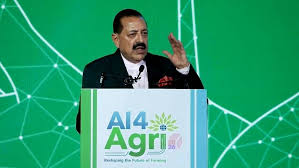
India’s Minister of State for Science and Technology, Jitendra Singh, stated that the effective use of Artificial Intelligence (AI) could generate nearly ₹70,000 crore in additional economic value for India’s agriculture sector. He was speaking at the उद्घाटन session of the AI4 Agri 2026 Summit held in Mumbai.
Dr. Singh emphasized that nearly 600 million people in the Global South depend on agriculture for their livelihoods and are increasingly facing challenges such as climate change, environmental degradation, and health-related risks. In this context, he described AI as a transformative technology that can strengthen farm resilience and improve productivity.
He explained that AI-driven solutions can enable farmers to achieve higher output at lower cost and within shorter timeframes. Technologies such as real-time weather advisories, disaster preparedness systems, predictive analytics for crop performance, and early warning systems for pests and diseases can make farming more scientific and risk-aware. By leveraging data-driven decision-making, farmers can optimize input usage, reduce losses, and improve overall efficiency.
Dr. Singh also stressed the importance of collaboration among policymakers, scientists, agri-tech startups, and agricultural experts. He noted that a coordinated approach could position India as a global leader in AI-powered agriculture. According to him, building a strong innovation ecosystem and encouraging technological partnerships will be critical for scaling solutions to the grassroots level.
The event was also addressed by Devendra Fadnavis and Maharashtra Agriculture Minister Dattatray Bharane. Several senior state officials and industry representatives attended the summit. During the conference, multiple Memorandums of Understanding (MoUs) were exchanged to promote the integration of AI technologies into agricultural practices.
The two-day summit is serving as a platform for discussions on innovation, data-driven farming, digital infrastructure, and collaborative partnerships in agriculture. Experts believe that if AI applications are effectively implemented at the field level, they can significantly enhance productivity, sustainability, and global competitiveness of Indian agriculture.
Overall, AI-based agricultural models have the potential not only to boost farmers’ incomes but also to strengthen the broader national economy.

 By
By