Atmospheric science experts from across the world congregated at Nainital, Uttarakhand discussed the changes in the greenhouse gases in the Earth’s atmosphere with implications on climate change and the importance of FTIR spectroscopy-based observations from ecologically sensitive Himalayan regions for studies on the topic.
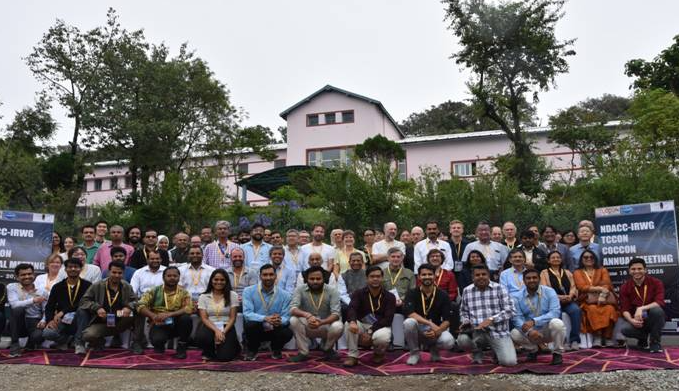
Aryabhatta Research Institute of Observational Sciences (ARIES), an autonomous research institute under the Department of Science & Technology (DST), Government of India is hosting the annual meeting of the Network for the Detection of Atmospheric Composition Change (NDACC-IRWG), the Total Carbon Column Observing Network (TCCON), and the Collaborative Carbon Column Observing Network (COCCON) communities from June 16-20, 2025 at its Manora Peak campus.
The 5-day flagship meeting unites global experts and data users in ground-based Fourier Transform InfraRed (FTIR) spectroscopy associated with the Infrared Working Group of the NDACC-IRWG, TCCON and COCCON, all working to advance our understanding of atmospheric composition change.
The meeting was inaugurated by former chairman, ISRO and member, Space Commission, Shri A. S. Kiran Kumar on June 16, 2025, who is also the chair of the governing body of ARIES. He emphasised the importance of monitoring greenhouse gases with space-based platforms.
Dr. Manish Naja, Director, ARIES, highlighted the importance of Himalayan region for such studies as ground observations are very limited and space-based observations are not useful for this region.
Dr. Mahesh Shah from Belgium said that FTIR based observations are very few in India and should be enhanced to better understand the climate change in this region. Dr. Nicholas Deutscher, Australia, Dr. Mathias Frey, Germany and Dr. Jim Hannigan, USA, who are the heads of three global networks of FTIR observations, stressed that observations from ecologically sensitive Himalayan regions are very important for assessing global warming.
Nearly 70 participants are participating in the meeting held in hybrid (in-person and online) mode, with 47 international experts representing countries like, Belgium, Japan, Spain, Germany, France, Australia, Canada, Ethiopia, Mexico, Sweden etc.


 By
By