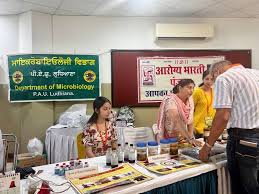
In a major stride towards spreading awareness about sustainable agricultural practices and natural resource management, the Department of Microbiology, Punjab Agricultural University (PAU) held an informative and interactive Herbal Garden Teacher Workshop at Guru Nanak Dev Bhawan, Ludhiana. The event saw an impressive turnout with 925 participants, including educators, students, and agricultural enthusiasts.
As part of the workshop, the department organized a comprehensive exhibition highlighting innovative technologies and research-driven solutions developed by PAU. These included bioenzymes, biofertilizers, water testing kits, and round-the-year mushroom cultivation techniques—tools that play a vital role in promoting eco-friendly and efficient farming practices.
Empowering Educators with Practical Knowledge
The workshop was led by Dr (Mrs) Urmila Gupta, Head of the Department of Microbiology, along with faculty members and enthusiastic student volunteers. They demonstrated how the use of bioenzymes and biofertilizers can reduce chemical dependency in agriculture, improve soil health, and enhance crop productivity.
Participants also received hands-on insights into the PAU-developed water testing kits, designed for rapid on-site analysis of irrigation water quality—a crucial step toward better crop planning and water management. The display on mushroom cultivation technology, designed to ensure year-round production, drew significant interest from attendees eager to explore low-cost, high-return agri-entrepreneurship avenues.
University Leadership Applauds the Initiative
The event was lauded by top university officials, including Dr Satbir Singh Gosal, Vice-Chancellor of PAU, Dr Ajmer Singh Dhatt, Director of Research, Dr Makhan Singh Bhullar, Director of Extension Education, and Dr Kiran Bains, Dean, College of Basic Sciences and Humanities. They commended the Department of Microbiology for its proactive approach in translating scientific research into community outreach and skill development.
Dr Gosal highlighted the significance of such workshops in empowering school teachers to become ambassadors of sustainable agriculture in their own institutions, thereby influencing young minds from an early age.
Bridging Science and Society
The Herbal Garden Teacher Workshop proved to be a successful platform for knowledge exchange, capacity building, and promoting eco-conscious agricultural technologies. By reaching out to educators, PAU is effectively planting the seeds of environmental stewardship and scientific curiosity across wider sections of society.
With overwhelming participation and positive feedback, the university reaffirmed its commitment to fostering grassroots awareness and innovation-driven farming solutions that align with the goals of climate resilience, food security, and rural empowerment.


 By
By