In a major relief for thousands of apple growers in Himachal Pradesh, the Supreme Court of India has put an immediate stay on the recent High Court order that directed the felling of apple trees planted on forest land classified as encroached. The apex court’s decision has come as a ray of hope for farmers, environmentalists, and local communities, especially at a time when the region is facing the peak apple harvesting season.
The issue began when the Himachal Pradesh High Court, on July 2, 2025, ordered the removal of fruit-bearing apple orchards from forest land that it termed illegally occupied. The court instructed the state government to cut down these trees and recover restoration costs from the farmers as arrears of land revenue. The decision sparked massive outrage, with farmer bodies warning that such action, especially during the monsoon season, could lead to landslides and environmental degradation in the fragile Himalayan landscape.
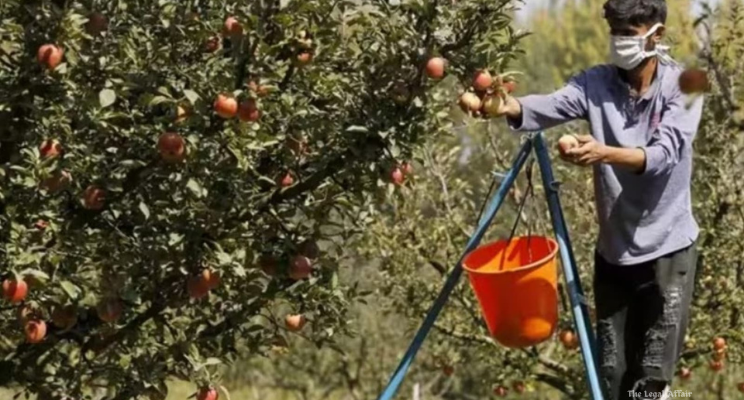
Taking cognizance of the widespread concern, the Supreme Court bench led by Chief Justice B.R. Gavai stayed the High Court’s directive. The top court allowed the Himachal Pradesh government to harvest and auction the apples from these orchards but strictly prohibited the cutting of apple trees until further notice. The matter will now be heard in detail in September 2025, and both the government and the petitioners have been asked to file their replies by then.
Petitioners, including former Shimla Deputy Mayor Tikender Singh Panwar, challenged the High Court’s order, calling it arbitrary, unconstitutional, and lacking in environmental sensitivity. They argued that many of the affected orchards are decades old and cutting them down would not only destroy the livelihoods of small farmers but also upset the ecological balance. Moreover, apple trees planted on hilly terrain help stabilize the soil and prevent erosion—making their removal a high-risk proposition in this rainy season.
According to reports, over 3,800 apple trees have already been axed in areas like Chaithla, Kotgarh, and Rohru, with the possibility of nearly one lakh more trees being affected across the state if the order is fully implemented. Farmers under associations like the Seb Utpadak Sangh and Himachal Kisan Sabha have planned protests, demanding a complete rollback of the felling orders and a more humane policy towards land regularization.
Interestingly, even the Himachal Pradesh government, while technically bound to implement the High Court order, had expressed serious concerns. Officials admitted that cutting fruit-laden trees during the monsoon would be disastrous, not just for the apple economy but also for the state’s delicate hill ecology. The government is now preparing to defend its position before the Supreme Court, seeking a more balanced and long-term solution.
This legal intervention by the apex court has not only prevented immediate damage to the apple economy valued at thousands of crores annually but also opened a wider conversation about how forest laws, farmers’ rights, and environmental protection can coexist in harmony. Experts suggest that instead of forced evictions, the state could explore models like cooperative ownership, lease renewals, or even gradual land regularization under the Forest Rights Act, which has provisions for traditional and dependent forest dwellers.
As Himachal Pradesh waits for the final outcome in September, this stay order is being seen as a welcome breather that protects both people and nature. For now, the apple trees will continue to stand, the fruit will be harvested, and the region’s fragile balance will be preserved at least until the nation’s highest court takes a final call.


 By
By