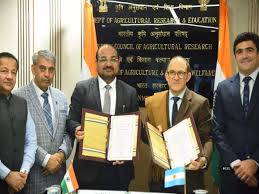
India and Argentina have strengthened their collaboration in agricultural research with the signing of a new work plan between the Indian Council of Agricultural Research (ICAR) and Argentina’s National Institute of Agricultural Technology (INTA). The agreement aims to enhance cooperation in crop science, technology development, and knowledge sharing to boost productivity and sustainability in both countries.
The work plan outlines joint initiatives in areas such as crop improvement, soil health, pest management, and climate-resilient farming practices. Researchers from both nations will collaborate on experimental trials, share best practices, and exchange germplasm and seed varieties to improve yields and nutritional quality of key crops. These efforts are expected to support smallholder farmers while fostering innovation in agribusiness and food security strategies.
Officials emphasized that the partnership reflects a shared commitment to scientific advancement and the use of technology to address pressing challenges in agriculture. By pooling expertise and resources, the two countries aim to accelerate research outcomes, develop scalable solutions for farmers, and strengthen the resilience of agricultural systems against climate variability and other risks.
The agreement also includes provisions for capacity-building programs, workshops, and training sessions for scientists, students, and extension workers. Both ICAR and INTA highlighted the importance of building human capital alongside technological advances, ensuring that research findings are effectively translated into practical applications at the farm level.
Analysts note that the collaboration comes at a time when global agricultural innovation is critical to meeting rising food demand, improving sustainability, and responding to environmental pressures. Strengthening ties between India and Argentina—two major agricultural producers—could facilitate more efficient crop production, enhance trade opportunities, and promote adoption of modern farming techniques.
The joint work plan is expected to serve as a framework for ongoing research projects and long-term collaboration, with periodic reviews to assess progress, share results, and identify new areas of cooperation. Officials expressed optimism that the partnership will contribute to greater food security, technological advancement, and mutually beneficial agricultural development.

 By
By