

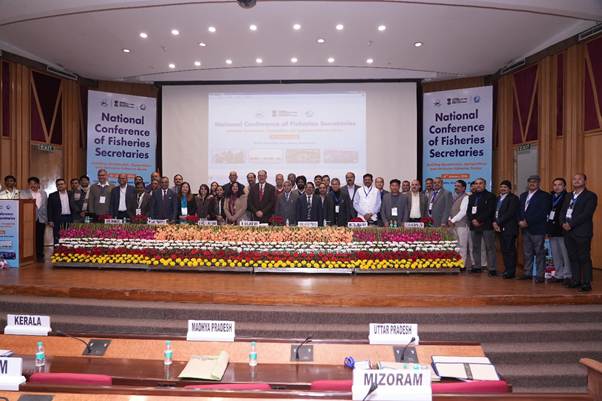
A National Conference of Fisheries Secretaries was held in New Delhi to review progress in the fisheries sector and outline a future roadmap for sustainable and inclusive growth. The conference was chaired by Dr. Abhilaksh Likhi, Secretary, Department of Fisheries, Ministry of Fisheries, Animal Husbandry and Dairying.
The meeting focused on the implementation and performance of key government initiatives, including the Pradhan Mantri Matsya Sampada Yojana (PMMSY), the Fisheries and Aquaculture Infrastructure Development Fund (FIDF), and the Pradhan Mantri Matsya Kisan Samriddhi Sah-Yojana (PM-MKSSY). Updates were also shared on the Marine Fisheries Census 2025, value-added seafood exports, and priority targets for the sector.
Senior officials from 25 States and Union Territories, along with representatives from ICAR institutions, SFAC, NCDC, NAFED, MPEDA, and other stakeholders, participated in the conference.
Focus on Timely Fund Utilisation and Scientific Planning
Addressing the conference, Dr. Likhi emphasized that timely action, strong implementation, and scientific planning would define the trajectory of India’s fisheries development in the coming years. He urged States and Union Territories to prioritize efficient and timely utilization of approved funds to ensure smooth execution of projects on the ground.
He highlighted the need for a time-bound approach to developing integrated aquaparks, seaweed cultivation, climate-resilient coastal fishermen villages (CRCFVs), artificial reefs, and cluster-based development. Dr. Likhi also called for greater adoption of digital tools, encouraging States and UTs to increase registrations on the National Fisheries Digital Portal.
Insurance, Digitalisation, and Livelihood Security
The Fisheries Secretary pointed out gaps in aquaculture insurance coverage and urged States to promote wider adoption to safeguard fishermen’s livelihoods. He also advised close monitoring of fisheries and aquaculture components under the PM Dhan-Dhanya Yojana to ensure benefits reach beneficiaries effectively.
Inland and Marine Fisheries Priorities
Joint Secretary (Inland Fisheries) Sagar Mehra reviewed progress in inland fisheries under PMMSY, noting that reservoir fisheries and inland clusters remain underdeveloped despite policy support. He stressed the need for diversification beyond Indian major carps by promoting market-linked, high-value species and strengthening export readiness in inland States.
Joint Secretary (Marine Fisheries) Neetu Kumari Prasad presented key issues affecting coastal States and UTs, calling for early implementation of Standard Operating Procedures (SOPs) for Mariculture Development 2025. She emphasized the importance of clear seawater leasing rules, biosecurity protocols, and simplified approvals for mariculture policies. Despite India’s long coastline, she noted that only a small portion of brackish water resources is currently utilized and urged diversification into finfish, shellfish, IMTA, seaweed cultivation, and open-sea cage farming. Adoption of climate-friendly technologies such as solar drying and green fuels was also highlighted to improve product quality and reduce post-harvest losses.
Boosting Value-Added Seafood Exports
MPEDA Chairman Dodda Venkata Swamy highlighted opportunities in value-added seafood exports, stressing the need for enhanced skill development, fish-waste utilization, sustainability, biosecurity, and traceability to strengthen India’s position in global markets.
ICAR and Data-Driven Fisheries Management
ICAR Deputy Director General Dr. J.K. Jena outlined expectations from States, including adoption of uniform technologies for catch-data collection, robust stock-assessment systems, compliance with minimum legal size norms, and wider dissemination of technologies through multiplier units.
NFDB CEO Dr. Bijay Kumar Behera set the strategic context for discussions, emphasizing assessment of public investment scale, addressing bottlenecks in project execution and value-chain integration, and developing time-bound action plans.
State-Level Progress and Way Forward
States and Union Territories presented their progress, shared operational challenges, reviewed fund-related issues, and outlined priorities for the coming period. Several States committed to meeting expenditure targets by March 2026. Best practices and innovations were also showcased by industry representatives, including success stories in value-added seafood processing.
Strengthening India’s Blue Economy Vision
The conference concluded with a shared commitment to strengthening coordination between the Centre and States, enhancing institutional capacity, and ensuring effective, timely implementation of fisheries programmes. Officials noted that the outcomes of the conference would play a key role in advancing India’s Blue Economy vision, supporting sustainable livelihoods, export growth, and long-term resilience of the fisheries sector.


 By
By











