

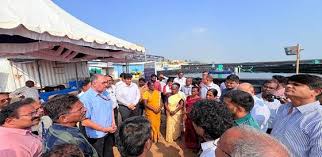
Dr Abhilaksh Likhi, Secretary, Department of Fisheries, Government of India, visited the ICAR–Central Institute of Brackishwater Aquaculture (ICAR–CIBA) and its Muttukadu Experimental Centre in Chennai, Tamil Nadu, to review ongoing research, innovation, and development initiatives in the brackishwater aquaculture sector. During the visit, he interacted directly with shrimp farmers and aquaculture entrepreneurs, holding detailed discussions on production practices, processing, marketing successes, best practices, and key challenges faced by the sector.
As part of the visit, Dr Likhi inspected the Penaeus indicus (Indian white shrimp) Genetic Improvement Programme being implemented by ICAR–CIBA under the Pradhan Mantri Matsya Sampada Yojana (PMMSY). The programme aims to strengthen scientific shrimp breeding in India and develop indigenous, genetically improved shrimp stocks, reducing dependence on imports and enhancing long-term sustainability.
The Secretary also engaged with ICAR–CIBA scientists and reviewed a wide range of advanced research facilities, including finfish and crustacean units, ornamental fish and crab culture systems, as well as the institute’s feed mill. These interactions provided him with first-hand insights into ongoing research, technological innovations, and capacity-building efforts supporting India’s brackishwater aquaculture growth.
The visit is considered particularly significant for the shrimp sector, as shrimp remains India’s largest marine export commodity, accounting for nearly 70 percent of the country’s total seafood exports and reaching markets in around 130 countries. Inputs gathered from farmers and industry stakeholders during the interaction are expected to help the Department of Fisheries design informed policy interventions for the sector’s sustainable development.
To expand shrimp export markets, the Department of Fisheries has undertaken several initiatives. Despite the 58 percent tariff imposed by the United States, the sector has shown strong resilience, recording a 21 percent increase in export value and a 12 percent rise in export volume during April–October 2025.
ICAR–CIBA is also playing a key role in shrimp feed development and is implementing two major PMMSY-supported projects. The first, the Genetic Improvement Programme of Penaeus indicus, is being implemented at a cost of ₹25.04 crore. The second project, titled “New-Age Shrimp System for Precision Use of Land, Water and Feed”, approved at a cost of ₹2.21 crore, focuses on promoting climate-smart and resource-efficient shrimp farming. Dr Likhi reviewed the progress of both projects during his visit.
On the occasion, two important Memoranda of Understanding (MoUs) were signed. The first MoU between ICAR–CIBA and M/s Selai Hatchery Tech, Marakkanam, aims at the commercialisation of India’s first indigenous shrimp larval feed. The second MoU, signed between ICAR–CIBA and M/s BRC Marine Products, Odisha, focuses on the use of rice-based DDGS as a cost-effective and sustainable protein source in shrimp feed, which is expected to reduce feed costs by 5–6 percent.
In addition, a live demonstration of drone-based feed spraying and transport was conducted in the presence of the Secretary. Recognising the growing potential of drones in fisheries and aquaculture, the Department of Fisheries has assigned pilot projects worth ₹1.16 crore to ICAR–CIFRI, Barrackpore.
Dr Likhi also chaired a hybrid meeting with officials from states and Union Territories, where he stressed the need for stronger coordination among research institutions, industry stakeholders, and state governments. He reiterated that the Government of India is placing special emphasis on indigenous technology development, climate-smart aquaculture practices, and efficient resource utilisation to ensure the fisheries sector achieves long-term, sustainable growth.


 By
By











