

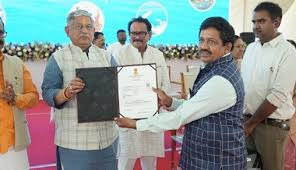
Union Minister for Fisheries, Animal Husbandry & Dairying and Panchayati Raj Rajiv Ranjan Singh today launched the ‘Access Pass’ system for fishing operations in India’s Exclusive Economic Zone (EEZ) at KCC Ground in Veraval, Gujarat. The fully online and free-of-cost platform aims to enhance transparency, traceability, offshore access, and income opportunities for Indian fishers.
The event was attended by Minister of State Prof. S. P. Singh Baghel, Minister of State George Kurian, Secretary (Department of Fisheries) Dr. Abhilaksh Likhi, and senior Gujarat government officials. More than 2,000 participants attended physically, including representatives from 24 fisheries cooperative societies across coastal states and Union Territories, while over 500 locations joined virtually.
Distribution of Access Passes and Safety Kits
The Union Minister handed over EEZ Access Passes to 37 fishermen representing 24 fisheries cooperative societies from across coastal regions. Safety kits—including life jackets, high-beam torches, and GPS devices—were also distributed to promote safe offshore operations. Newly formed fisheries cooperatives in Gujarat received financial assistance of ₹2 lakh each to strengthen institutional capacity.
Toward Modern, Fisher-Centric Governance
The Access Pass system marks a significant reform in implementing a modern, sustainable, and fisher-centric governance framework for India’s EEZ. The initiative seeks to promote offshore fishing, increase fishermen’s incomes, ensure responsible utilization of marine resources, and advance an inclusive Blue Economy.
Minister Singh stated that the EEZ framework was developed following extensive consultations with fisher associations, cooperatives, states/UTs, and scientific institutions. He informed that a large number of applications have already been received on the RealCraft portal, and Access Passes will be issued in accordance with notified guidelines in the coming month.
He urged fishermen to organize under cooperatives and leverage the EEZ regulations for economic advancement. In line with Budget 2026 announcements, fish caught by Indian vessels in the EEZ and high seas will not attract any fee. He also highlighted safety measures such as real-time vessel tracking through transponders and advisories on Potential Fishing Zones (PFZs).
Ministers Emphasize Transparency and Sustainability
Prof. S. P. Singh Baghel noted that the system is simple, transparent, and entirely digital, providing regulatory clarity and operational confidence to authorized Indian fishing vessels operating offshore. He reiterated that foreign fishing vessels are strictly prohibited from entering India’s EEZ.
George Kurian stated that the initiative reflects India’s commitment to the next phase of marine fisheries development, aligned with the “Viksit Bharat 2047” vision. He highlighted that under the Pradhan Mantri Matsya Sampada Yojana, Veraval has been designated as a Fishing Harbour Cluster.
Infrastructure and Sustainable Resource Management
Secretary Dr. Abhilaksh Likhi emphasized that a significant portion of India’s EEZ remains underutilized, despite scientific assessments indicating high-value potential species such as tuna. He stressed the importance of sustainable fisheries management, strengthening cooperatives and Fisheries Farmer Producer Organizations (FFPOs), and capacity building.
He also referred to infrastructure projects under PMMSY, including the development of smart and integrated fishing harbours such as Jakhau.
India’s Exclusive Economic Zone spans approximately 2.4 million square kilometres, offering vast potential for marine fisheries expansion, livelihood generation, and export growth. Currently, most Indian fishing vessels operate within 40–50 nautical miles from the coastline, leaving deeper EEZ waters relatively untapped.
To unlock this potential, the Government notified the “Sustainable Harnessing of Fisheries in the Exclusive Economic Zone (EEZ), 2025” Rules on November 4, 2025, aligned with the Budget 2025–26 announcements.
The Access Pass initiative is being viewed as a transformative step toward making India’s marine fisheries sector more self-reliant, competitive, and globally empowered.


 By
By











