

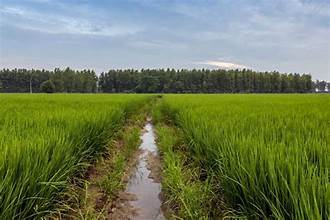
India has officially emerged as the world’s largest rice producer, surpassing China with an estimated output of 150 million tonnes in the latest agricultural year. This milestone marks a significant moment not only for India’s crop economy but also for global food supply chains, as the country strengthens its position at the centre of world rice production and trade.
According to senior agriculture officials and early production estimates, India’s record output is driven by a combination of high-yield seed varieties, expanded cultivation area and improved agronomic practices. The achievement reflects decades of research and policy investment in the rice sector, along with consistent performance across both Kharif and Rabi seasons.
A major contributing factor has been the rapid adoption of hybrid and climate-resilient paddy varieties that promise higher productivity and better resistance to pests, drought and irregular rainfall. Institutions such as the Indian Council of Agricultural Research (ICAR) and state agricultural universities have been at the forefront of developing advanced rice genetics that help farmers achieve significantly higher yields per hectare.
Favourable monsoon distribution during key growing periods also supported production, while states such as West Bengal, Uttar Pradesh, Punjab, Telangana and Andhra Pradesh reported strong uplifts in output. In several irrigated belts, yield levels touched record highs due to wider use of modern techniques including direct-seeded rice (DSR), laser land levelling and precision irrigation.
Economists highlight that India’s rise to the top spot is particularly relevant at a time when global markets are experiencing uncertainty due to geopolitical tensions and climate-induced production volatility in many rice-producing countries. With India now leading global output, it has greater influence over the world’s rice balance sheets and trade flows.
However, policymakers caution that high production does not necessarily translate into surplus availability for export. India continues to maintain partial restrictions on non-basmati rice shipments to manage domestic inflation and ensure affordable supplies for its population of more than 1.4 billion people. While the country remains the world’s largest rice exporter, any further relaxation of export controls will depend on the stability of domestic prices and procurement dynamics.
Agriculture analysts also note that sustaining this level of production will require continued government support, especially in terms of irrigation investment, crop diversification strategies and climate adaptation measures. The increasing frequency of extreme weather events—including heatwaves, floods and erratic monsoons—poses a structural risk to rice production across South Asia.
Despite these challenges, India’s new position as the world’s leading rice producer underscores the resilience and capacity of its farming sector. With strong farmer participation, research breakthroughs and evolving market systems, India has set a new benchmark in global crop output.
As international demand for rice grows, India’s production milestone is expected to play a key role in stabilising global food supplies and ensuring availability across import-dependent regions in Asia, Africa and the Middle East. For now, the country’s agriculture sector is celebrating a landmark achievement that reflects its long-term commitment to food security, innovation and farmer-led growth.


 By
By











