

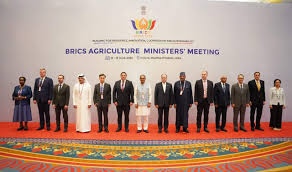
Representatives from BRICS nations have reaffirmed their commitment to strengthening agricultural cooperation, with a renewed focus on supporting smallholder farmers, improving food security, and promoting sustainable farming practices. The discussions took place during the recent BRICS Agriculture Meetings hosted in India, where policymakers, agricultural experts, and government officials explored strategies to address shared challenges facing the global farming sector.
Smallholder farmers form the backbone of agricultural production in many BRICS countries, contributing significantly to food supplies, rural employment, and local economies. Recognizing their vital role, participating nations stressed the importance of increasing access to modern technologies, quality inputs, financing, climate-resilient farming methods, and digital agricultural services.
Delegates highlighted that empowering small-scale producers is essential for building resilient food systems capable of meeting the demands of growing populations while adapting to changing climatic conditions. They also emphasized the need for knowledge sharing, innovation, and capacity-building initiatives that can help farmers increase productivity without compromising environmental sustainability.
A key theme of the meetings was strengthening food security through international cooperation. Participants acknowledged that global supply chain disruptions, climate variability, and resource constraints have created new challenges for agricultural production and food availability. In response, BRICS members expressed their intention to work more closely on research collaboration, seed development, crop diversification, and efficient resource management.
Sustainable agriculture emerged as another major priority during the discussions. Member countries encouraged the adoption of environmentally friendly farming practices that improve soil health, conserve water resources, reduce emissions, and protect biodiversity. The integration of precision agriculture, digital monitoring tools, and climate-smart technologies was identified as an important pathway to achieving long-term agricultural resilience.
Innovation and technology transfer also featured prominently in the agenda. Officials discussed expanding partnerships in agricultural research, biotechnology, mechanization, and digital extension services to ensure that farmers—particularly those in rural and underserved regions—benefit from scientific advancements. The use of data-driven decision-making and artificial intelligence in agriculture was highlighted as a promising avenue for improving farm management and productivity.
The meetings further emphasized the importance of strengthening agricultural trade and investment among BRICS countries. Enhanced cooperation in market access, logistics, and value chains could create new opportunities for farmers and agribusinesses while contributing to stable food supplies across member nations.
Special attention was given to youth and women in agriculture, with delegates recognizing their growing role in driving innovation and rural development. Expanding training programs, entrepreneurship opportunities, and financial inclusion initiatives for these groups was viewed as essential for ensuring the long-term sustainability of the agricultural sector.
The discussions also underlined the significance of climate adaptation measures, including improved irrigation systems, resilient crop varieties, and disaster preparedness strategies. By sharing best practices and technical expertise, BRICS countries aim to help farmers better withstand extreme weather events and changing environmental conditions.
As the meetings concluded, participating nations reiterated their shared vision of creating more inclusive, productive, and sustainable agricultural systems. Through stronger collaboration, policy coordination, and investment in smallholder farmers, the BRICS partnership seeks to contribute to global food security while fostering economic growth and rural prosperity.
The outcomes of the discussions are expected to strengthen future cooperation among member countries and encourage practical initiatives that support farmers, enhance resilience, and advance sustainable agricultural development across the BRICS bloc.


 By
By











