

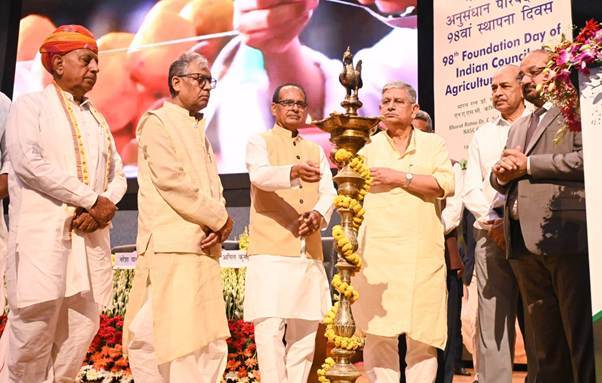
: Marking the 98th Foundation Day of the Indian Council of Agricultural Research (ICAR), Union Minister for Agriculture & Farmers’ Welfare and Rural Development Shivraj Singh Chouhan unveiled an ambitious roadmap for transforming Indian agriculture under the vision of “Developed Agriculture–Prosperous Farmers”, stating that the dream of Viksit Bharat 2047 can only be achieved through a prosperous farming community supported by cutting-edge agricultural research and innovation.
The grand celebration was held at the Bharat Ratna C. Subramaniam Auditorium in the NASC Complex, New Delhi, in the presence of agricultural scientists, ICAR institute heads, vice-chancellors of agricultural universities, Krishi Vigyan Kendra (KVK) experts, policymakers, and thousands of farmers connected virtually from across the country.
On the occasion, the Union Minister dedicated 43 new crop varieties, 17 advanced agricultural technologies and products, and 14 important publications to the farming community. More than 70 technology licensing agreements (MoUs) were also signed to accelerate the transfer of ICAR-developed innovations to farmers and the private sector.
Farmers and Scientists Must Work Together
Addressing the gathering, Chouhan emphasized that agriculture is not merely a means of production but the foundation of India’s economy, food security, and rural prosperity. He remarked that “farmers are the soul of agriculture, while scientists are its brain.” According to him, true agricultural transformation occurs when government policies, scientific innovation, and farmers’ hard work come together.
He paid tribute to former ICAR Directors General and agricultural scientists whose pioneering research helped India overcome food shortages and achieve the Green Revolution, making the country self-reliant in food production.
Focus Shifts from Quantity to Quality
The Minister noted that India has emerged as a global leader in food grain, horticulture, dairy, and fisheries production. However, he stressed that future agricultural growth must focus on quality rather than quantity. With climate change, El Niño-related weather uncertainties, and growing global competition, India needs climate-resilient, high-quality, and export-oriented crop varieties and technologies. He added that under Prime Minister Narendra Modi’s leadership, India is expanding into new global markets, making quality agricultural production more important than ever.
Seven Major Goals for the Future of Indian Agriculture
To strengthen agricultural research and improve farmers’ livelihoods, Chouhan announced seven key initiatives:
- Development of 100 Climate Smart Villages before ICAR completes 100 years, showcasing climate-resilient farming, water conservation, soil health management, and integrated farming systems.
- Launch of the “One Institute–One Grand Innovation” mission, under which every ICAR institute will develop at least one breakthrough technology, crop variety, vaccine, digital solution, or innovation with nationwide impact.
- Expansion of ICAR’s outreach so that its technologies and scientific innovations reach 10 crore farmers across the country.
- Celebration of the next two years as “Mission ICAR-100,” with Krishi Vigyan Kendras evolving into innovation hubs, startup support centres, climate advisory centres, and technology demonstration centres. A nationwide 15-day campaign will also see every KVK demonstrating modern farming technologies in at least 100 villages.
- Creation of an ICAR Open Digital Knowledge Platform to provide farmers with free scientific advice, training videos, weather forecasts, soil testing guidance, crop management practices, and market information directly on their mobile phones.
- Stronger legal action against fake seeds and adulterated pesticides, along with the development of simple field-level testing technologies that farmers can use themselves.
- A target for ICAR to generate ₹10,000 crore in internal revenue by 2029 through commercialization of technologies, improved crop varieties, vaccines, and licensing, making the institution more financially self-reliant.
New Varieties, Technologies, and Employee Welfare
The Minister highlighted that the newly released 43 crop varieties include high-yielding and disease-resistant cultivars, while the 17 technologies and products feature digital agriculture solutions, livestock vaccines, fisheries innovations, and biotechnology-based advancements. He praised ICAR scientists for their contribution to developing indigenous technologies and vaccines, particularly in controlling diseases such as Foot and Mouth Disease (FMD).
Chouhan also announced that more than 150 ICAR employees have been regularized for the first time, describing it as long-overdue justice that would strengthen employee morale and institutional efficiency.
Concluding his address, he urged scientists to view their work as a mission for nation-building rather than merely a profession. Drawing inspiration from Lord Krishna’s philosophy of Karma Yoga, he encouraged researchers to remain dedicated, humble, patient, and committed to farmers’ welfare. He expressed confidence that the combined efforts of scientists, policymakers, and farmers would transform India into a global agricultural powerhouse by 2047.
The event was attended by Union Minister for Fisheries, Animal Husbandry and Dairying Rajiv Ranjan Singh, Ministers of State Ramnath Thakur and Prof. S.P. Singh Baghel, ICAR Director General Dr. M.L. Jat, senior officials, scientists, and representatives from ICAR institutes, KVKs, and agricultural universities across the country.


 By
By











