

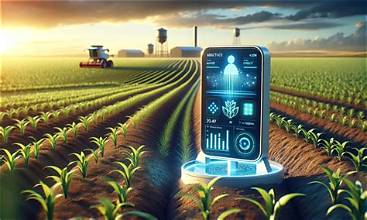
Artificial intelligence is emerging as one of the most important technologies transforming Brazil’s agriculture and agri-food sector. From livestock health monitoring and food traceability to crop management and farm decision-making, AI-based tools are increasingly helping producers analyse large volumes of data and make faster, more informed decisions.
Brazil’s vast agricultural landscape, large-scale crop production and extensive livestock sector provide significant opportunities for digital technologies. In recent years, the country’s agricultural industry has accelerated its adoption of AI, sensors, remote sensing, automation and data platforms to improve productivity while managing climate, economic and logistical challenges.
AI Moves from Experiment to Farm Management
AI is increasingly being used to convert data collected from farms into practical recommendations. Information from satellites, drones, weather stations, soil sensors, machinery and farm-management platforms can be analysed to identify patterns and support decisions.
Applications include crop and pasture monitoring, yield forecasting, pest and disease detection, geospatial analysis, precision application of agricultural inputs, logistics planning and management recommendations.
For farmers, the biggest advantage is the ability to bring multiple sources of information together. Instead of relying only on individual observations, producers can use AI-supported systems to assess field conditions and identify potential problems earlier.
Livestock Health Gets a Digital Upgrade
Brazil’s livestock industry is also benefiting from AI-powered monitoring systems. Smart sensors, cameras and connected devices can track animal movement, behaviour and other indicators that may signal health or productivity problems.
Research and technology development in Brazil is increasingly exploring the use of AI and machine learning for livestock management. New systems can help producers monitor animals continuously and support earlier intervention when unusual behaviour or health conditions are detected.
AI-enabled livestock tracking is also being connected with digital identities and traceability systems. In one recent Brazilian initiative, smart collars and digital tracking were used to monitor cattle and create digital records associated with individual animals.
Traceability Becomes More Intelligent
Food traceability is another area where AI could have a major impact. As consumers, regulators and international markets demand greater transparency about where food comes from, digital systems are becoming increasingly important.
AI can analyse information collected throughout the supply chain and help identify irregularities, predict risks and improve monitoring. When combined with technologies such as the Internet of Things and blockchain, AI can contribute to more transparent and verifiable supply chains.
For Brazil, where agricultural commodities are exported to markets around the world, stronger traceability could help improve compliance, quality assurance and supply-chain efficiency.
Precision Agriculture and Climate Resilience
AI is also helping Brazilian farmers manage climate-related risks. Remote sensing and machine-learning systems can analyse vegetation, soil and weather information to identify changes in crop and pasture conditions.
Recent research in Brazil has demonstrated the use of airborne multispectral sensing and machine learning to estimate biomass and nutritional characteristics of tropical pastures. Such technologies could help livestock producers make better decisions about grazing and feed management.
AI-supported systems can also assist farmers with irrigation, input management, crop protection and timing of field operations.
Challenges Remain
Despite its rapid growth, AI adoption is not without challenges. Reliable data, connectivity, technical skills, cost and interoperability remain important barriers. Brazil’s agricultural sector is highly diverse, and technologies developed for large commercial farms may not always be suitable for smaller producers.
Researchers have also stressed that AI systems are only as effective as the data and infrastructure supporting them. Questions around data ownership, privacy, transparency, regulation and technological access will become increasingly important as AI becomes more deeply integrated into agriculture.
Brazil’s Agriculture Enters a New Digital Era
The expansion of AI is signalling a shift from traditional digital farming toward increasingly predictive and data-driven agriculture. Instead of simply recording what happens on a farm, modern systems are beginning to analyse information, predict potential problems and recommend actions.
For Brazil, AI could become a powerful tool for improving productivity, livestock management, traceability, resource efficiency and climate resilience. However, ensuring that these benefits reach farmers of different sizes will be critical.
As technology continues to advance, the future of Brazilian agriculture may depend not only on producing more food, but also on using data and artificial intelligence to produce it more efficiently, sustainably and intelligently.


 By
By











