

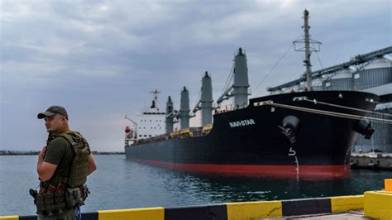
Agricultural exports through the Black Sea continue to face significant security risks as attacks involving port infrastructure, grain facilities and commercial vessels raise concerns over the reliability of one of the world’s most important food trade corridors. Ongoing conflict and military activity in the region are creating uncertainty for exporters, shipping companies, farmers and international food markets.
The Black Sea plays a critical role in global agricultural trade. Countries surrounding the region are major producers and exporters of wheat, maize, sunflower oil and other agricultural commodities. Large volumes of grain move through Black Sea ports to food-importing countries across the Middle East, North Africa, Asia and other regions.
Any disruption to these export routes can therefore have consequences far beyond the immediate conflict zone. Damage to ports, storage facilities and loading infrastructure can reduce the ability of exporters to move grain efficiently. Attacks or security threats involving commercial vessels can also increase insurance costs and force shipping companies to reconsider routes or operating schedules.
Ukraine remains particularly important to the global grain trade. Despite the challenges created by the war, the country has continued efforts to maintain agricultural exports through maritime routes. Ukrainian farmers and exporters have adapted to difficult circumstances, but attacks on port infrastructure continue to create operational and logistical risks.
Russia is also a major global supplier of wheat and other agricultural commodities. Continued instability in the wider Black Sea region can therefore affect both Ukrainian and Russian export flows, even when agricultural production itself remains relatively strong.
The security situation can influence global prices through expectations as much as through actual supply losses. If traders believe that grain shipments could be disrupted, futures markets may react quickly. Higher freight and insurance costs can also increase the final price of grain delivered to importing countries.
For food-importing nations, the reliability of Black Sea supplies is especially important. Countries that depend heavily on imported wheat and other cereals may face higher costs or difficulties securing supplies if shipping disruptions become widespread. This could create additional pressure on food inflation and food-security programs.
The impact also extends to farmers. International grain prices influence planting decisions, farm revenues and access to markets. Prolonged uncertainty could encourage buyers to diversify their sources of supply, while exporters may seek alternative routes and infrastructure to reduce their dependence on vulnerable ports.
Alternative export corridors can provide some protection. Railways, roads, inland waterways and ports outside the most affected areas can help maintain agricultural trade when traditional maritime routes are disrupted. However, alternative routes often have higher transportation costs and limited capacity compared with major deep-water ports.
The situation also highlights the importance of resilient global food supply chains. Governments, traders and international organizations are increasingly focused on maintaining open trade routes, improving maritime security and ensuring that disruptions do not develop into wider food-supply crises.
Weather conditions add another layer of uncertainty. Global grain markets are already sensitive to drought, heatwaves, floods and other extreme weather events. If conflict-related disruptions occur at the same time as poor harvests in major producing regions, the combined impact could be significantly greater.
For now, the Black Sea remains a critical area for global agricultural markets. Continued attacks on agricultural infrastructure and risks to commercial shipping mean that exporters and international buyers must operate in an environment of elevated uncertainty.
The future direction of grain prices and trade flows will depend on the scale of disruptions, the security of shipping routes, harvest conditions and the ability of exporters to maintain alternative supply channels. Maintaining reliable agricultural trade through the Black Sea will remain important for global food security and market stability.


 By
By











