

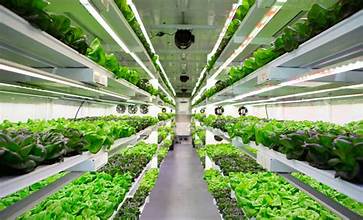
The global controlled-environment agriculture (CEA) market is continuing to expand as farmers, investors and technology companies increasingly adopt vertical farming, advanced greenhouse systems and other technologies designed to produce crops under controlled growing conditions. Rising demand for fresh food, efficient resource use and year-round production is supporting the development of new agricultural technologies, including Nutrient Film Technique (NFT) systems.
Controlled-environment agriculture allows crops to be grown in carefully managed environments where factors such as temperature, humidity, light, water and nutrients can be monitored and adjusted. Unlike conventional farming, which depends heavily on outdoor weather conditions, CEA provides producers with greater control over the growing environment.
Vertical farming is one of the most visible areas of growth. By stacking multiple growing layers vertically, producers can increase crop production within a relatively small land area. This approach is particularly attractive in urban and densely populated regions where agricultural land is limited and consumers are located close to production centers.
Greenhouse cultivation is also contributing to the expansion of the sector. Modern greenhouses increasingly incorporate automated climate-control systems, sensors, irrigation technologies and data-driven crop management. These systems can help farmers improve growing conditions and produce consistent harvests throughout the year.
Among the technologies gaining attention is the Nutrient Film Technique, commonly known as NFT. In an NFT hydroponic system, a thin flow of nutrient-rich water continuously moves across the roots of plants grown without conventional soil. The system allows crops to receive water and nutrients efficiently while reducing the amount of water required compared with some traditional cultivation methods.
NFT systems are particularly suitable for leafy vegetables and herbs, which have relatively short production cycles and can be grown in controlled environments. Their ability to support high-density cultivation makes them useful for vertical farms, indoor farms and modern greenhouse operations.
Water efficiency is another major factor driving interest in controlled-environment agriculture. Traditional agriculture can be highly dependent on rainfall and irrigation, while hydroponic systems can recycle water within the production system. This can reduce water consumption and make crop production more feasible in areas facing water shortages.
The sector is also benefiting from advances in automation and digital agriculture. Sensors can monitor nutrient levels, temperature, humidity and other conditions, while automated systems can adjust irrigation and environmental settings. Artificial intelligence and data analytics are increasingly being explored to optimize crop growth, identify problems early and improve production efficiency.
However, controlled-environment agriculture also faces challenges. High initial investment costs, electricity requirements, specialized equipment and technical expertise can make these systems expensive compared with conventional farming. Energy costs are particularly important for indoor farms that rely heavily on artificial lighting and climate-control equipment.
Economic viability therefore remains a key consideration for producers. Successful CEA businesses generally need to combine high productivity with efficient energy and resource management. Crop selection is also important, as high-value and fast-growing crops may provide better returns than commodities with low market prices.
Despite these challenges, market forecasts indicate continued expansion of controlled-environment agriculture through 2035. Growing urban populations, increasing demand for locally produced fresh food and concerns about climate variability are expected to encourage further investment in the sector.
CEA could also contribute to food-system resilience by allowing production closer to consumers and reducing dependence on seasonal weather conditions. Local production can shorten supply chains and potentially reduce transportation time for highly perishable vegetables.
As technology improves and equipment costs gradually become more competitive, controlled-environment agriculture is expected to become increasingly integrated with modern food production. Vertical farms, greenhouses, hydroponics, automation and precision monitoring are likely to play complementary roles.
Overall, the expansion of controlled-environment agriculture reflects a broader shift toward technology-driven food production. With continued innovation in NFT systems, energy efficiency, automation and crop management, the sector could become an increasingly important part of the global agricultural landscape over the next decade.


 By
By











