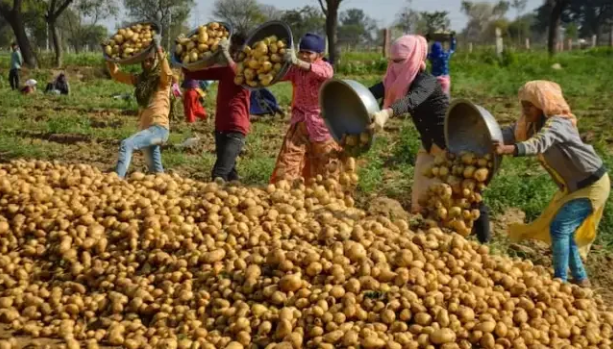
In a significant move to enhance potato productivity and strengthen the processing industry, the Union Ministry of Agriculture has approved four newly developed potato varieties from the ICAR–Central Potato Research Institute (CPRI) for nationwide seed production and agricultural use.
The approved varieties Kufri Ratan, Kufri Tejas, Kufri Chip Bharat-1, and Kufri Chip Bharat-2—were cleared based on the recommendations of the Central Seed Committee. These high-yielding, disease-resistant, and climate-resilient potatoes are expected to benefit farmers, improve processing efficiency, and provide a strong push to India’s potato-based industries.
Key Features of the New Varieties
Kufri Ratan
- Type: Red-skinned table potato
- Maturity: 90 days (medium duration)
- Yield: 37–39 t/ha
- Suitable Regions: Northern plains and plateau states (Haryana, Punjab, Uttar Pradesh, Madhya Pradesh, Rajasthan, etc.)
- Highlights: Excellent storability, deep red tubers with attractive yellow flesh.
Kufri Tejas
- Type: Heat-tolerant table potato
- Maturity: 90 days
- Yield: 37–40 t/ha
- Suitable Regions: Haryana, Punjab, Uttarakhand (early season); Madhya Pradesh, Gujarat, Maharashtra (main season)
- Highlights: High heat tolerance, white flesh, good storability.
Kufri Chip Bharat-1
- Type: Suitable for chip processing
- Maturity: 100 days
- Yield: 35–38 t/ha
- Suitable Regions: Haryana, Punjab, Uttar Pradesh, Karnataka, Tamil Nadu, etc.
- Highlights: Low sugar content, high dry matter (21%), acceptable chip color.
Kufri Chip Bharat-2
- Type: Early-maturing chip processing variety
- Maturity: 90 days
- Yield: 35–37 t/ha
- Suitable Regions: Plains of northern and southern India
- Highlights: Excellent storability, low reducing sugars, high dry matter (21%).
Experts Welcome the Approval
Dr. Brajesh Singh, Director of ICAR-CPRI, described the development as “a landmark step for India’s potato sector,” emphasizing that these varieties will help increase farmers’ income, improve processing efficiency, and strengthen potato-based industries. Dr. Sledge Sood, potato breeder at CPRI, highlighted that the varieties reflect the institute’s commitment to providing region-specific solutions.
National and State-Level Initiatives
Alongside these approvals, the Haryana government has signed an MoU with the International Potato Center (CIP) to promote disease-free seed production, funded under the Rashtriya Krishi Vikas Yojana (RKVY) with a budget of ₹18.70 crore. In addition, states like Uttar Pradesh are offering incentives, including a subsidy of ₹10,000 per hectare under its Potato Development Policy 2014.
Strengthening India’s Potato Sector
This approval is part of the central government’s broader strategy to modernize potato cultivation and strengthen the processing industry. With the rollout of these advanced varieties, farmers can expect higher yields, improved quality, and greater profitability, while India positions itself as an emerging global leader in potato processing.


 By
By