

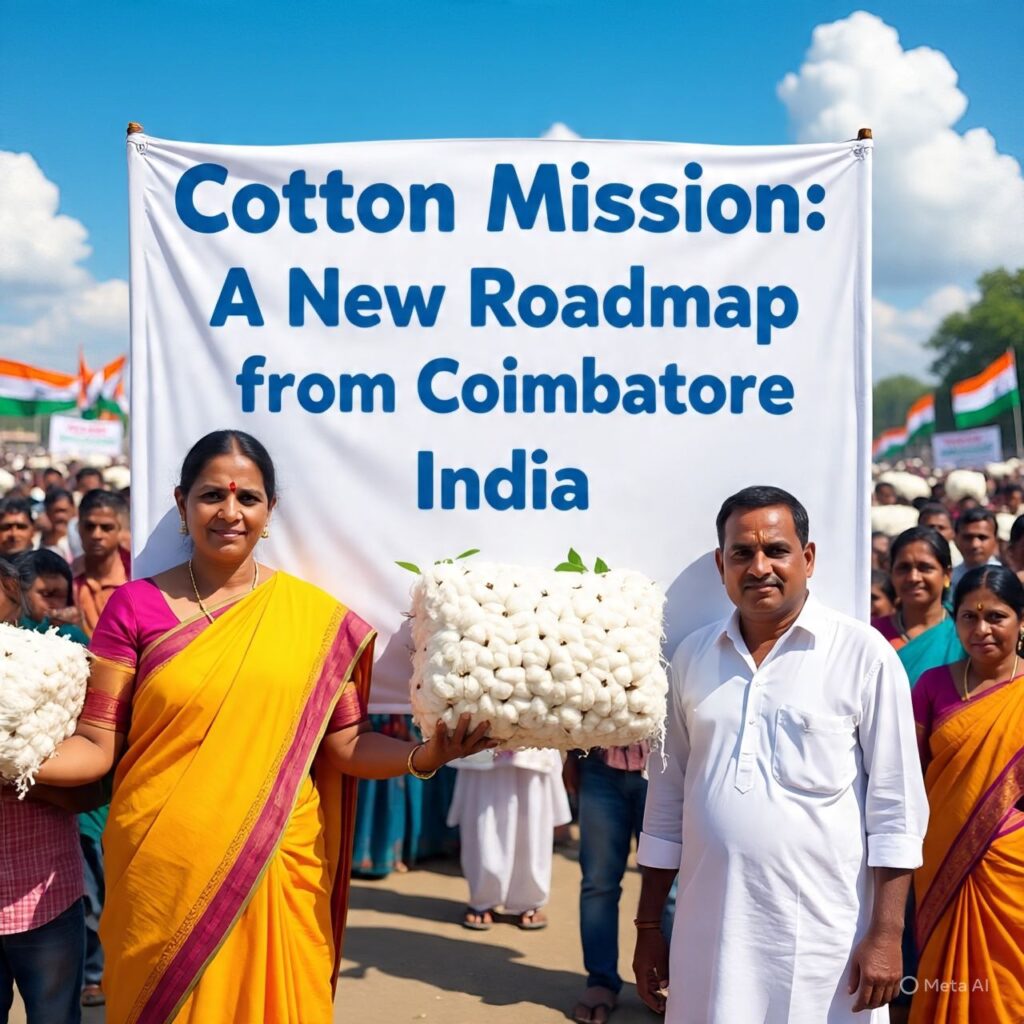
Coimbatore, Tamil Nadu — A New Direction for India’s Cotton Sector
In a significant move to boost India’s cotton production and overall productivity, the Union Government organized a major brainstorming session in Coimbatore. The event, presided over by Union Agriculture and Farmers Welfare Minister Shivraj Singh Chauhan, marked a pivotal moment in India’s plan to strengthen its cotton ecosystem through a comprehensive and coordinated approach.
Held at the ICAR-Sugarcane Breeding Institute in Coimbatore, this meeting brought together key stakeholders, including Union Textiles Minister Giriraj Singh, Haryana Agriculture Minister Shyam Singh Rana, senior officials from ICAR (Indian Council of Agricultural Research), agricultural scientists, industry experts, farmer representatives, and entrepreneurs engaged in the cotton value chain.
However, notably, the Tamil Nadu State Government — the host state — chose not to attend despite an official invitation. Minister Chauhan, while addressing this absence, reminded everyone that when it comes to farmers’ welfare or national interests, political considerations must come second. He reiterated that the mission is about putting farmers first and ensuring that Indian cotton regains its competitive edge in global markets.
‘Team Cotton’: A Dedicated Alliance for Cotton’s Future
One of the core outcomes of this extensive dialogue was the formation of ‘Team Cotton’. This initiative will be a multi-level, integrated task force that binds together different arms of the government and industry. The team will include the Union Ministry of Agriculture, the Ministry of Textiles, ICAR, agricultural universities, state government officials, experienced scientists, and progressive farmers.
The vision is clear: make Indian cotton not just sufficient for domestic demand but strong enough to compete globally. Cotton remains vital to India’s textile sector — a sector that employs millions, supports rural economies, and contributes significantly to exports. Yet, challenges like fluctuating yields, pest infestations, and inconsistent seed quality continue to affect farmers’ income and industry standards.
Why a Cotton Mission Now?
The timing of this renewed Cotton Mission is strategic. India is one of the world’s largest cotton producers and consumers. The textile and garment industry depends heavily on a stable supply of high-quality cotton. For decades, Indian cotton farmers have faced multiple hurdles — from pest attacks like pink bollworm to poor seed replacement rates and climate-related uncertainties.
Addressing these issues requires a unified action plan involving advanced research, robust extension services, modern farm machinery, and stricter regulation to curb counterfeit seeds and pesticides. Minister Chauhan emphasized that this mission isn’t just a government programme — it’s a service to millions of cotton farmers who ensure that India remains clothed and competitive.
Key Priorities: Research, Seeds & Technology
A major focus of the new action plan is on strengthening research and development. ICAR and its associated institutes will intensify work on developing improved cotton seed varieties. The aim is to produce seeds that can withstand adverse weather, resist pests like pink bollworm, and deliver better yields.
Scientists shared that research will now prioritise High-Density Planting Systems (HDPS), which have shown promise in boosting yield per hectare. Smart technologies like AI-based pest monitoring tools — including smart traps — will be promoted to help farmers monitor and tackle pests efficiently, reducing pesticide use and increasing productivity.
Quality Seeds: The Backbone of Productivity
Another major challenge faced by cotton growers is the availability of good quality seeds. The plan is to expand certified seed production, promote registered seed dealers, and intensify action against fake seeds. Ensuring farmers get timely access to reliable seeds will directly impact both yield and quality.
Minister Chauhan clearly stated that the government will work with ICAR and private sector innovators to develop and distribute seeds that align with the needs of farmers as well as the industry. Seed testing and certification processes will be strengthened and decentralized to reach remote regions faster.
A Boost for Machinery and Farmer-Friendly Innovations
During the discussions, Minister Chauhan acknowledged the lack of adequate testing facilities for cotton farming machinery in South India. To address this gap, a new machinery testing centre will be established in South India so that local farmers do not have to transport equipment to distant states for certification and trials.
Additionally, the mission will push for the development of small, cost-effective machines suitable for smallholder cotton farmers. Mechanization is vital to reduce labour costs, improve efficiency, and ensure uniform quality — especially during harvesting and ginning.
Jinning Modernization and Industry Integration
Another critical aspect of the Cotton Mission is modernizing India’s ginning factories. Many ginning units still operate with outdated equipment that affects the quality of cotton lint, impacting its value in global markets. The plan includes modernizing ginning and pressing units to ensure that Indian cotton meets international quality benchmarks.
The Ministries of Agriculture and Textiles will work closely with industry stakeholders to incentivize investments in modern ginning facilities. Better ginning will mean less contamination, improved fibre quality, and better prices for farmers.
Empowering Farmers Through Extension & Capacity Building
Minister Chauhan highlighted that technology and research are only useful when they reach the farmer’s field. For this, extension services will be strengthened with a focus on farmer training, capacity building, and awareness campaigns.
Krishi Vigyan Kendras (KVKs) and agricultural universities will be tasked with conducting regular workshops to train farmers on best practices for crop management, pest control, optimal seed use, and integrated farming systems. Mobile-based advisory services and AI-powered pest alert systems will also be expanded to keep farmers informed in real-time.
Tackling Counterfeit Inputs: Strict Measures Ahead
A recurring challenge discussed at the Coimbatore meeting was the spread of fake seeds, fertilizers, and pesticides — a menace that hurts both productivity and farmer trust. The Cotton Mission includes a proposal to enact and strictly enforce tighter laws against counterfeit agricultural inputs.
Enforcement agencies will step up inspections, while seed certification processes will be upgraded to use modern tagging and traceability solutions. The mission team acknowledged that safeguarding farmers from fake inputs is as important as supplying them with quality inputs.
A Shared Commitment: State Governments and the Centre
Despite the absence of Tamil Nadu’s state representatives at the Coimbatore session, Minister Chauhan emphasized that states play a central role in the Cotton Mission’s success. Agriculture in India is a state subject as well, and without close cooperation between states and the Centre, large-scale change is impossible.
‘Team Cotton’ has been envisioned to foster this spirit of partnership — a platform where states, the Centre, scientific institutions, and farmers’ bodies work as equals towards the shared goal of a robust, competitive cotton sector.
A Vision for 2030: Self-Reliant Cotton
The session concluded with an ambitious but achievable goal: making India self-sufficient in cotton production by or before 2030. This means not only meeting domestic textile industry needs but also boosting exports and securing better incomes for cotton farmers.
Participants reaffirmed that India must move from being a quantity supplier to a quality leader in the global cotton market. The mission sets out to transform India into a hub of premium cotton production, resilient farming systems, modernized processing, and efficient supply chains.
‘Crop Dialogue’ Series: Cotton After Soybean
The Coimbatore session was the second major gathering under the ‘Crop Dialogue’ series — a new approach where the Centre convenes focused brainstorming meetings for key crops. The first such dialogue centred on soybean and was held recently to address issues like seed quality and oilseed productivity.
By holding targeted dialogues crop-by-crop, the government aims to tailor policies, research, and field implementation more effectively rather than adopting one-size-fits-all models.
Bringing Together Farmers, Scientists, and Industry
A recurring theme in Minister Chauhan’s address was that real change happens when farmers, scientists, and industry leaders work together with mutual trust and shared responsibility. He praised the contributions of scientists who develop new technologies, but also stressed that they must be practical, farmer-friendly, and accessible.
The event concluded with an open house where farmers shared on-ground challenges, scientists offered solutions, and industry leaders discussed market trends and export competitiveness. This collaborative spirit is expected to shape the next steps of the Cotton Mission.
Moving Ahead: Cotton as a Symbol of Rural Prosperity
Cotton is more than just a crop; it is a symbol of rural livelihoods, an economic lifeline for millions of small and marginal farmers, and an important driver for India’s textile exports. The Coimbatore meeting, despite political differences, underscored that when it comes to farmers’ welfare and national interest, cooperation must prevail over competition.
With ‘Team Cotton’ ready to work on the ground, India’s cotton farmers can look forward to better seeds, better prices, modern technology, and a support system designed to tackle today’s and tomorrow’s challenges.
In the words of Minister Chauhan, “Just as bread is essential for life, so is clothing — and it is the humble cotton farmer who makes that possible. This mission is not just about increasing numbers; it is about respecting and empowering our farmers.”


 By












