

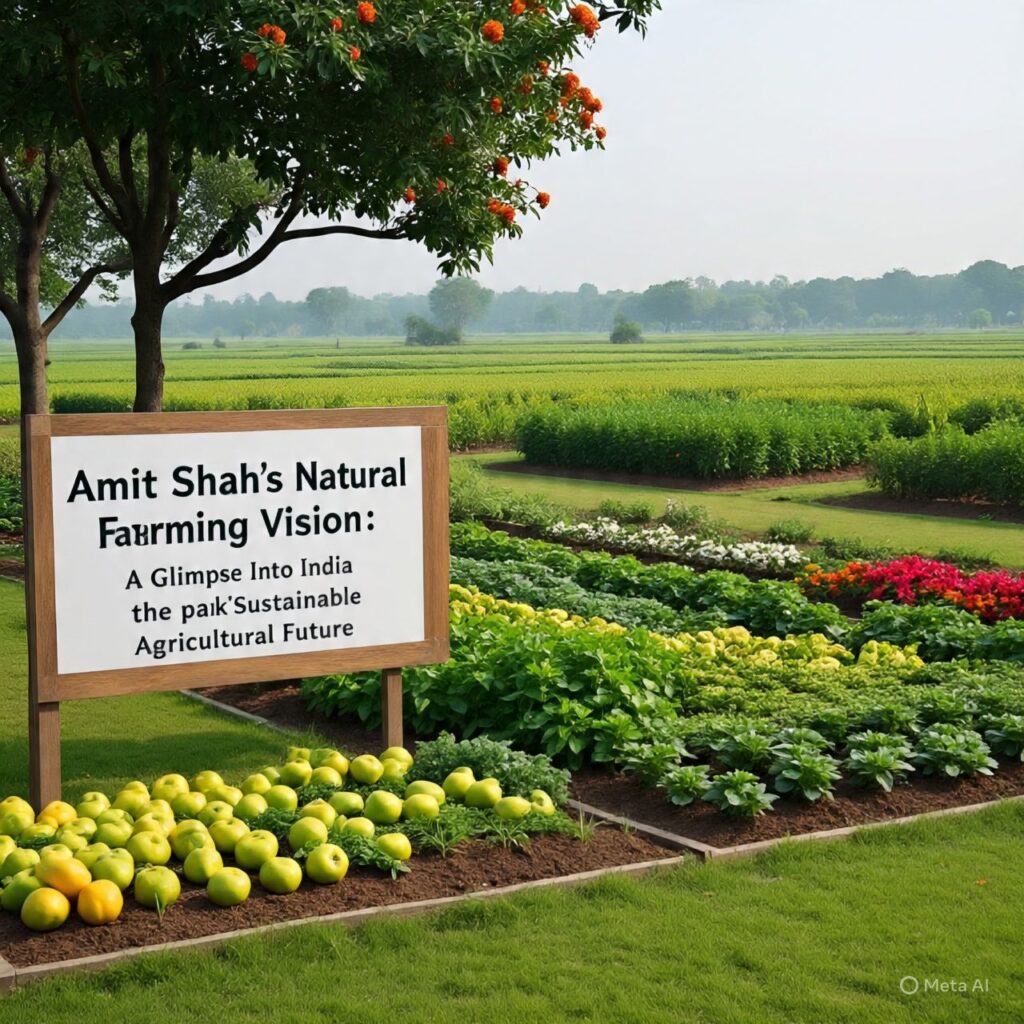
In a rare, candid revelation, India’s Union Home Minister Amit Shah recently shared an interesting plan for life beyond politics — to take up natural farming. This statement has sparked fresh conversations across policy circles, farming communities, and the general public. It’s not every day that one of the country’s most influential political figures publicly talks about switching from the power corridors of Delhi to the green fields of organic agriculture.
More than just a personal plan, Shah’s statement draws attention to a vital agricultural shift that India urgently needs: moving away from chemical-intensive farming towards methods that are more sustainable, healthy, and economically resilient. As the nation grapples with issues like soil degradation, declining farmer incomes, and rising health concerns linked to food quality, natural farming could offer part of the answer.
What Did Amit Shah Say?
While addressing a gathering, Amit Shah spoke about how chemical fertilizers used to grow staple crops like wheat contribute to various health issues. He emphasized that natural farming not only helps keep the body disease-free but can also boost agricultural productivity in the long run.
This was not just a passing comment — it reflected a conviction rooted in his own observations. The idea that after retiring from active politics he would adopt natural farming suggests a personal endorsement of a practice that is gaining traction among progressive farmers, researchers, and policymakers.
Why Talk About Natural Farming Now?
India’s Green Revolution of the 1960s and 70s was a turning point that made the country self-sufficient in food grains. But the same revolution, dependent heavily on chemical fertilizers, pesticides, and high-yielding varieties, has over decades taken a toll on the soil, groundwater, and human health.
A growing number of farmers now face declining yields, rising input costs, soil fatigue, and pest resistance. Added to this is the burden of chemical residues in food, which many researchers link to long-term health concerns like digestive issues, certain cancers, and hormonal imbalances.
Natural farming is being promoted as an antidote to this crisis — a way to restore the soil’s health, cut farming costs, improve produce quality, and deliver healthier food to consumers.
What Exactly Is Natural Farming?
Natural farming, often interchangeably used with terms like Zero Budget Natural Farming (ZBNF) or organic farming (though technically they have differences), is an agricultural method that aims to grow crops without using synthetic chemicals or fertilizers.
Instead, it relies on:
✅ Using farmyard manure, compost, green manure, and bio-fertilizers.
✅ Using indigenous seeds suited to local conditions.
✅ Protecting and encouraging soil organisms and beneficial insects.
✅ Natural pest management techniques — neem extracts, cow dung solutions, fermented plant extracts.
✅ Mulching and intercropping to retain soil moisture and fertility.
One of the leading advocates of this practice in India was the late Subhash Palekar, whose ZBNF approach inspired thousands of farmers across states like Andhra Pradesh, Maharashtra, Himachal Pradesh, and Karnataka.
Why Are Farmers Interested in Natural Farming?
For millions of small and marginal farmers in India, the promise of natural farming is straightforward: freedom from costly chemical inputs. By using locally available resources like cow dung, urine, crop residues, and botanical extracts, farmers can reduce their dependence on expensive fertilizers and pesticides, which often push them into debt.
Natural farming also helps revive soil health. Years of chemical fertilizer use deplete the soil’s natural microbes, nutrients, and structure. Techniques like mulching, cover cropping, and adding organic compost restore this balance, improving water retention and soil fertility.
Many farmers also find that natural farming methods improve the taste, shelf life, and market value of produce — especially among health-conscious urban consumers willing to pay a premium for chemical-free fruits, vegetables, and grains.
Is Natural Farming Scientifically Sound?
Skeptics argue that natural farming cannot produce yields at the scale required to feed India’s 1.4 billion people. However, several field studies and pilot projects have shown promising results.
In Andhra Pradesh, for instance, the Community Managed Natural Farming (CMNF) program (inspired by ZBNF) has covered millions of farmers and thousands of hectares of farmland. Reports indicate that farmers practicing natural farming have seen reduced input costs, stable yields, better soil health, and increased resilience to climate shocks.
A 2020 FAO study also acknowledged that well-managed organic or natural farming systems can match conventional yields over time, especially when supported by training, local knowledge, and effective pest management.
Health Benefits: Beyond the Farm
When Amit Shah talks about how chemical-grown wheat can cause health issues, he echoes a concern shared by many nutritionists and researchers. Residual pesticides, nitrates, and heavy metals in food have been linked to various ailments.
Natural farming promotes chemical-free produce, which means fewer toxins entering the food chain. Fresher, cleaner grains, vegetables, and fruits can boost immunity, lower the risk of non-communicable diseases, and promote overall well-being.
For a country facing a dual burden of malnutrition and rising lifestyle diseases like diabetes, obesity, and cancer, food quality is as crucial as food quantity.
Environment: The Unseen Savings
Natural farming goes beyond producing safe food. It helps heal ecosystems damaged by years of intensive chemical use.
🌿 Soil Health: Natural methods rebuild soil organic carbon, improve microbial diversity, and enhance the soil’s water retention capacity — crucial in a country prone to droughts and erratic monsoons.
🌊 Water Conservation: Reduced chemical runoff means less contamination of rivers and groundwater. Practices like mulching and cover cropping minimize water evaporation, helping conserve precious groundwater.
🐝 Biodiversity: Natural farms support pollinators like bees and butterflies, birds, and beneficial insects that conventional pesticides often harm.
Challenges and Criticisms
Transitioning to natural farming is not without its hurdles. Farmers used to chemical fertilizers may initially see yield drops while the soil adjusts. Many lack training or easy access to organic inputs.
Market linkages for natural produce are still underdeveloped in many regions. Unless farmers can get a fair premium price, they may struggle to make up for any initial shortfall in production.
Another challenge is scaling natural farming in densely populated regions where food security is paramount. Policymakers must ensure a balanced approach — scaling up natural farming where it works best, while supporting scientific improvements in conventional systems too.
Amit Shah’s Statement: Symbolic or Transformative?
Amit Shah’s remark about retiring into natural farming may sound symbolic, but it carries weight. When a senior national leader endorses natural farming, it adds momentum to the wider push for chemical-free agriculture.
This isn’t the first time senior policymakers have supported this vision. Prime Minister Narendra Modi has repeatedly spoken about promoting natural farming along the Ganga river basin and beyond. States like Andhra Pradesh, Himachal Pradesh, Sikkim, Uttarakhand, and Maharashtra have run large-scale programs and pilot projects.
The Bigger Policy Push
India’s Union Budget in recent years has repeatedly allocated funds for natural farming clusters. Training programs for farmers, certification support, market development, and awareness campaigns are being rolled out.
Various states are experimenting with models like Farmer Producer Organizations (FPOs) and direct-to-consumer supply chains to help natural farmers get better prices and secure buyers.
Some states also offer subsidies on inputs like bio-fertilizers, biopesticides, and compost units to ease the transition.
The Road Ahead: What India Needs
If India truly wants to make natural farming more mainstream, a few things must happen:
✅ Research and Innovation: There is a need for more localized research on crop-specific natural farming methods, climate resilience, and yield optimization.
✅ Training and Extension: Farmers require ongoing training to adopt best practices, pest management techniques, and soil health monitoring.
✅ Market Linkages: Strong supply chains, organic certification, branding, and fair price mechanisms are critical to reward farmers for producing chemical-free food.
✅ Policy Alignment: Policies should balance food security goals with sustainability. They must ensure natural farming doesn’t compromise yield at scale but instead boosts income, resilience, and environmental health.
Rural Livelihoods and Youth
One of the lesser-discussed benefits of natural farming is its potential to revive interest among rural youth. Farming, once seen as unprofitable and laborious, could regain its dignity and profitability if it shifts towards premium, sustainable models.
Young people trained in eco-friendly farming, organic input production, direct marketing, and value addition can find new entrepreneurial opportunities. Villages can see economic revival alongside ecological restoration.
A Return to Roots, A Step to the Future
At its core, natural farming is not an alien concept to India. For centuries, Indian farmers cultivated crops in harmony with nature, using cow dung, compost, green manures, and traditional pest repellents.
The chemical farming boom was necessary for food security at a time of scarcity. Today, with new challenges — climate change, degraded soils, and health crises — India’s farmers are rediscovering the wisdom of older, time-tested practices, supported by modern science.
Amit Shah’s Choice: A Message for Farmers and Policy Makers
When Amit Shah says he plans to practice natural farming, he is not just sharing a retirement plan. He is subtly encouraging millions of Indians — from farmers to urban consumers — to think about what goes into their food, what it costs the soil, and what it means for the nation’s health.
For policymakers, it is a reminder that the future of Indian agriculture must strike a balance: high productivity, farmer prosperity, ecological sustainability, and public health.
Conclusion: Can Natural Farming Be the New Normal?
Natural farming is not a magic bullet. It will not replace all conventional farming overnight. But as more farmers experiment, as more consumers demand chemical-free food, and as policymakers lend support, it can grow from a niche movement to a mainstream practice.
Amit Shah’s personal endorsement is likely to energize the discourse. It signals that India’s leaders understand the stakes — for farmers, consumers, and the country’s long-term wellbeing.
Perhaps when Amit Shah finally trades his political office for a farm, it will be more than symbolic. It might just be the push India needs to root its future in healthier, greener, more sustainable soil.


 By












