

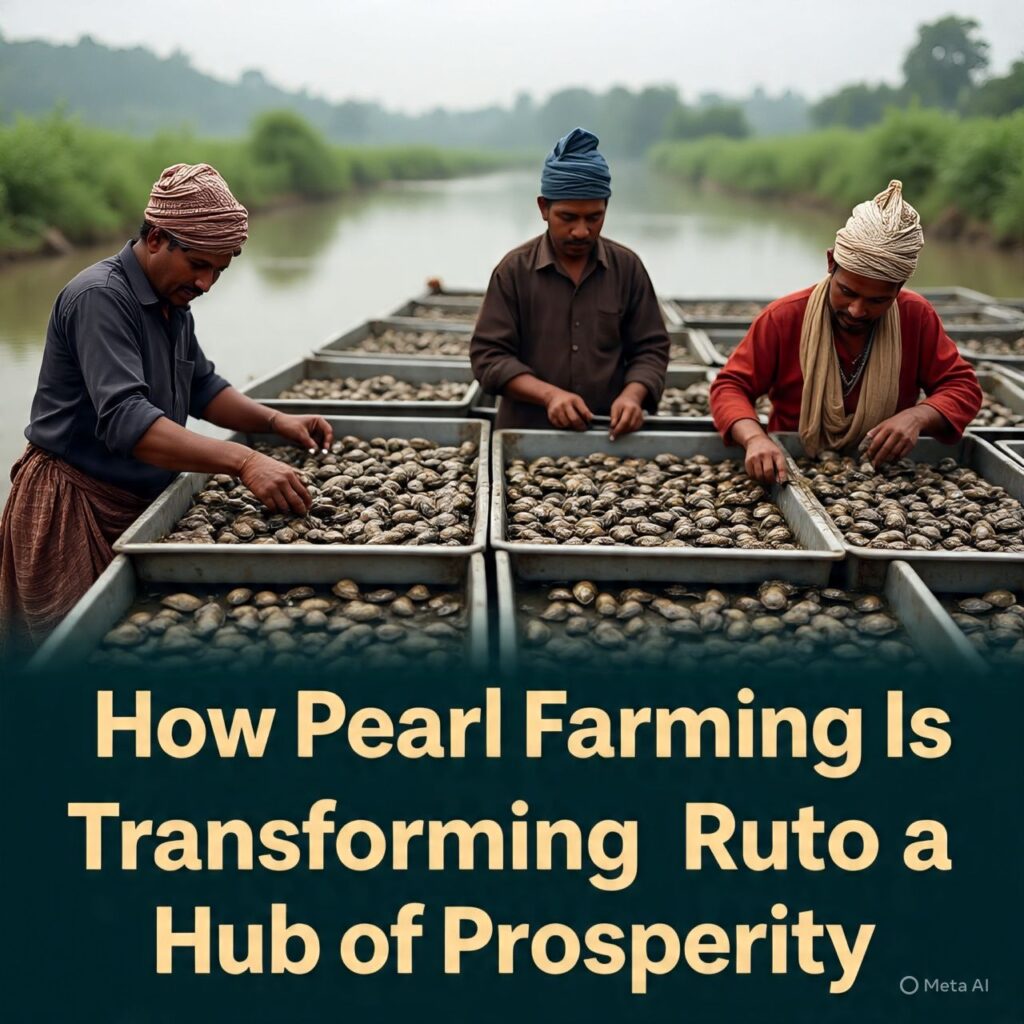
When we hear about Jharkhand, images of dense forests, rich mineral reserves, and tribal culture often come to mind. But in recent years, this eastern Indian state has added a new, sparkling identity to its profile: pearl farming.
In a quiet yet significant transformation, villages in Jharkhand are discovering prosperity through cultivating freshwater pearls. Thanks to government support, innovative training, and a willingness to explore new ventures, farmers who once depended on traditional crops with limited returns are now earning up to ten times more income by farming pearls.
This is more than an economic success story; it’s a glimpse into how rural India is embracing modern, sustainable livelihoods—and building a truly self-reliant future.
From Fields to Freshwater: The Journey Begins
Until a few years ago, the idea of pearl farming in Jharkhand seemed almost impossible. The region is historically known for coal, mica, and other minerals, but not aquaculture.
The turning point came in 2019–2020, when the Jharkhand state government launched a pilot project to introduce pearl farming under its own development schemes. Though small in scale, the project showed promising results. Farmers noticed that, compared to seasonal agriculture, pearls could provide steadier, higher returns.
Encouraged by these early successes, the state decided to scale up.
A National First: Hazaribagh Declared “Pearl Farming Cluster”
In a landmark move, the central government designated Hazaribagh district as the country’s first official Pearl Farming Cluster. Backed by the Pradhan Mantri Matsya Sampada Yojana (PMMSY), this initiative attracted an investment of around ₹22 crore (approximately 2.7 million USD).
This funding is being used to build essential infrastructure: freshwater ponds, hatcheries, pearl seeding units, and training centers where farmers and youth can learn the craft.
As the first cluster of its kind, Hazaribagh is poised to become a national model—proving that pearl farming can thrive even in non-coastal, landlocked states.
Training the Next Generation of Pearl Farmers
A key factor behind this transformation has been systematic training.
The government, along with partner institutions, set up specialized training centers. Here, farmers and young entrepreneurs learn not just the basic science but also the art of pearl farming: selecting healthy oysters, seeding them carefully, and monitoring water quality and nutrition.
This knowledge transfer bridges an important gap. Unlike traditional farming, pearl cultivation involves aquaculture skills and precision techniques that most villagers had never encountered before.
By demystifying the process, training programs have turned a once “elite” business into an accessible, grassroots opportunity.
The Science of Cultivating Pearls
So how does pearl farming work?
- Selection and Preparation: Farmers collect or purchase healthy freshwater oysters suitable for pearl production.
- Seeding: A tiny nucleus (a piece of shell or synthetic bead) is delicately inserted inside the oyster’s mantle tissue. This step is highly skilled; done poorly, it can kill the oyster.
- Farming: The seeded oysters are then suspended in clean, freshwater ponds. Over months, the oyster secretes layers of nacre around the nucleus, forming a pearl.
- Harvesting: After 12–18 months, the pearls are carefully removed. The best pearls are smooth, round, and lustrous—fetching premium prices.
It’s a process that blends patience, skill, and scientific understanding—qualities that farmers are quickly mastering.
10x Profit: Turning Shells into Prosperity
One of the most striking outcomes of this initiative is its economic impact.
Farmers who earlier struggled to earn steady income from seasonal crops like paddy or vegetables now see up to 10 times more profit from pearl farming.
For instance:
- A single oyster can produce a pearl worth anywhere from ₹300 to several thousand rupees, depending on quality.
- Even after deducting the cost of seeds, infrastructure, and maintenance, profit margins remain significant—especially when scaled up.
Many farmers now supplement traditional farming with pearl farming, creating a dual income stream that’s far less dependent on unpredictable rainfall or market price fluctuations.
Youth Engagement and New Employment Opportunities
The pearl farming revolution isn’t just about boosting incomes; it’s also about changing mindsets—especially among the rural youth.
For years, many young people in Jharkhand saw migration to cities as the only way to secure stable employment. Now, pearl farming offers an alternative: a modern, respectable, and sustainable enterprise close to home.
With just a few weeks of training and relatively low startup costs, even small farmers and young entrepreneurs can begin pearl cultivation. This is creating local jobs in:
- Seeding and farming operations
- Processing and grading
- Marketing and direct sales
- Pond maintenance and water quality management
The ripple effect is already visible: local economies are getting stronger, families are staying together, and rural communities are gaining new hope.
Environmental Benefits: Sustainable and Low Impact
Beyond economics, pearl farming aligns beautifully with sustainable development.
- It uses freshwater ponds, which can also support fish farming, doubling farm income.
- It doesn’t need chemical fertilizers or pesticides, making it environmentally friendly.
- The process helps maintain water quality and biodiversity.
By contrast to extractive industries like mining, pearl farming is renewable: oysters can produce pearls repeatedly over their lifespan, ensuring continued income for farmers without degrading the environment.
Scaling Up: Vision for the Future
The government’s vision doesn’t stop at a few villages. The long-term goal is bold:
- Make Jharkhand India’s leading state in pearl production
- Position Indian freshwater pearls as a recognized brand in national and international markets
- Develop allied industries like pearl jewelry design, processing, and export
To support this, plans include:
- Setting up more clusters beyond Hazaribagh
- Launching marketing and branding campaigns
- Providing affordable credit and insurance schemes for farmers
- Creating direct market linkages to buyers and retailers
Women Farmers: A Hidden Strength
Interestingly, women are emerging as strong participants in this revolution.
In many villages, self-help groups (SHGs) are adopting pearl farming collectively. Women bring careful attention to seeding and maintenance, often achieving higher success rates.
This is not only empowering women economically but also giving them a stronger voice in household and community decisions.
Challenges Ahead: What Still Needs Work
While the progress so far is impressive, pearl farming in Jharkhand is still young. Challenges remain:
- Technical skill gaps, especially in delicate seeding
- Disease management in oysters
- Access to consistent, clean water sources
- Need for efficient marketing channels to prevent middlemen exploitation
- Financing, especially for very small farmers who can’t afford initial investment
Addressing these will be crucial to ensuring long-term sustainability and scaling.
Beyond Pearls: Building a Self-Reliant Rural Economy
At its core, Jharkhand’s pearl farming story is about rural transformation. It shows how:
- Modern skills and traditional livelihoods can blend
- Government support can unlock hidden potential
- Villagers can move from survival farming to profitable entrepreneurship
As part of the broader Atmanirbhar Bharat (self-reliant India) mission, pearl farming isn’t just about jewelry. It’s about giving rural India tools, training, and confidence to shape its own future.
Voices from the Ground
Many farmers share stories that bring this data to life:
“Earlier, I used to earn barely ₹30,000–40,000 a year from paddy. Now, with pearl farming, I can earn ₹3–4 lakh,” says Ram Kumar, a farmer from Hazaribagh.
“I was planning to leave for Delhi to work as a laborer. After training in pearl farming, I stayed back. Now I run my own farm,” shares Sunita Devi, who also trains other women.
Such testimonials highlight why the model is not just economically attractive but also socially transformative.
Conclusion: A Model for Rural India
In just a few years, Jharkhand has turned an experimental pilot into a thriving model of rural enterprise. Farmers once trapped by low-yield crops and erratic markets now find themselves at the center of an emerging industry with global demand.
Pearl farming isn’t a magic bullet. But as part of a broader strategy—combining modern aquaculture, rural entrepreneurship, and government partnership—it offers a clear, hopeful roadmap.
If scaled thoughtfully, with a focus on quality, branding, and sustainable practices, this “pearl revolution” could shine as brightly in other states too, making India not only a consumer of pearls but a producer of them.
And for thousands of rural families, that could mean turning the age-old saying “pearls of wisdom” into a very real, very valuable livelihood.


 By












