

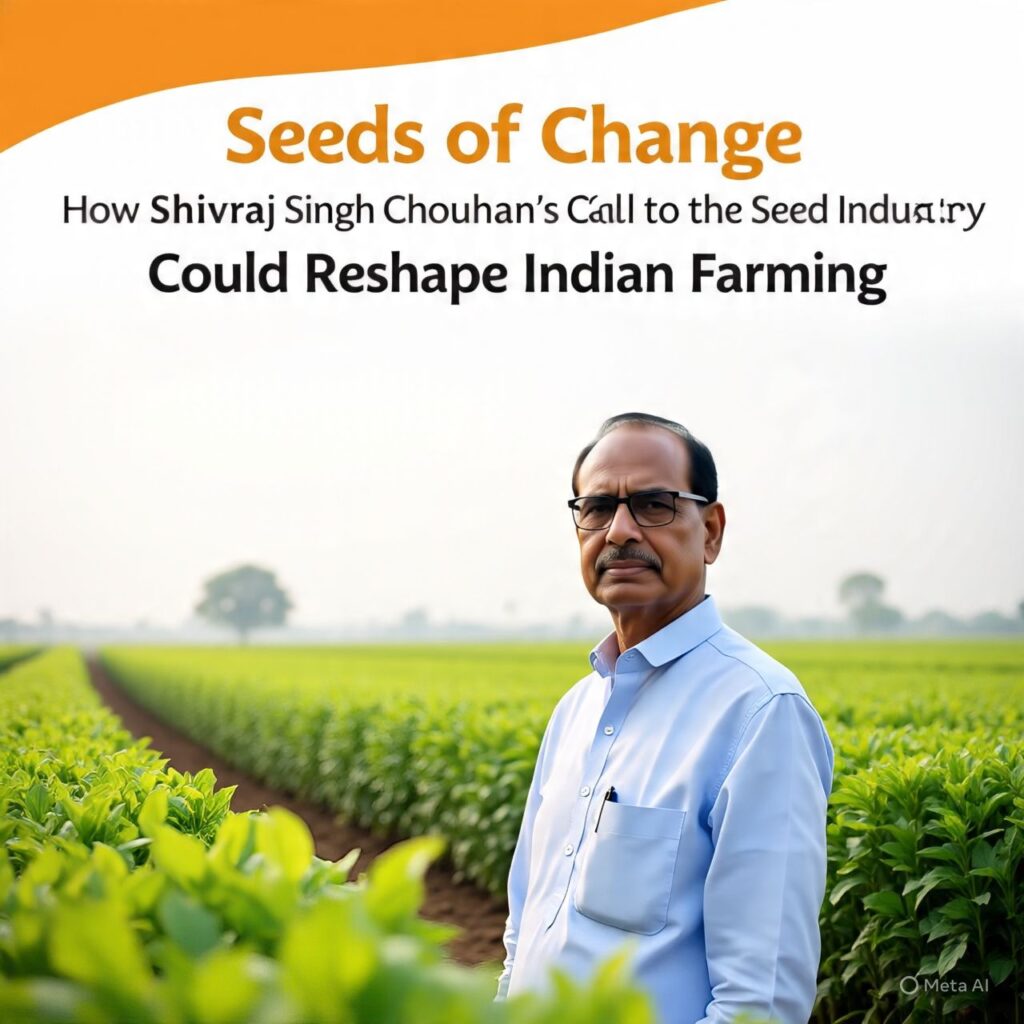
In a country where agriculture remains the backbone of the economy and the lifeline for over half the population, the humble seed holds enormous power. It is the first building block of food security, farmer income, and ultimately, national prosperity. Recognizing this, India’s Union Minister for Agriculture, Farmers Welfare, and Rural Development, Shivraj Singh Chouhan, has issued a clear and timely appeal: treat the farmer not merely as a customer, but as the core stakeholder in India’s seed industry.
This call for a shift in mindset may appear simple on the surface. But for India’s vast, complex, and sometimes opaque seed sector, it could be transformative.
Why This Statement Matters
For decades, millions of Indian farmers — especially small and marginal landholders — have depended heavily on seed companies for access to improved, high-yielding, disease-resistant varieties. However, problems persist: poor-quality seeds, counterfeit brands, high prices, and sometimes, a lack of region-specific options leave farmers vulnerable to crop failures and economic loss.
Minister Shivraj Singh Chouhan’s message signals a growing realization within the government: the relationship between seed producers and farmers cannot remain transactional. It must evolve into a true partnership rooted in trust, fairness, and shared growth.
The Reality Farmers Face Today
Seeds account for up to 20% of the total cost of cultivation for many crops. In India’s input-intensive agriculture system, farmers spend heavily on seeds, fertilizers, and pesticides each season. If seeds fail — due to low germination rates, adulteration, or simply unsuitability for local conditions — the entire harvest is jeopardized.
Small farmers often lack the technical knowledge to verify seed quality before sowing. They rely on brand names, dealers’ claims, or word-of-mouth recommendations. Sadly, this trust is sometimes misplaced. News reports often surface about spurious seeds flooding markets, especially during peak sowing seasons. When such seeds fail, farmers rarely get compensation.
The consequences are devastating: crop losses, unpaid debts, and sometimes, tragic stories of farmer suicides.
Why the Seed Industry Must Change Its Lens
Minister Chouhan’s statement is more than a warning — it’s a vision for an ethical, responsible seed industry that sees India’s farmers as its partners in prosperity, not just profit.
In his words and actions, he underlines that it is time seed companies invest seriously in:
- Research & Development: India’s diverse agro-climatic zones demand region-specific, climate-resilient varieties. One-size-fits-all solutions do not work.
- Transparency: Every seed packet must deliver exactly what it promises in germination rates, yield potential, and pest resistance.
- Affordability: Better seeds should not mean unaffordable seeds. Fair pricing is vital to ensure that improved genetics reach even the smallest farmer.
- After-Sales Support: Companies must stand by their products — providing guidance, advisories, and grievance redressal if seeds fail to perform.
The Hidden Cost of Bad Seeds
Low-quality or fake seeds impact more than an individual farmer’s income. They affect national food security, too.
For example, if a large number of farmers unknowingly sow poor-quality seeds, yields drop drastically. This means higher imports, supply chain shocks, and price volatility in the market. The ripple effect is felt by consumers who see higher prices for basic staples.
So when Minister Chouhan talks about the seed industry’s accountability, it is not just about protecting farmers. It is about protecting the entire nation’s food security.
The Role of Government: A Balancing Act
The government plays a key role in regulating the seed sector. India already has laws and rules under the Seeds Act, 1966, and Seeds Control Order, 1983. However, enforcement gaps remain, especially at the local retail level where counterfeit seeds slip in.
Minister Chouhan’s message to states to tighten inspection, certification, and penalties for violators is crucial. Stronger monitoring can weed out fly-by-night operators who damage farmers’ trust.
At the same time, the government must balance regulation with innovation. India needs an ecosystem where honest seed companies can thrive, invest in R&D, and bring new varieties to market swiftly. Bureaucratic hurdles must not choke genuine enterprise.
Farmers Must Be at the Centre
Minister Chouhan’s statement, “The time has come when the farmer should not be seen only as a customer but as the centre,” strikes at the heart of India’s rural reality.
Today, India’s average farm size is less than 1.1 hectares. Over 85% of farmers are small or marginal. For them, every rupee spent on inputs must yield value. When they buy seeds, they put in more than money — they place their trust, their family’s hope, and their year’s food security into that tiny packet.
This is why treating the farmer as a true partner is essential. It means involving them in the feedback loop: what works, what doesn’t, and what local adaptations are needed. It means respecting their traditional knowledge while supporting them with modern science.
Better Seeds for a Changing Climate
India’s farmers today face not just market risks, but an increasingly unpredictable climate. Erratic monsoons, longer dry spells, and sudden floods have become common. Traditional seed varieties sometimes fail under such stresses.
The seed industry has a critical role in helping Indian agriculture adapt. Developing drought-tolerant, flood-resistant, and heat-resilient seeds is no longer optional — it is a survival strategy.
Public and private players must invest heavily in developing seeds that help farmers cope with climate extremes. Minister Chouhan’s appeal is a reminder that good seeds are the first step toward climate resilience in Indian farming.
Learning from Success Stories
There are plenty of examples that show how powerful farmer-centric seed development can be.
Take India’s cotton revolution in the early 2000s. Genetically modified Bt cotton transformed India into the world’s second-largest cotton producer. Though not without controversy, this success hinged on seeds tailored to local pest pressures and climate conditions.
Similarly, in hybrid rice and improved pulse varieties, targeted breeding and extension work have helped farmers increase productivity.
What’s common in these stories? When seeds deliver what they promise, farmers prosper — and so does the country.
The Importance of Public Sector Seed Agencies
While private players dominate India’s seed market in high-value crops like vegetables and cotton, public sector seed agencies remain vital, especially for staples like wheat, rice, pulses, and oilseeds.
Organizations like the National Seeds Corporation (NSC) and various state seed corporations have played a crucial role in distributing certified seeds to remote areas at affordable rates. Strengthening these agencies, ensuring timely supply, and eliminating bureaucratic inefficiencies is just as important as regulating the private sector.
Technology and Traceability
One way to ensure farmers get genuine seeds is by embracing technology. QR codes, digital tracking, and blockchain systems can help farmers verify seed authenticity. Several states have begun experimenting with such systems to prevent counterfeit products.
Apps that connect farmers directly with breeders or certified dealers could further close the trust gap.
Minister Chouhan’s push for accountability could catalyze wider adoption of such tools, empowering farmers to demand what they deserve.
Farmers as Innovators
It’s easy to think of farmers as passive consumers. But Indian farmers are often innovators in their own right. Many still save seeds from previous harvests, practice selective breeding, and share knowledge within their communities.
Recognizing and rewarding this grassroots innovation is part of treating farmers as the centre. Programs that certify farmer-bred varieties, encourage seed banks, and protect traditional genetic resources can complement modern commercial seeds.
The Road Ahead
Minister Shivraj Singh Chouhan’s statement should not remain just a headline. For real change, the entire seed supply chain — breeders, producers, certifiers, dealers, and regulators — must align around the idea that the farmer’s welfare is paramount.
If done right, this shift can:
- Reduce crop failures caused by poor-quality seeds
- Boost national food production
- Raise farm incomes sustainably
- Build trust between farmers and industry
- Make India’s agriculture more resilient to climate change
But this requires strict enforcement of quality standards, better farmer education, stronger extension services, and, above all, a culture of accountability in every link of the chain.
Conclusion: Sowing Trust for a Stronger Future
In the end, the humble seed carries more than genetic material — it carries the dreams of millions of Indian farm families. When that seed grows well, it feeds the nation. When it fails, it breaks more than a crop — it breaks trust.
Shivraj Singh Chouhan’s call is a timely reminder that the prosperity of India’s agriculture rests not on transactions but on trust. The seed industry, policymakers, scientists, and farmers must come together to sow this trust deep and wide.
Only then can we truly say that Indian farming has been made future-ready — not just with better seeds in the soil, but with a stronger bond between those who grow and those who supply the means to grow.


 By












