

Bio Agri Next 2025 in Ahmedabad Marks a Historic Leap Toward Organic and Sustainable Agriculture
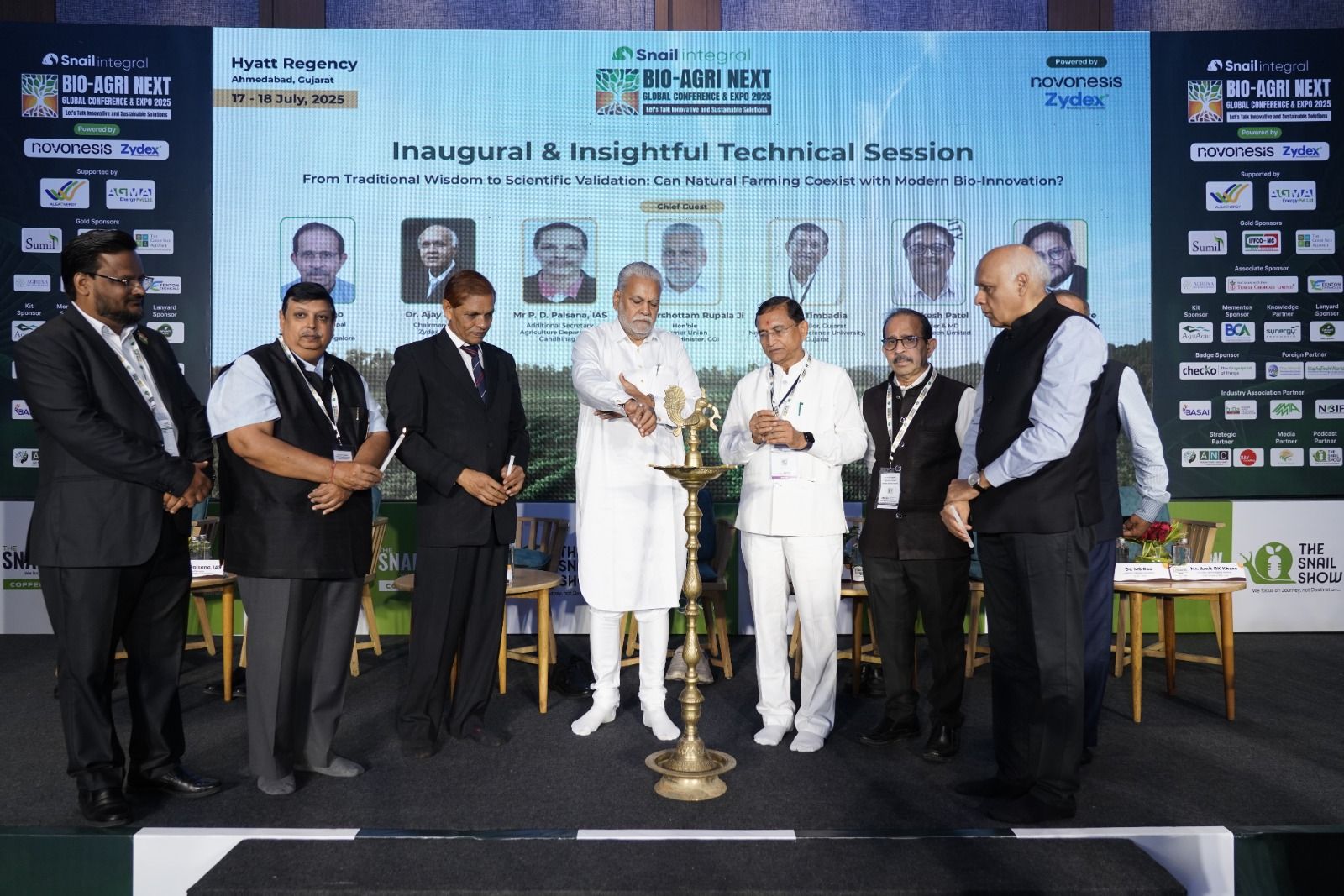
The Bio Agri Next Global Conference & Expo 2025, held at the Hyatt Regency in Ahmedabad, Gujarat, has emerged as a landmark event in India’s journey toward organic and regenerative agriculture. Organized by Snail Integral Pvt. Ltd., the two-day conference brought together innovators, policymakers, scientists, and stakeholders from across the globe to discuss the future of sustainable farming.
The event was inaugurated by former Union Agriculture and Farmers Welfare Minister Parshottam Rupala, who emphasized the integration of India’s rich traditional farming wisdom with cutting-edge biological innovations.
“Indian agriculture must blend its traditional knowledge with modern bio-innovations. The future lies in farming that is profitable, residue-free, and globally respected,” he said in his keynote address.
Thought Leaders Converge: Bridging Tradition with Science
The conference featured prominent voices in the field of organic agriculture, including:
- Dr. M.S. Rao, Chairman of the Bio Agri Next Organizing Committee and former Principal Scientist, ICAR-IIHR, Bengaluru
- Dr. Ajay Ranka, Co-chair and CMD of Zydex Industries
- Dr. C.K. Timbadia, Vice Chancellor, Gujarat Natural Farming Science University
- P.D. Palsana, Additional Secretary, Agriculture Department, Government of Gujarat
- Vipin Saini, CEO, BASAI Agri
- Amit Khare, Founder, Snail Integral Pvt. Ltd.
Other notable speakers included Deepak Shah, Sandipa Kanitkar, Manoj Varshney, Shanmugam Sambanthan, Dr. Mukesh Patel, Amit Kumar Singh, and Manoj Kumar Rupa.
From Ancient Wisdom to Modern Innovation
With the central theme “From Traditional Knowledge to Scientific Validation”, the event highlighted how indigenous farming techniques like mulching, zero tillage, and organic soil management are being enhanced with technologies such as bio-digesters, microbial solutions, and nano-based inputs.
Dr. Ajay Ranka posed an important question: “Can natural farming and bio-innovation go hand in hand?” His answer showcased how modern microbial technologies are complementing traditional techniques.
Dr. Timbadia elaborated on practices like “Vapasa”, mulching, and zero tillage being enhanced by bio-stimulants, microbial consortia, and gobar gas systems for improved outcomes.
P.D. Palsana stressed that natural farming not only restores soil health and boosts biodiversity but also significantly reduces chemical input costs for farmers.
Komal Shah Bhukhanwala spoke about the role of bio-fertilizers, which activate beneficial soil microbes, enhance nutrient availability, and decrease dependency on synthetic fertilizers.
Innovation Meets Profitability
Speakers highlighted that sustainable farming is not just eco-friendly but also economically viable. Manoj Kumar Rupa discussed bio-resilient solutions such as bio-stimulants, bio-fertilizers, and bio-pesticides that equip farmers to deal with climate change while cutting costs and increasing profitability.
Manoj Varshney emphasized, “Grow more, grow safe, grow cheap, grow for the planet,” underlining that bio-inputs increase both sustainability and yield.
Shanmugam Sambanthan pointed out that farmers can even benefit from carbon credit markets by adopting organic solutions making farming both sustainable and profitable.
Dr. Jigar Mistry added that composting, cover cropping, and reducing chemical inputs not only benefit the environment but also offer financial returns through carbon credit participation.
Addressing the Climate Crisis Through Organic Agriculture
Rajkumar Agrawal, Founder & MD of Ray Consulting, underscored the need to cut carbon emissions and rejuvenate soil health through bio-based inputs.
Yogesh Mohite elaborated that bio-fertilizers, bio-pesticides, organic fungicides, and compost help store carbon in the soil and build climate-resilient agricultural ecosystems.
In the fourth panel discussion, led by Suhas Joshi, experts explored strategies to tackle climate change through bio-agriculture, including carbon credit systems, policy integration, and scientific innovation.
AlgaEnergy and the Future of Microalgae in Agriculture
Debabrata Sarkar, President of AlgaEnergy Asia Pacific, addressed the session on “Innovative and Sustainable Solutions,” detailing the promise of microalgae-based technologies and next-generation biological inputs that support regenerative and climate-smart agriculture.
Key Policy Recommendations
The conference concluded with a set of strategic policy recommendations for the government:
- Formation of a National Task Force for organic agriculture.
- Clear recognition and classification of biological inputs with regulatory guidelines.
- Integration of natural farming with scientific bio-innovations.
- Promotion of public-private research collaborations.
- Launch of awareness and subsidy programs for farmers.
Toward a Self-Reliant, Greener Future
Bio Agri Next 2025 demonstrated that the confluence of traditional wisdom and modern science can lead Indian agriculture toward self-reliance, environmental sustainability, and global leadership. The event received widespread appreciation for its impactful execution by Snail Integral Pvt. Ltd. and its founder, Amit Khare.
More than just a conference, it marked a concrete step toward building a regenerative, economically viable, and climate-resilient farming future for India and beyond.


 By
By











