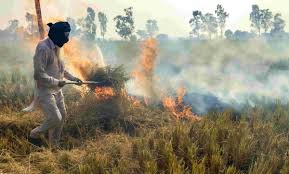
In Punjab, two more FIRs have been registered in stubble burning cases, taking the total number of cases this season to 51. The action comes on a day when five new stubble-burning incidents were reported, bringing the seasonal total to 95. Additionally, the government has placed a “red entry” against one violator and issued notices to officials in areas where stubble-burning cases occurred.
Farmer organizations have begun protesting against the government’s enforcement measures and are demanding cash incentives for crop residue management, in line with the Supreme Court’s 2019 directives.
This season, nearly 50 FIRs have been filed against farmers, and ₹1.7 lakh in environmental compensation has already been collected. Authorities are also making red entries in the land records of accused farmers.
Farmer Unions Mobilize
The Punjab Kisan Union has started organizing village-level meetings to rally support against the crackdown. In Joga village, Mansa district, the union’s state vice president, Gora Singh, criticized the authorities for acting swiftly against farmers while remaining inactive during real crises. He said, “When farmers face hardship, no officer or satellite intervenes, but the moment stubble is burned, officers arrive in fields to take action, which is unacceptable.”
Joint Farmers’ Front Joins Protests
The Joint Kisan Morcha (SKM) has also opposed the stringent action against farmers. Led by Jagjit Singh Dallewal, the BKU (Ekta Siddhupur) blocked roads and staged a protest outside the Bathinda Deputy Commissioner’s office. The unions demanded cash incentives for crop residue management and a halt to penalties against farmers for stubble burning.
Farmers’ Perspective
Resham Singh Yatri, district general secretary of the union, stated that farmers do not want to burn stubble, as its harmful effects are felt even before the smoke reaches the national capital. However, many are forced to burn due to lack of resources. He added that if the government provides cash incentives, farmers could manage crop residue sustainably.
Stubble-Burning Incidents by District
So far this year, 95 stubble-burning incidents have been reported in Punjab, compared to 119 in the same period in 2024 and 133 in 2023. The breakdown by district is:
- Amritsar: 55
- Tarn Taran: 11
- Patiala: 10
- Malerkotla: 4
- Barnala and Kapurthala: 3 each
- Sangrur and Hoshiarpur: 2 each
- Bathinda, Faridkot, Firozpur, Jalandhar, SAS Nagar: 1 each
According to the Consortium for Research on Agroecosystem Monitoring and Modelling from Space (CREAMS), 126 stubble-burning cases were reported across five states until 28 September, with Punjab accounting for 90 (71%), followed by Uttar Pradesh (25), Madhya Pradesh (6), Haryana (4), and Rajasthan (1).
The ongoing protests and enforcement measures highlight the growing tension between farmers and the government in Punjab over stubble-burning policies, raising questions about implementation, incentives, and sustainable crop residue management.


 By
By