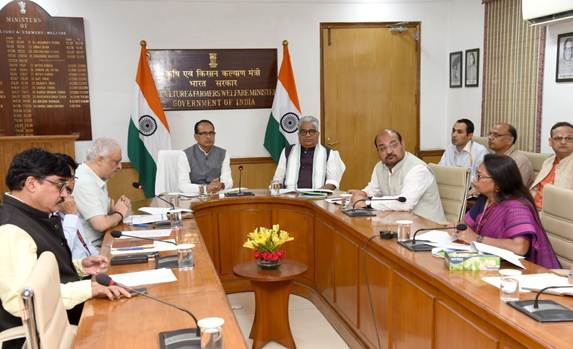
A high-level meeting on stubble burning prevention and crop residue management was held today at Krishi Bhawan, New Delhi, under the chairmanship of Union Minister for Agriculture and Farmers Welfare, Shri Shivraj Singh Chouhan. The meeting was also attended by Union Minister for Environment, Forest and Climate Change, Shri Bhupender Yadav. Agriculture Ministers from Punjab, Haryana, and Uttar Pradesh, along with the Environment Minister of Delhi, participated virtually.
The meeting aimed to formulate effective strategies for managing crop residue, raise farmer awareness, ensure efficient implementation of financial assistance schemes, and promote crop diversification as a long-term solution to stubble burning.
States Present Current Status and Initiatives
At the outset, Agriculture Ministers from Punjab, Haryana, and Uttar Pradesh shared updates on the current status of stubble management and the ongoing initiatives in their respective states. They informed that state-level officers and field functionaries are working with full commitment and vigilance to control stubble burning incidents.
The Agriculture Minister of Haryana highlighted that the state government is offering financial assistance to farmers who avoid stubble burning, which has yielded positive results. He noted that farmers are increasingly adopting alternative methods of crop residue management.
“Time to Strengthen Efforts Further” – Shivraj Singh Chouhan
Union Agriculture Minister Shri Shivraj Singh Chouhan appreciated the states for their proactive measures and emphasized the need to intensify and strengthen these efforts. He stressed that farmer awareness is the cornerstone of success and called upon panchayats, local representatives, and nodal officers to take an active role in spreading awareness.
During the meeting, the Minister also discussed direct seeding, crop diversification, efficient fund utilization, monitoring systems, and practical action plans. He remarked that with coordinated and result-oriented actions, all states can collectively achieve substantial progress in curbing stubble burning.
Minister to Lead by Example in Direct Seeding
Appealing to all states to promote Direct Seeding of Wheat (DSW), Chouhan announced that he would personally undertake direct seeding in his own farm on October 12 to motivate farmers.
“When farmers see me adopting this practice, they too will be inspired to follow it,” he said.
He urged farmers to adopt modern machinery such as rotavators, choppers, bio-decomposers, and mulchers, and encouraged the promotion of bio-CNG and ethanol plants. The Minister also directed states to ensure transparent fund utilization so that adequate machinery remains available to farmers without delay.
Linking Industries and Real-Time Monitoring
Chouhan emphasized that for successful stubble management, systems should be developed to link bio-CNG units, pellet plants, compost units, industries, and thermal power plants with stubble collection and disposal mechanisms. He also underlined the importance of training, capacity building, awareness drives, and real-time monitoring at the grassroots level.
“With coordinated efforts between the Centre and the states, incidents of stubble burning will certainly decline. Strengthening ground-level monitoring will yield better outcomes and help protect the environment,” he said.
Environment Ministry Calls for Enhanced Coordination
Union Environment Minister Shri Bhupender Yadav lauded the efforts of the states and stressed the need for enhanced coordination between the Agriculture Ministry and state governments over the next ten days. He underscored the importance of stubble collection, storage, and industrial utilization, adding that stubble can be effectively used in brick kilns and thermal power plants as an alternative fuel source.
The meeting was also attended by Agriculture Secretary Dr. Devesh Chaturvedi, ICAR Director General Dr. M. L. Jat, and senior officials from both ministries.
With the combined resolve of the Centre and States, the meeting reaffirmed the government’s commitment to reducing stubble burning, supporting farmers with sustainable alternatives, and ensuring cleaner air for the entire region.


 By
By