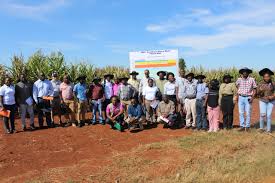
In a strong demonstration of agricultural innovation and collaboration, the International Maize Improvement Consortium for Africa (IMIC-Africa) recently held a major two-day field event at its research stations in Kiboko and Naivasha, Kenya. The event brought together a wide network of seed companies, plant breeders, and agricultural researchers to evaluate more than 800 elite maize hybrid lines, marking an important step forward in efforts to strengthen Africa’s maize breeding and production capacity.
The field day provided a valuable platform for participants to assess the performance, yield potential, and resilience of new maize hybrids developed under varying agro-climatic conditions. The initiative aims to accelerate the development and release of improved maize varieties that can meet the region’s growing demand for food and adapt to challenges such as climate change, pest outbreaks, and soil degradation.
Maize is a staple crop for millions across sub-Saharan Africa, serving as both a key food source and a livelihood base for smallholder farmers. However, productivity in many regions remains below global averages due to limited access to improved seeds, erratic weather, and input constraints. Through collaborative programs like IMIC-Africa, researchers and private-sector partners are working together to close this yield gap by investing in advanced breeding technologies, germplasm sharing, and knowledge exchange.
Participants at the event emphasized the importance of public-private partnerships in scaling innovation from research plots to farmers’ fields. By connecting breeders, seed producers, and policymakers, such initiatives ensure that scientific progress translates into practical benefits, delivering improved hybrids that are high-yielding, drought-tolerant, and resistant to major diseases and pests.
The field day also reinforced Africa’s growing role in global agricultural research and seed innovation, showing how regional collaboration can drive food security and rural development. Experts noted that similar approaches could be replicated in other developing regions — including India — where the need for resilient, high-performing crop varieties is equally pressing.
With hundreds of promising hybrid lines under evaluation, the IMIC-Africa event underscores the continent’s commitment to modernizing maize production through science and partnership. As breeding programs continue to evolve, these efforts are expected to deliver tangible gains for farmers, enhance seed diversity, and contribute to a more sustainable and food-secure future for Africa and beyond.


 By
By