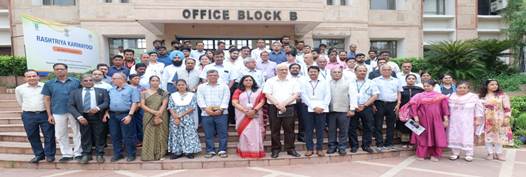
A national-level workshop focusing on “Agroforestry for Resilient Rainfed Landscapes” was held today at the National Agricultural Science Centre (NASC) Complex in New Delhi. The event was jointly organised by the National Rainfed Area Authority (NRAA), the Natural Resource Management (NRM) Division of the Department of Agriculture & Farmers Welfare (DA&FW), and the Revitalising Rainfed Agriculture (RRA) Network.
The workshop was inaugurated in the presence of Shri Devesh Chaturvedi, Secretary, Department of Agriculture & Farmers Welfare. In his remarks, he emphasized the importance of integrated agroforestry approaches to address the growing challenges of sustainability in rainfed agricultural regions.
Prominent experts including Dr. P.K. Meherda, CEO, NRAA; Dr. Susama Sudhishri, Watershed Development Specialist; Dr. A.K. Mishra, Expert in Water Management; Dr. Pankaj K. Shah, Director (Agriculture & Horticulture); Dr. S.D. Singh, Senior Consultant (Agroforestry); and Dr. Sabyasachi Das, National Coordinator, RRA Network, shared their insights during the technical sessions.
The workshop featured detailed discussions on a wide range of topics such as innovative agroforestry models, policy alignment, farmer experiences, convergence of existing government schemes, industrial linkages, and financial inclusion. Experts stressed that agroforestry can play a key role in promoting ecological stability, increasing farmers’ income, and ensuring long-term soil and water conservation.
Several strategic priorities emerged from the deliberations:
- Recognising carbon benefits: Tapping into carbon markets to provide additional income sources for farmers practicing agroforestry.
- Ecosystem-wide planning: Moving beyond tree planting to include broader ecological restoration in rainfed areas.
- Coordinated action: Establishing a dedicated working group to streamline efforts across various departments and schemes.
- Regulatory reform: Revisiting restrictive laws and encouraging legal frameworks that align with local ecological contexts.
- Land degradation neutrality: Emphasising grassroots-level planning to combat land degradation and restore soil health.
Participants unanimously agreed that agroforestry needs to be mainstreamed through collaborative approaches, supportive policy frameworks, and active participation of farming communities. The workshop concluded with a call to action for enhanced institutional cooperation, policy innovation, and knowledge-sharing platforms to accelerate agroforestry adoption in India’s rainfed regions.


 By
By