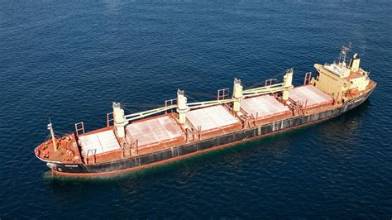
A cargo vessel carrying approximately 3,000 metric tonnes of wheat sank in the Black Sea off Bulgaria’s coast on November 16 following a reported sea-drone attack, raising fresh concerns about the safety of international agricultural shipments through one of the world’s most important grain-export corridors.
The vessel, identified as Betul8, was travelling from Romania to Egypt when the incident occurred in Bulgaria’s exclusive economic zone. According to Bulgaria’s Transport Ministry, the ship sent a distress signal early Monday morning, reporting that it was sinking approximately 40 nautical miles off Cape Kaliakra.
All 12 crew members aboard the vessel were rescued safely through a coordinated search-and-rescue operation involving military and maritime authorities. Bulgarian officials confirmed that a helicopter transported the rescued sailors to shore and that they were in generally good condition.
According to maritime security sources cited by Reuters, the vessel had been struck by a sea drone before its crew abandoned ship. Crew members also reportedly told journalists that the vessel had been hit by sea drones. However, Bulgarian authorities had not officially established responsibility for the incident.
Growing Security Threats to Black Sea Shipping
The sinking of Betul8 highlights the increasing security challenges facing commercial shipping in the Black Sea region. The waters surrounding Bulgaria and Romania have become increasingly important for agricultural exports, particularly grain shipments originating from Ukraine and neighbouring countries.
The Black Sea is a strategic route connecting major grain-producing regions with international markets across Europe, North Africa, the Middle East and Asia. Countries including Egypt depend significantly on imported wheat to meet domestic food requirements.
Any disruption to commercial shipping in this region could affect the movement of agricultural commodities, increase transportation costs and create uncertainty for international grain buyers and exporters.
According to maritime security firm Diaplous, Betul8 was the 17th vessel attacked off the coasts of Bulgaria and Romania since mid-July 2026. The increasing frequency of such incidents has raised concerns among shipping companies, insurers and agricultural commodity traders.
Potential Impact on Global Wheat Trade
The loss of approximately 3,000 tonnes of wheat represents a direct disruption to one agricultural shipment. However, the broader concern is the possibility that repeated attacks could discourage shipping operators from using Black Sea routes.
Higher maritime insurance premiums, additional security requirements and longer alternative shipping routes could increase the cost of transporting agricultural commodities. These additional expenses may eventually affect the landed prices of imported grains, particularly in countries heavily dependent on international wheat supplies.
Egypt, one of the world’s major wheat-importing countries, is particularly exposed to developments affecting international grain transportation. Any prolonged disruption could complicate procurement planning and increase logistical challenges for importers.
International Attention on Maritime Security
The incident comes amid continuing tensions linked to the Russia-Ukraine conflict, which have increasingly affected commercial maritime activities in the Black Sea. Bulgarian and Romanian officials have exercised caution in assigning responsibility for attacks near their coastlines, while Russia has denied responsibility for previous attacks attributed to it.
For the global agricultural sector, the incident is another reminder that food security depends not only on crop production and international trade but also on safe and reliable transportation infrastructure.
As global grain markets continue to monitor supply, demand and price movements, the security of major export corridors will remain an important factor influencing international agricultural trade.
The sinking of Betul8 therefore represents more than the loss of a wheat shipment. It highlights how geopolitical tensions and maritime security risks can create additional challenges for global food supply chains.


 By