

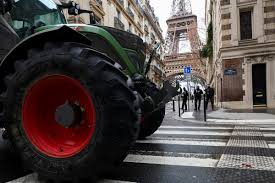
Large-scale farmers’ protests erupted in France and Greece as agricultural groups voiced strong opposition to the proposed European Union–Mercosur free-trade agreement, citing concerns over market stability, production costs, and the future of domestic farming.
In France, farmers drove tractors into central Paris and organised demonstrations near key government buildings, drawing public attention to what they describe as unfair competition from agricultural imports. Protesters argue that the agreement would allow cheaper products from South American countries to enter the European market, undercutting local producers who face higher input costs and stricter environmental and labour regulations.
Similar unrest was reported in Greece, where farmers blocked highways and gathered at strategic transport routes to disrupt supply chains. Greek agricultural unions warned that small and medium-scale farmers would be particularly vulnerable if the trade deal moves forward, as they already struggle with rising fuel prices, fertiliser costs, and climate-related pressures.
The proposed EU–Mercosur agreement aims to strengthen trade ties between the European Union and the South American bloc comprising Brazil, Argentina, Uruguay, and Paraguay. While supporters of the deal highlight potential economic benefits and expanded export opportunities, farmers’ organisations insist that agricultural safeguards remain inadequate.
Protest leaders in both countries have called on national governments and EU institutions to reassess the agreement and introduce stronger protections for European farmers. They argue that imports produced under different environmental and animal welfare standards could distort competition and weaken the EU’s sustainability objectives.
Government officials have acknowledged the concerns and indicated that consultations with farmer groups are ongoing. However, no immediate changes to the negotiation framework have been announced.
The protests in France and Greece reflect broader unease across Europe’s farming community, where trade liberalisation, environmental regulations, and cost inflation are increasingly intersecting issues. As negotiations continue, agricultural stakeholders are urging policymakers to ensure that trade agreements do not compromise farm livelihoods or food security within the European Union.


 By
By











