

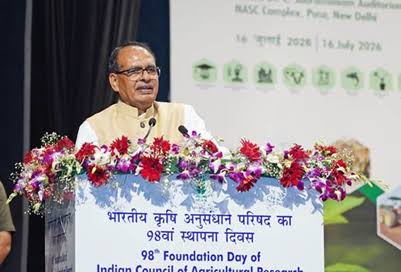
The Indian Council of Agricultural Research (ICAR) celebrated its 98th Foundation Day, reaffirming its commitment to advancing agricultural science and innovation in support of India’s vision of becoming a developed nation (Viksit Bharat) by 2047. The occasion highlighted ICAR’s remarkable contributions to climate-resilient agriculture, digital farming, sustainable resource management, and cutting-edge scientific research that continue to strengthen the country’s food and nutritional security.
The Foundation Day celebrations brought together agricultural scientists, policymakers, researchers, students, and farmers to reflect on nearly a century of ICAR’s pioneering role in transforming Indian agriculture. Since its establishment in 1928, ICAR has played a central role in developing improved crop varieties, advanced farming technologies, livestock innovations, fisheries development, and agricultural education that have significantly enhanced farm productivity and rural livelihoods.
Addressing the gathering, senior officials emphasized that Indian agriculture is entering a new era driven by science, technology, and innovation. They highlighted ICAR’s ongoing efforts to develop climate-resilient crop varieties capable of withstanding drought, floods, heat stress, and emerging pest and disease challenges. Such innovations are becoming increasingly important as climate change continues to impact agricultural production across the country.
Digital agriculture was another major focus of the celebration. ICAR showcased various initiatives involving artificial intelligence, remote sensing, drones, precision farming, digital advisory services, and smart agricultural technologies that enable farmers to make informed decisions regarding crop management, irrigation, nutrient application, and pest control. These technologies are expected to improve productivity while reducing production costs and conserving natural resources.
The Council also reiterated its commitment to promoting sustainable farming practices, including efficient water management, conservation agriculture, integrated nutrient management, natural resource conservation, and environmentally friendly crop production systems. Scientists stressed that sustainable agriculture will be essential for ensuring long-term food security while protecting soil health, water resources, and biodiversity.
ICAR’s contributions extend beyond crop research to livestock, fisheries, horticulture, agricultural engineering, biotechnology, and post-harvest management. Over the decades, the organization has developed thousands of improved crop varieties and livestock technologies that have contributed significantly to India’s Green Revolution, White Revolution, and overall agricultural transformation.
Officials also emphasized the importance of strengthening collaborations between ICAR institutes, State Agricultural Universities (SAUs), Krishi Vigyan Kendras (KVKs), startups, agribusinesses, and private-sector partners to accelerate the transfer of scientific innovations from laboratories to farmers’ fields. Expanding technology dissemination and capacity-building programmes will remain a priority for enhancing farmers’ incomes and improving agricultural resilience.
The Foundation Day celebrations recognized the contributions of scientists, researchers, extension professionals, and institutions that have made significant achievements in agricultural research and technology development. Interactive sessions, exhibitions, and knowledge-sharing programmes highlighted the latest advances in genomics, digital agriculture, mechanization, biofortification, climate adaptation, and sustainable production systems.
Experts noted that agriculture will play a critical role in achieving India’s long-term development goals, including food security, nutritional security, rural prosperity, and environmental sustainability. Continuous investment in agricultural research and innovation is expected to remain a key driver of productivity growth and global competitiveness.
As ICAR enters its 99th year, the organization reaffirmed its vision of building a resilient, technology-driven, and farmer-centric agricultural ecosystem. By integrating scientific excellence with sustainable development and digital innovation, ICAR aims to empower millions of farmers, strengthen India’s agricultural economy, and contribute significantly to the national goal of Viksit Bharat 2047.


 By
By











