

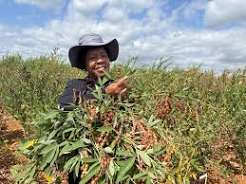
Malawi is stepping up efforts to improve agricultural productivity and strengthen food security by encouraging farmers to adopt modern farming technologies and climate-smart agricultural practices. Researchers at the Lilongwe University of Agriculture and Natural Resources (LUANAR) are leading the initiative, working closely with farming communities to promote innovative solutions that can help increase crop yields while building resilience against climate change.
Agriculture remains the backbone of Malawi’s economy, employing the majority of the population and contributing significantly to national income. However, the sector continues to face major challenges, including erratic rainfall, prolonged droughts, declining soil fertility, pest outbreaks, and the growing impacts of climate change. To address these issues, LUANAR researchers are introducing practical, science-based technologies designed to help farmers produce more food with limited resources.
The university’s innovation program focuses on climate-smart agriculture, an approach that aims to increase productivity, improve resilience to changing weather conditions, and reduce the environmental impact of farming. Farmers are being trained in improved crop management techniques, conservation agriculture, efficient water use, soil fertility management, and the adoption of high-yielding, climate-resilient crop varieties.
Researchers are also promoting the use of digital technologies and precision farming tools to help farmers make better decisions regarding planting, irrigation, fertilizer application, and pest management. These innovations are expected to reduce production costs while improving crop performance and farm profitability.
One of the key objectives of the initiative is to bridge the gap between agricultural research and practical farming. Through field demonstrations, extension programs, and farmer training workshops, LUANAR scientists are ensuring that research findings are translated into real-world solutions that can be easily adopted by smallholder farmers.
Experts believe that embracing agricultural innovation is essential for ensuring long-term food security in Malawi, where agriculture supports the livelihoods of millions of people. Improved farming practices can help stabilize food production, reduce hunger, increase household incomes, and strengthen the country’s resilience to climate-related shocks.
The initiative also encourages collaboration between researchers, government agencies, development partners, and the private sector to accelerate the adoption of modern agricultural technologies across the country. Such partnerships are expected to improve access to quality seeds, agricultural inputs, financing, and extension services for farmers.
As climate change continues to pose significant risks to food production across Africa, Malawi’s focus on agricultural innovation reflects a growing recognition that science and technology will play a critical role in transforming the sector. By investing in climate-smart farming and modern agricultural solutions, the country aims to build a more productive, sustainable, and resilient food system.
The ongoing efforts by LUANAR demonstrate how research-driven innovation can empower farmers, improve agricultural productivity, and contribute to national food security. If widely adopted, these technologies have the potential to transform Malawi’s agricultural landscape while serving as a model for other African nations seeking sustainable solutions to future food challenges.


 By
By











