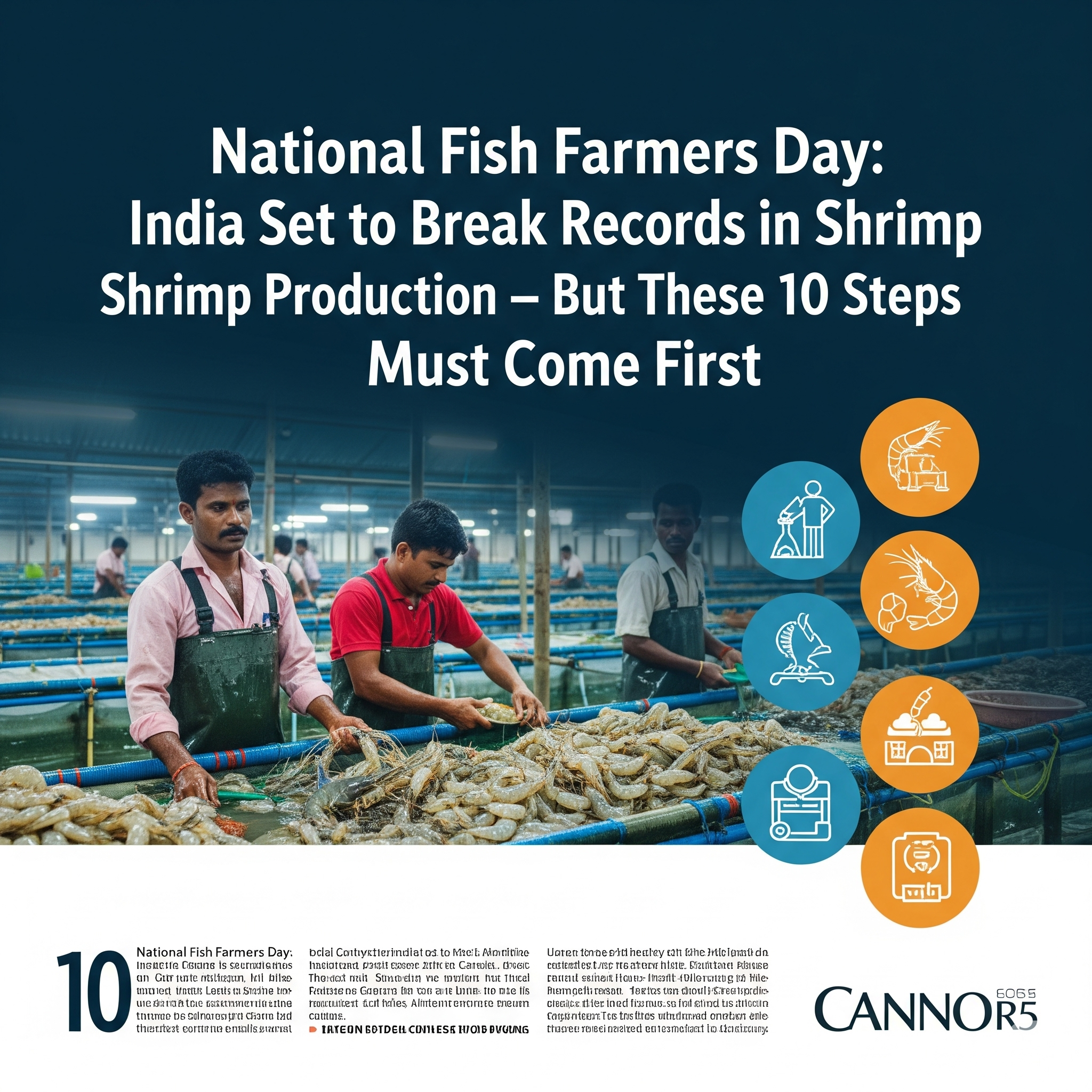

National Fish Farmers Day, observed every year on July 10, honors the tireless efforts and significant contributions of fish farmers, aquaculturists, and those involved in India’s blue economy. The date marks the success of India’s first induced breeding of Indian Major Carps in 1957 by scientists Dr. Hiralal Chaudhury and Dr. K. H. Alikunhi, a milestone that sparked the Blue Revolution.
In recent years, India has emerged as a global leader in aquaculture, particularly in shrimp farming. The country is the largest exporter of frozen shrimp and is now aiming for record-breaking production to meet global demands and domestic income targets. But to achieve this ambitious goal, fish farmers must adopt modern methods and proactive practices.
Here are the 10 essential steps fish farmers must implement to achieve record-level shrimp yields:
✅ 1. Choose High-Quality, Disease-Free Seed
Start with certified, high-yielding, and disease-resistant shrimp varieties. This ensures healthy growth, higher survival rates, and better production.
✅ 2. Monitor Water Quality Regularly
Maintain balanced pH levels, dissolved oxygen, temperature, and salinity in the ponds. Frequent testing is vital to keep the environment optimal for shrimp growth.
✅ 3. Adopt Biofloc or RAS Technologies
Modern shrimp farming systems like Biofloc and Recirculating Aquaculture Systems (RAS) are revolutionizing shrimp production by allowing better water usage, faster growth, and higher densities.
✅ 4. Prevent and Control Diseases Timely
Apply regular health checks, use probiotics, and follow biosecurity protocols. Early detection and natural treatment methods can prevent massive losses.
✅ 5. Provide Stage-Wise Balanced Feeding
Feeding based on shrimp size, age, and water conditions is crucial. Overfeeding or underfeeding both negatively affect growth and water quality.
✅ 6. Maintain Proper Pond Hygiene
Regularly clean ponds, remove sludge and uneaten feed. This minimizes the risk of infections and maintains a healthy environment.
✅ 7. Upgrade Skills Through Training
Stay updated with the latest aquaculture techniques. Participate in training programs offered by government or private institutions to boost productivity.
✅ 8. Harvest at the Right Time
Timely harvesting based on market demand, size, and health of the shrimp helps maximize profits and ensures better quality for buyers.
✅ 9. Build Direct Market Access
Avoid middlemen by using online platforms, FPOs (Farmer Producer Organizations), or cooperatives to sell directly to exporters or retailers.
✅ 10. Avail Government Support and Subsidies
Utilize schemes like PM Matsya Sampada Yojana (PMMSY) for infrastructure, feed, insurance, and machinery support. Timely registration and application can significantly reduce costs.
🌊 The Road Ahead
With the right practices, India’s shrimp sector can not only meet international demand but also empower thousands of rural farmers. Record production will require more than effort—it demands innovation, sustainability, and proactive adaptation.
As we observe National Fish Farmers Day, it’s time to acknowledge our fish farmers as frontline contributors to food security and rural prosperity. Let’s support them in turning India’s potential into a global benchmark in aquaculture.National Fish Farmers Day, observed every year on July 10, honors the tireless efforts and significant contributions of fish farmers, aquaculturists, and those involved in India’s blue economy. The date marks the success of India’s first induced breeding of Indian Major Carps in 1957 by scientists Dr. Hiralal Chaudhury and Dr. K. H. Alikunhi, a milestone that sparked the Blue Revolution.
In recent years, India has emerged as a global leader in aquaculture, particularly in shrimp farming. The country is the largest exporter of frozen shrimp and is now aiming for record-breaking production to meet global demands and domestic income targets. But to achieve this ambitious goal, fish farmers must adopt modern methods and proactive practices.

 By
By