

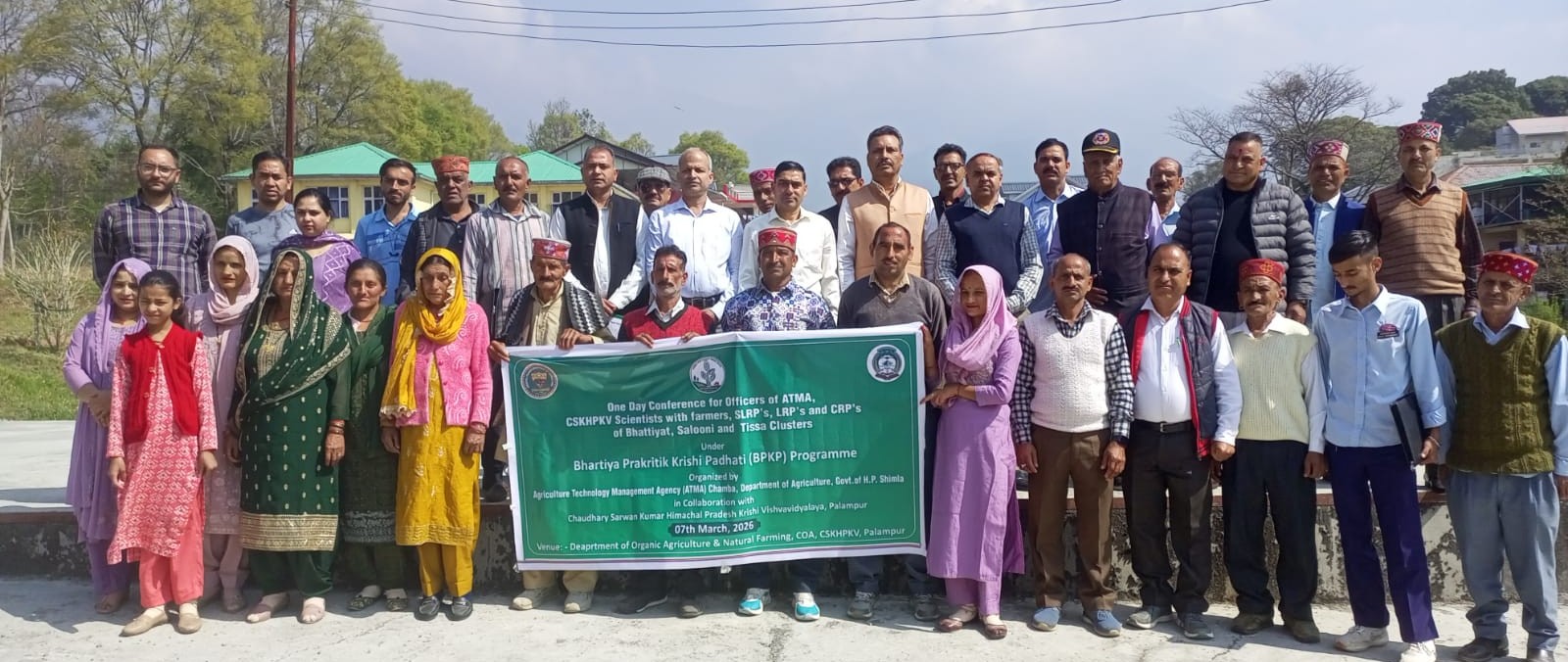
A one-day workshop on natural and organic farming was organised at Chaudhary Sarwan Kumar Himachal Pradesh Krishi Vishvavidyalaya (CSKHPKV), Palampur, to encourage farmers to adopt sustainable and chemical-free agricultural practices. The programme was conducted by the university’s Department of Organic Agriculture and Natural Farming and witnessed participation from farmers and agriculture officials of Bhatiyat and Salooni blocks of Chamba district in Himachal Pradesh. A total of 31 participants attended the workshop to gain insights into modern and environmentally sustainable farming techniques.
In his message, Vice-Chancellor Ashok Kumar Panda emphasised that natural farming plays a crucial role in promoting sustainable agriculture while safeguarding the environment. He highlighted that adopting organic and natural farming methods helps improve soil health, reduces dependence on chemical fertilisers and pesticides, and supports long-term agricultural sustainability. He also noted that agricultural universities have a significant role in providing scientific guidance and awareness to farmers, particularly in hill regions where sustainable farming practices are essential.
The workshop was chaired by Janardan Singh, Head of the Department of Organic Agriculture and Natural Farming. During his address, he explained the adverse effects of excessive use of chemical inputs on soil, water, air and the broader ecosystem. He encouraged farmers to adopt natural farming practices that work in harmony with nature. He also briefed participants about the government-supported Bharatiya Prakritik Krishi Paddhati (BPKP), which promotes chemical-free farming methods across the country.
Nitin Kumar Sharma, Project Director of Agricultural Technology Management Agency (ATMA), Chamba, also participated in the programme. He motivated farmers to utilise locally available resources in a scientific manner while transitioning to natural farming systems.
During the technical sessions, experts provided detailed information on the importance and benefits of natural farming. Farmers were given practical training on preparing and applying traditional bio-inputs such as Jeevamrit, Beejamrit and Ghanjeevamrit, along with the use of cow dung and cow urine-based formulations. Participants were also introduced to sustainable practices such as mulching and crop diversification, which help improve soil fertility and crop productivity while reducing input costs.
The programme was attended by senior scientists Gopal Katna and Rakesh Chauhan. The workshop was organised with the support of the Agriculture Department of Chamba district and Greeneri Agribusiness Pvt. Ltd., Nadoun, Hamirpur.
Concluding the event, Anil Sharma, Director of Greeneri Agribusiness Pvt. Ltd., expressed gratitude to the scientists, experts and participants. He stated that such training initiatives play an important role in helping farmers adopt sustainable and environmentally friendly farming practices.


 By
By











