

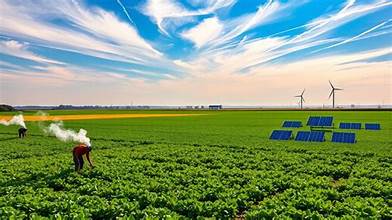
A new body of research has revealed that improving farm productivity can play a central role in reducing greenhouse gas (GHG) emissions from global agriculture, highlighting a powerful link between efficiency gains and environmental sustainability. The findings add weight to growing calls for climate-smart farming practices that simultaneously boost yields and lower the sector’s carbon footprint.
According to the study, higher productivity—achieved through improved crop genetics, precision farming, optimised fertiliser use and better livestock management—can reduce emissions per unit of food produced. By generating more output with fewer resources, farms can avoid land expansion, limit input wastage and curb the intensity of methane, nitrous oxide and carbon dioxide emissions.
Agricultural emissions account for roughly one-third of global greenhouse gases when considering the full food system. Much of this stems from enteric fermentation in cattle, soil emissions from fertilisers, rice paddies, and land-use change driven by agricultural expansion. Researchers note that productivity improvements directly target these hotspots by reducing pressure on land, enhancing nutrient efficiency and encouraging more sustainable herd and crop management practices.
One of the study’s key conclusions is that yield improvements are among the most effective tools for preventing deforestation, which remains a major driver of emissions. When farmers achieve higher output on existing land, the economic incentive to convert forests into cropland decreases. This effect is particularly pronounced in tropical regions, where population growth and food demand exert strong pressure on natural ecosystems.
Precision agriculture technologies—such as remote sensing, variable-rate fertiliser systems, soil analytics and automated irrigation—were identified as high-impact pathways for cutting emissions. By tailoring inputs to actual crop requirements, these technologies reduce over-application, lower energy consumption and improve nitrogen-use efficiency, one of the most critical factors in reducing agricultural nitrous oxide emissions.
The study also emphasises productivity opportunities in the livestock sector. Improved feed quality, selective breeding, enhanced animal health and rotational grazing can increase productivity per animal while reducing methane emissions per unit of meat or milk. Some regions have already demonstrated these gains: dairy systems in parts of Europe and North America produce significantly fewer emissions per litre of milk compared to less efficient systems in developing regions.
However, researchers caution that productivity gains must be achieved sustainably. Intensification that relies heavily on chemical inputs or monoculture practices can generate environmental trade-offs if not managed carefully. The report urges policymakers to prioritise climate-smart intensification, ensuring that productivity enhancements are coupled with soil conservation, biodiversity protection and responsible water management.
The findings have strong policy implications. Governments and development agencies are being encouraged to invest in agricultural R&D, extension services and digital infrastructure to accelerate knowledge transfer. Supporting smallholders—who represent the majority of global farmers—is especially critical, as they often lack access to modern technologies and improved seed varieties that drive productivity.
Climate experts argue that productivity-based mitigation offers a practical route for countries working to meet their emissions targets under the Paris Agreement. Unlike more disruptive interventions, efficiency improvements can deliver measurable climate benefits while enhancing food security and farmer incomes.
As the world faces rising food demand, shrinking arable land and intensifying climate risks, the research underscores a central message: making farms more productive is not only a pathway to feeding a growing population but also a key strategy for reducing global agricultural emissions. The challenge now lies in scaling these solutions equitably and sustainably across regions.


 By
By











