

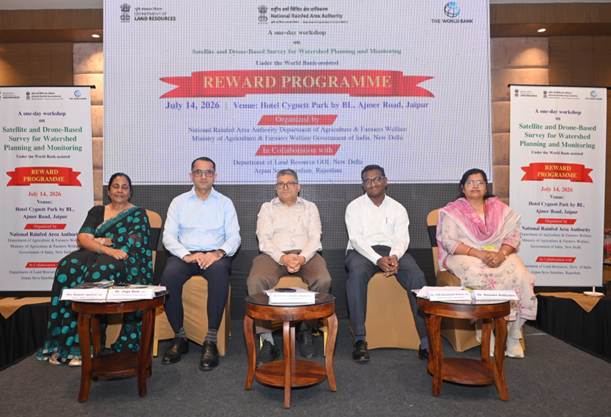
In a significant step toward strengthening water conservation and making rainfed agriculture more scientific and resilient, the National Rainfed Area Authority (NRAA) organized a high-level workshop on “Satellite and Drone-Based Surveys for Watershed Planning and Monitoring” under the World Bank-supported REWARD (Rejuvenating Watersheds for Agricultural Resilience through Innovative Development) Programme. The workshop focused on leveraging advanced geospatial technologies to improve the planning, implementation, monitoring, and evaluation of watershed development projects across India.
Organized by the NRAA as the knowledge partner of the Department of Land Resources (DoLR), the event brought together senior government officials, scientists, policymakers, technical experts, industry representatives, and NGO professionals from across the country to discuss the integration of modern technologies into watershed management.
Harnessing Technology for Smarter Watershed Development
The workshop was inaugurated by Dr. Susma Sudhishree, Technical Expert (Watershed Development) and REWARD Project In-charge at NRAA. She emphasized that climate change, erratic rainfall patterns, and increasing pressure on natural resources have made the adoption of advanced technologies essential for effective watershed development.
She highlighted that satellite imagery and drone surveys can significantly enhance the accuracy of watershed mapping while enabling real-time monitoring of land use, water harvesting structures, soil conservation measures, vegetation cover, and overall project progress. These technologies, she noted, would improve decision-making and ensure better utilization of public resources.
Modern Technologies to be Integrated into National Guidelines
Addressing the gathering, Dr. Chandrashekhar Kumar, Chief Executive Officer (CEO) of the National Rainfed Area Authority, stressed that the upcoming National Technical Guidelines (NTG) should clearly define how satellite-based surveys and drone technologies should be used during different stages of watershed projects, including planning, implementation, monitoring, and impact assessment.
He pointed out that India’s diverse agro-climatic and geographical conditions require a standardized yet flexible framework that allows states to adopt modern technologies effectively while addressing local needs.
Strengthening WDC-PMKSY 3.0
Experts agreed that the recommendations emerging from the workshop would contribute to the formulation of the National Technical Guidelines for the Watershed Development Component of the Pradhan Mantri Krishi Sinchayee Yojana (WDC-PMKSY 3.0).
According to participants, integrating satellite and drone-based surveys into watershed programmes would improve project quality, reduce implementation time and costs, enhance transparency and accountability, and enable more accurate assessment of physical progress and environmental outcomes.
Experts Discuss AI, GIS and Digital Monitoring
The workshop witnessed participation from several distinguished officials and experts, including Dr. Joga Ram (IAS), Secretary and Commissioner, Panchayati Raj Department, Government of Rajasthan; Y.V.K. Shanmukh Kumar (IFS), Director of Watersheds, Andhra Pradesh; Kalpana Agrawal, Director, Watershed Development and Soil Conservation, Rajasthan; Dr. S. Bandyopadhyay, Director, MNCFC, Ministry of Agriculture & Farmers’ Welfare; and Sushila Yadav, Chief Engineer and Joint Secretary (Soil & Conservation), Government of Maharashtra.
Participants discussed the growing role of Artificial Intelligence (AI), remote sensing, GIS mapping, drone-based data collection, and digital monitoring systems in watershed development. Experts recommended that these technologies should not only support surveys but also be integrated into project evaluation, water resource management, and long-term conservation of natural resources.
Direct Benefits for Farmers and Water Conservation
Experts observed that wider adoption of advanced technologies in watershed development would significantly improve rainwater harvesting, groundwater recharge, soil conservation, and agricultural productivity, especially in rainfed regions. Better water management would help farmers reduce cultivation costs while improving crop yields and resilience against climate variability.
Digital monitoring systems would also enhance transparency, ensuring that government-supported watershed projects are implemented more efficiently and that benefits reach the intended farming communities.
Building Climate-Resilient Agriculture
The workshop concluded with a strong emphasis on the need for science-driven and technology-enabled watershed management to address the growing challenges posed by climate change. Participants expressed confidence that the technical framework being developed under the REWARD Programme would provide a robust foundation for WDC-PMKSY 3.0 and play a crucial role in strengthening water conservation, sustainable natural resource management, and climate-resilient agriculture across India.


 By
By











