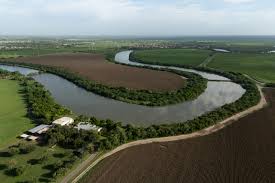
The United States has reaffirmed its commitment to the 1944 Water Treaty with Mexico, a move aimed at improving water delivery certainty for farmers and ranchers in South Texas, where water availability remains critical for agriculture and rural livelihoods. The reassurance came jointly from the U.S. Department of State and the U.S. Department of Agriculture (USDA), underscoring the federal government’s coordinated approach to cross-border water management.
The 1944 treaty governs the sharing of water from the Rio Grande and Colorado River basins, forming the backbone of water cooperation between the two countries for decades. Under the agreement, Mexico is required to deliver a specified volume of water from tributaries of the Rio Grande to the United States over five-year cycles, while the U.S. provides Mexico with water from the Colorado River. Compliance with the treaty is particularly important for downstream agricultural communities in Texas that rely heavily on predictable irrigation supplies.
In recent years, periodic shortfalls and delivery delays from Mexico have raised concerns among South Texas growers, especially producers of citrus, sugarcane, cotton, and vegetables. Uncertainty over water allocations has affected planting decisions, farm investment planning, and long-term crop sustainability in the region. The latest reaffirmation signals stronger diplomatic engagement to ensure treaty obligations are met and water deliveries remain reliable.
U.S. officials indicated that the State Department will continue to work through the International Boundary and Water Commission (IBWC) to monitor treaty compliance and resolve disputes, while the USDA will focus on supporting farmers impacted by water stress. This includes technical assistance, conservation programmes, and potential financial support mechanisms aimed at improving on-farm water efficiency and resilience.
Farm groups and local irrigation districts in South Texas have welcomed the renewed commitment, viewing it as a positive step toward stabilising agricultural production in a region frequently affected by drought and climate variability. Reliable water deliveries are essential not only for crop yields but also for sustaining rural employment, agribusiness supply chains, and regional food systems.
Experts note that while the treaty remains a vital framework, long-term solutions will also require investments in water infrastructure, improved binational coordination, and adaptation strategies to address increasing pressure on shared river systems. Against this backdrop, the U.S. government’s renewed focus on the 1944 Water Treaty is being seen as a critical move to safeguard agricultural interests while maintaining cooperative relations with Mexico.


 By
By