

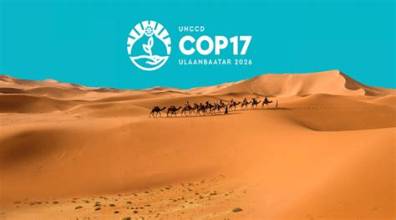
The 17th Conference of the Parties to the United Nations Convention to Combat Desertification (UNCCD COP17) begins on August 17 in Ulaanbaatar, Mongolia, bringing countries together to address growing threats from drought, land degradation and desertification. The summit, being held from August 17 to 28, is expected to place strong emphasis on practical solutions for restoring degraded land and strengthening resilience in vulnerable communities.
The meeting comes at a time when drought and land degradation are increasingly affecting agriculture, food security and rural livelihoods across different regions of the world. Governments and experts are expected to discuss how international finance can be converted into practical projects that improve the ability of farmers, pastoralists and communities to withstand prolonged water shortages and extreme weather.
One of the key issues attracting attention is a $12 billion public-sector funding pool aimed at supporting drought resilience in vulnerable countries. The financing initiative is linked to the Riyadh Global Drought Resilience Partnership launched during COP16 and is intended to support projects such as efficient irrigation, drought-resistant crops and rainwater storage.
For agriculture, the discussions are particularly important because drought can quickly reduce crop yields, damage soil health and increase pressure on already limited water resources. Improving irrigation efficiency and adopting climate-resilient farming practices could help farmers maintain production while using less water.
Land restoration is another major priority. Healthy soils and productive land are essential for food production, biodiversity and rural livelihoods. Restoring degraded land can improve soil quality, increase water retention and strengthen ecosystems against drought and other climate-related stresses.
Mongolia’s role as host is also significant. The country is highly exposed to desertification, drought and land degradation and has been promoting initiatives focused on restoring landscapes, improving pasture management and strengthening climate-resilient agriculture and water systems. Mongolia has also highlighted the potential role of satellite monitoring, artificial intelligence and geospatial technologies in tracking land health and improving drought preparedness.
Pastoralism and rangeland management are expected to receive particular attention during COP17. Rangelands cover a major share of the world’s land surface and support billions of people through livestock production and other livelihoods. Mongolia has placed pastoralism at the centre of its COP17 agenda, highlighting its potential contribution to biodiversity conservation, climate adaptation and sustainable land management.
However, the financial challenge remains substantial. The $12 billion funding pool represents an important commitment, but it is considerably smaller than the estimated investment needed globally to tackle land degradation and build long-term drought resilience.
The outcome of COP17 could therefore have important implications for farmers and food systems worldwide. Stronger investment in irrigation, soil restoration, drought-resistant crops and sustainable land management could help agricultural communities adapt to increasingly unpredictable weather.
As governments meet in Ulaanbaatar, the central challenge will be turning international commitments into projects that deliver measurable benefits on the ground. For countries facing worsening drought and land degradation, effective financing and practical implementation could be critical to protecting food production, rural livelihoods and long-term environmental resilience.


 By
By











