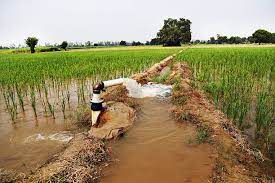
A new international study led by researchers from Vrije Universiteit Brussel and ETH Zurich has found that irrigation — a practice long considered essential for increasing crop yields and stabilizing food production — can, in some regions, worsen heat stress and intensify water scarcity. The findings challenge conventional assumptions about irrigation’s role in agricultural resilience and highlight the urgent need for more sustainable water management strategies worldwide.
The research analyzed global irrigation patterns using advanced climate and hydrological models, revealing a complex relationship between irrigation, local climate, and water availability. While irrigation helps maintain crop productivity during dry periods, it can also lead to unintended consequences. In several regions, particularly in South Asia, the Middle East, and parts of North America, heavy irrigation is altering local atmospheric conditions — raising humidity, trapping heat near the surface, and increasing heat stress for both crops and people.
Moreover, excessive groundwater extraction to support irrigation is accelerating aquifer depletion, putting long-term water security at risk. The study found that in areas with limited renewable water resources, such as northern India and central Iran, irrigation is contributing to severe water strain, reducing the very resilience it was meant to enhance.
According to the authors, these feedback effects demonstrate that irrigation must be managed within a broader understanding of climate-water interactions. Simply expanding irrigation infrastructure without considering local water cycles can create a “double-edged sword” scenario — short-term yield gains followed by long-term ecological and climatic stress.
The researchers suggest that adopting climate-smart irrigation practices could help mitigate these challenges. Techniques such as drip irrigation, soil moisture monitoring, and precision water application can optimize water use while reducing surface evaporation and energy consumption. In addition, integrated water resource management (IWRM) and policies that promote sustainable groundwater governance are crucial for ensuring long-term agricultural viability.
The study’s findings carry important implications for global food security. As climate change intensifies droughts and heatwaves, efficient and adaptive irrigation systems will be essential — but they must be designed to work with, not against, natural hydrological processes.
Ultimately, the research underscores that solving the global water and heat crisis in agriculture requires rethinking traditional irrigation models. Sustainable solutions will depend on innovation, local adaptation, and global cooperation to ensure that irrigation supports — rather than undermines — the resilience of farming systems worldwide.


 By
By