

The 3rd edition of BRAND R.Comm 2025, organized by Snail Integral, came alive today at the Holiday Inn, Aerocity, New Delhi, bringing together leaders, innovators, policymakers, and agri-industry experts to discuss the future of Indian agriculture and rural communication. The summit focused on empowering farmers through precise, data-driven communication, innovative solutions, and science-backed practices.
The day’s agenda was packed with technical panels on soil, seeds, agri-inputs, biologicals, and fertilizers, along with high-impact CEO discussions. The event also saw the launch of the SnailShow Coffee Table Book, a Knowledge Paper by Market Insight Consultants, and the BRAND R.Comm Awards ceremony, celebrating excellence in agricultural communication and innovation.
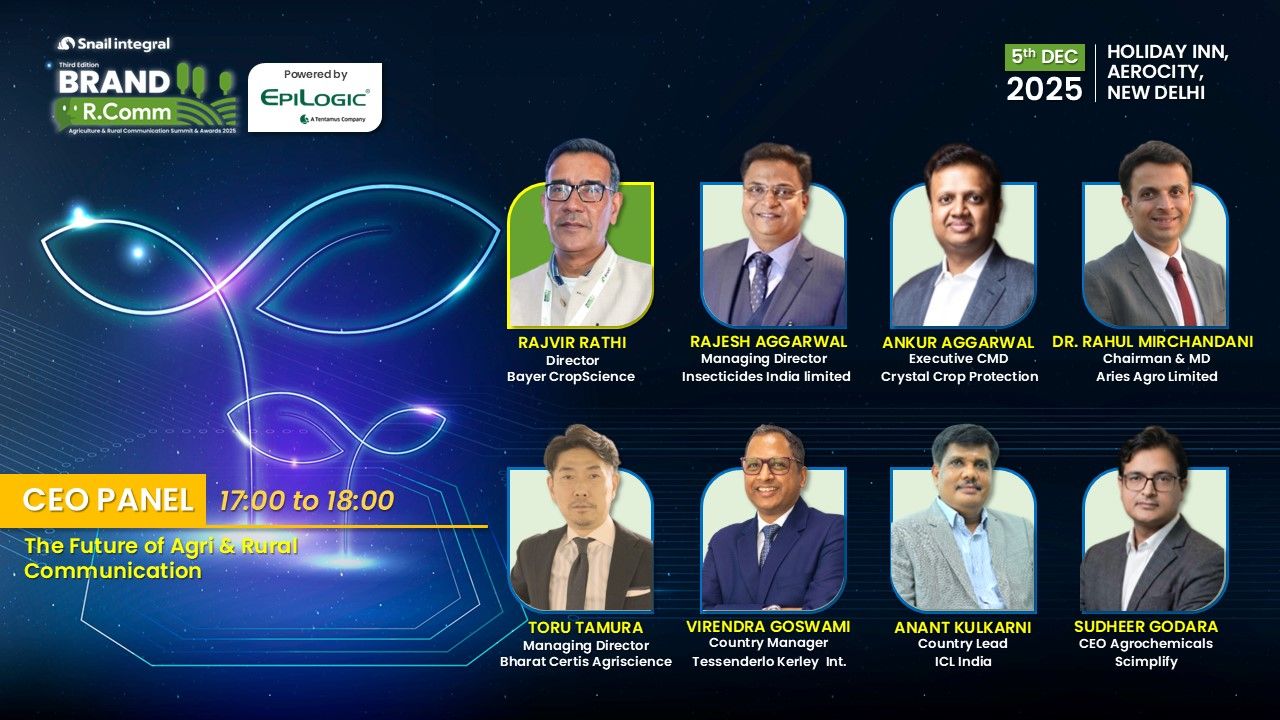
Moderating the CEO panel, Mr. Rajvir Rathi Singh Rathi, Director – Agricultural Affairs & Policy, IM–IBSL and Lead – Traits Licensing Business at Bayer CropScience, underscored the transformative power of communication in agriculture. He emphasized that farmers are the true center of the agricultural ecosystem, and every product, policy, and innovation must address their needs. Precision in product details, usage instructions, and information flow is critical for farmers to make informed decisions. His moderation facilitated discussions on building farmer-centric brands and designing strategies to shape India’s agricultural roadmap for 2030.
Soil health, biofertilizers, and biostimulants were central to discussions. Mr. Rajiv Choudhary highlighted the critical role of biological solutions in restoring soil vitality, especially in light of India’s alarmingly low soil carbon levels. He emphasized the need for farmer education, awareness, and robust policy frameworks to ensure proper adoption of solutions such as seaweed-based biostimulants. Clear regulation, coupled with initiatives like the Soil Health Card scheme, will guide farmers in selecting the right inputs and achieving sustainable outcomes.
The summit also addressed the importance of climate-smart seeds and seed replacement strategies. Mr. Mrinmoy Choudhury Choudhary stressed accelerating India’s Seed Replacement Rate (SRR) and implementing “One Nation, One Seed Law” to ensure quality, uniformity, and transparency nationwide. With increasing pest incidences, climate change impacts, and reduced farm labor, farmers need accessible, timely, and actionable guidance to maintain productivity and resilience.
Affordability, accessibility, and technology adoption were emphasized by Mr. Murari Agrawal Agarwal, who highlighted that small and marginal farmers face high costs for digital tools, inputs, and credit. He called for collaborative digital platforms, financial support mechanisms, custom hiring services, and stronger insurance frameworks to ensure technology empowers farmers rather than overwhelms them.
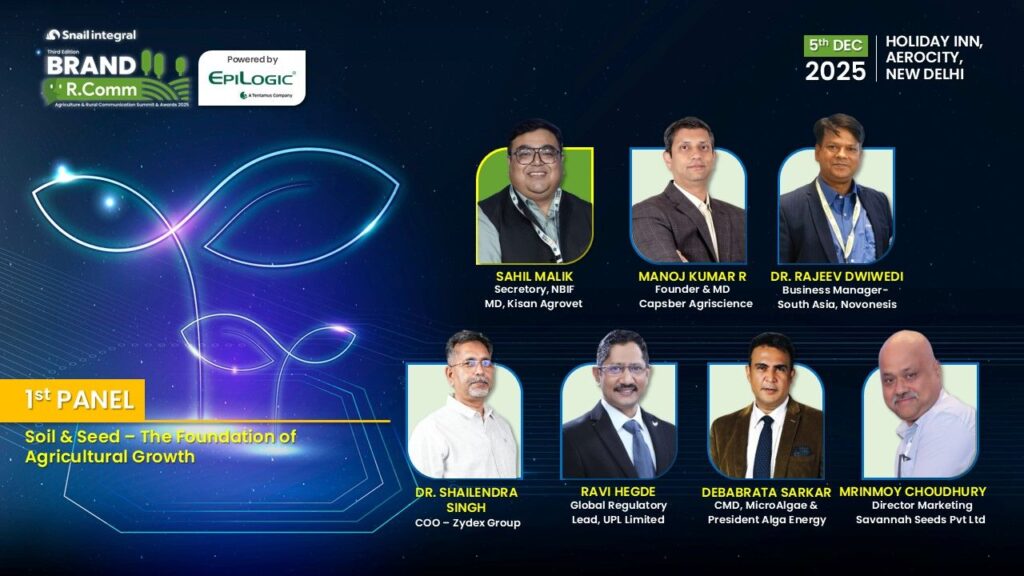
Technical sessions moderated by experts such as Mr. Sahil Malik, Mr. Vipin Saini, and Mr. Dinesh Singh explored pressing issues like soil degradation, nutrient deficiencies, and pest management. Discussions highlighted the role of biologicals, fortified nutrients, and integrated pest management (IPM) in enhancing crop resilience and soil health. Speakers like Mr. Manas Tewari, Mr. Navdeep Mehta, and Mr. Manoj Varshney emphasized that biologicals act as a “blood transfusion” for plants, improving nutrient availability, soil microbes, and water retention, and ensuring long-term sustainability.
The summit stressed integrated solutions—combining chemical fertilizers, crop protection, and emerging technologies—to address challenges holistically. Experts including Dr. Bakul Joshi and Dr. Prafull Gadge highlighted successful case studies where biological solutions replaced chemical inputs, demonstrating the potential for sustainable pest management and crop protection. The discussions emphasized the importance of fortified nutrients in addressing malnutrition, noting that nearly 40% of Indian children are zinc-deficient.
Communication and trust-building were recurring themes. Speakers such as Dr. Rahul Mirchandani Mirchandani, Mr. Anant Kulkarni, and Mr. Toru Tamura highlighted the need for consistent, transparent, and meaningful engagement with farmers. They stressed the importance of feedback loops, digital tools, and farmer-to-farmer communication in driving adoption and building confidence. Companies were urged to focus on creating value-rich solutions, fostering credibility, and supporting long-term productivity rather than chasing short-term visibility.
The summit also reinforced the role of regulatory alignment, public-private partnerships, and knowledge dissemination in shaping the agricultural ecosystem. Experts emphasized moving from food security to nutrient security, ensuring that economic, environmental, and social aspects of farming are addressed cohesively.
Prof. R. B. Singh highlighted the significance of communication in linking soil, crop, market, and industry, while Gijs Manneveld emphasized the importance of data-driven communication in empowering farmers to make profitable and informed decisions. The summit recognized that effective communication is as critical as scientific innovation in ensuring sustainable agricultural growth.
BRAND R.Comm 2025 reaffirmed that the future of Indian agriculture lies at the intersection of innovation, science, and farmer-centric communication. By fostering collaboration between industry, policymakers, and farmers, the summit showcased a roadmap for sustainable, resilient, and profitable agriculture, laying the foundation for the next green revolution in India.


 By
By











