

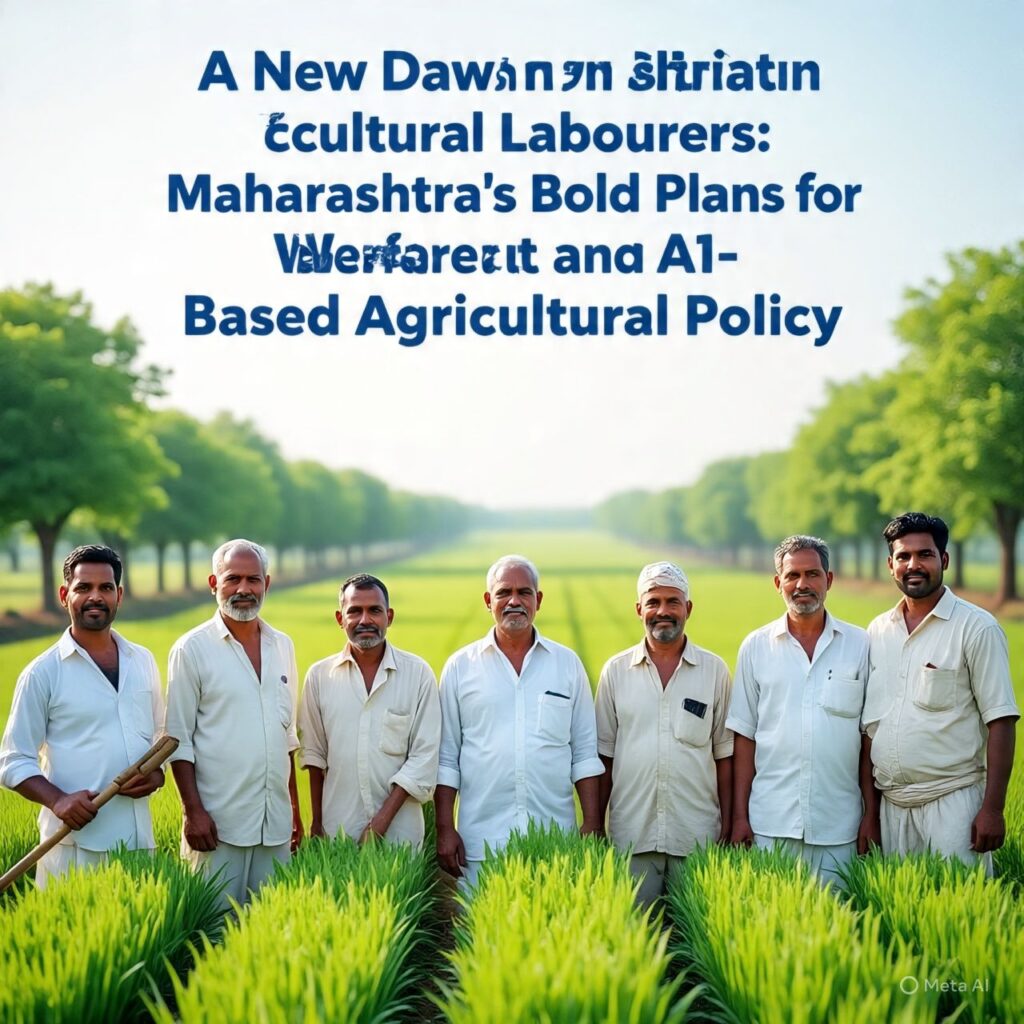
Agriculture remains the backbone of India’s economy. Yet, behind the lush green fields and bountiful harvests lies a sobering truth — the plight of the agricultural workforce. In Maharashtra, a state known for its vast farmlands and cash crops, farmers and farm labourers have long struggled with challenges such as unpredictable weather, debt, fluctuating prices, and lack of social security.
The state government has recently taken significant steps to change this narrative. In an important announcement, Maharashtra’s Minister of State for Agriculture, Ashish Jaiswal, outlined a comprehensive roadmap for strengthening the social security net for agricultural workers, deploying AI technology for better farm management, and driving export-oriented crop growth.
This ambitious vision, if implemented effectively, could transform rural livelihoods, address issues like farmer suicides, and usher in a new era of resilient, tech-enabled farming in India’s second-most populous state.
The Urgent Need for Social Security for Agricultural Workers
India’s agricultural workforce is vast and diverse, ranging from large landowners to marginal farmers and seasonal labourers who earn daily wages by toiling in the fields. While several welfare schemes target landholding farmers, agricultural labourers — who are often landless or marginal cultivators — are among the most vulnerable sections in rural society.
For years, factors like crop failure, erratic monsoons, wildlife damage, and mounting debt have driven countless farmers and labourers to despair. Tragically, farmer suicides have been a persistent challenge, especially in Maharashtra’s drought-prone districts like Vidarbha and Marathwada.
Recognizing this, Minister Ashish Jaiswal made it clear during a recent Assembly session that the government’s priority is to bring farmer suicides down to zero. To do this, the government plans to launch a new social security scheme specifically for agricultural labourers — a first-of-its-kind move in the state.
A Look at Existing Farmer Welfare Initiatives
While the new scheme will focus on farm workers, Maharashtra has already rolled out several initiatives aimed at uplifting farmers:
- Namo Shetkari Samman Yojana: This flagship scheme alone has distributed ₹56,293 crore over the last three years.
- Chief Minister’s Baliraja Electricity Subsidy Scheme: ₹19,310 crore has been spent to provide affordable electricity for farming needs.
- Crop Insurance Scheme: Over ₹16,389 crore has been disbursed under this scheme to protect farmers from crop loss.
- Gopinath Munde Shetkari Anudan Yojana: This grant scheme helps farmers purchase agricultural equipment and mechanize their farms.
In total, more than ₹69,889 crore has already been spent on farmer welfare, benefiting 1.71 crore farmers in the state.
What Will the New Scheme Offer?
The proposed social security scheme will provide agricultural labourers with financial safety nets to protect them during crises. Although detailed guidelines are yet to be shared, the core idea is to extend benefits like insurance, pension, and crisis relief funds to daily-wage farm workers who currently have little or no fallback during tough times.
Such a move could be a game changer for millions of rural families who survive on seasonal farm work and daily wages. It aligns with broader national discussions about universal social security for informal sector workers.
Wildlife Crop Protection Policy: Another Critical Step
Wildlife intrusion is another significant challenge faced by farmers. Crop damage caused by wild boars, monkeys, nilgai, and other animals can wipe out an entire season’s earnings overnight. To address this, Maharashtra is designing a dedicated Wildlife Crop Protection Policy, which will provide affected farmers with compensation and preventive support.
Under this policy, farmers hit by wildlife incursions or natural disasters will get timely subsidies and technical support to recover their losses.
Using AI to Transform Farming
One of the most promising announcements is the deployment of Artificial Intelligence (AI) for farm management and pest control. As per Minister Jaiswal, the government will invest ₹500 crore in developing an AI-based policy that will:
- Use real-time data to predict pest outbreaks.
- Help plan timely interventions to minimize crop damage.
- Guide farmers with best practices for crop health management.
This move aims to make farming more scientific, efficient, and less dependent on guesswork. It will empower farmers with actionable insights so they can plan irrigation, fertilizer use, and pest control more effectively.
Harnessing Satellite Technology for Faster Relief
Another progressive decision is to use satellite imagery and the Maharashtra Remote Sensing Applications Centre (MR-SAC) for quick crop damage assessments — known locally as panchanamas. This modernized approach will make surveys more accurate and faster, ensuring that farmers receive timely compensation.
In the past, delays in damage assessment often led to late or insufficient compensation, pushing farmers deeper into debt. Using satellite data will help bridge this gap.
Strengthening Fertilizer Supply and Promoting Organic Farming
Fertilizer shortages and inconsistent supply chains have long troubled farmers, especially during peak sowing seasons. To resolve this, the government plans to appoint dedicated officers at the taluka (sub-district) level to monitor fertilizer distribution and tackle linkage issues.
At the same time, there is a strong push towards encouraging organic and natural farming methods. By promoting bio-fertilizers and reducing the state’s subsidy burden on chemical fertilizers, the government hopes to make agriculture more sustainable and eco-friendly.
Investing in Rural Infrastructure: 45,000 km of Paddy Roads
Good rural infrastructure is essential for efficient agricultural operations. To improve connectivity between farms and markets, the government plans to construct 45,000 kilometers of paddy roads — all-weather rural roads that make transporting produce easier and reduce post-harvest losses.
Better roads mean faster access to mandis (agriculture markets) and lower transportation costs, which can directly improve farmers’ earnings.
One Rupee Crop Insurance Scheme and New Investments
Maharashtra’s famous One Rupee Crop Insurance scheme, which provides insurance coverage at a nominal premium, will be revamped to attract larger participation. The state plans to invest ₹5,000 crore to strengthen this scheme, ensuring more farmers are protected against crop failures.
A Shift Towards Export-Oriented Agriculture
Maharashtra is also turning its focus to export-oriented agriculture. The state is encouraging farmers to grow high-value crops with strong global demand. Crops will be categorized as assets or liabilities based on their profitability and sustainability.
By doing so, the government aims to diversify agricultural income sources and make Maharashtra a key player in India’s agricultural exports.
Ending Lottery-Based Benefits, Adopting First-Come, First-Serve
In a significant reform, the traditional lottery system used to distribute benefits under various schemes is being replaced with a first-come, first-serve approach. This will bring more transparency and ensure timely support reaches those who need it most.
Additionally, the government plans to increase expenditure on high-demand schemes and conduct periodic surveys to understand farmers’ evolving needs.
A Holistic, Farmer-First Vision
The announcements made by Minister Ashish Jaiswal reflect a holistic approach to agriculture. They cover everything from social security for vulnerable agricultural workers and new technological interventions to wildlife damage compensation, rural infrastructure, and export-oriented strategies.
At their core, these efforts aim to build a resilient, sustainable agricultural ecosystem that safeguards farmers’ livelihoods and brings long-term prosperity to Maharashtra’s rural communities.
Why These Steps Matter Now More Than Ever
Maharashtra’s agriculture is battling multiple threats — climate change, erratic monsoons, wildlife incursions, pest attacks, and the growing gap between input costs and market prices. While farmers have adapted and innovated over decades, they continue to face an uphill battle without sufficient institutional support.
The government’s renewed push for social security and tech-driven solutions sends a clear message: the welfare of farmers and farm labourers is not just a political slogan but a policy priority.
Challenges and The Road Ahead
Announcing schemes is only the first step. Implementing them effectively — especially in vast rural areas with diverse challenges — requires robust planning, local governance, and transparency.
Ensuring that the social security scheme reaches every eligible agricultural labourer, that AI solutions are accessible even to small farmers, and that compensation for crop damage is disbursed promptly will be the real test.
Partnerships with local cooperatives, farmer producer organizations (FPOs), and rural institutions will be crucial. So will training farmers to adopt new technologies, understand insurance terms, and transition to sustainable practices.
Conclusion: A Hopeful Future for Rural Maharashtra
If the plans outlined by Maharashtra’s government are executed well, they could bring lasting positive change for millions of rural families. From protecting the most vulnerable farm workers with social security to empowering farmers with AI-driven insights and modern infrastructure, the vision is bold and forward-thinking.
Ultimately, the goal is clear — to make agriculture not just a means of survival but a secure, sustainable, and profitable livelihood for everyone who works the fields.
The hope is that other states will watch, learn, and adopt similar measures, so that India’s farmers — the true backbone of the nation — can look forward to a future where their hard work is rewarded with stability, dignity, and prosperity.


 By












