

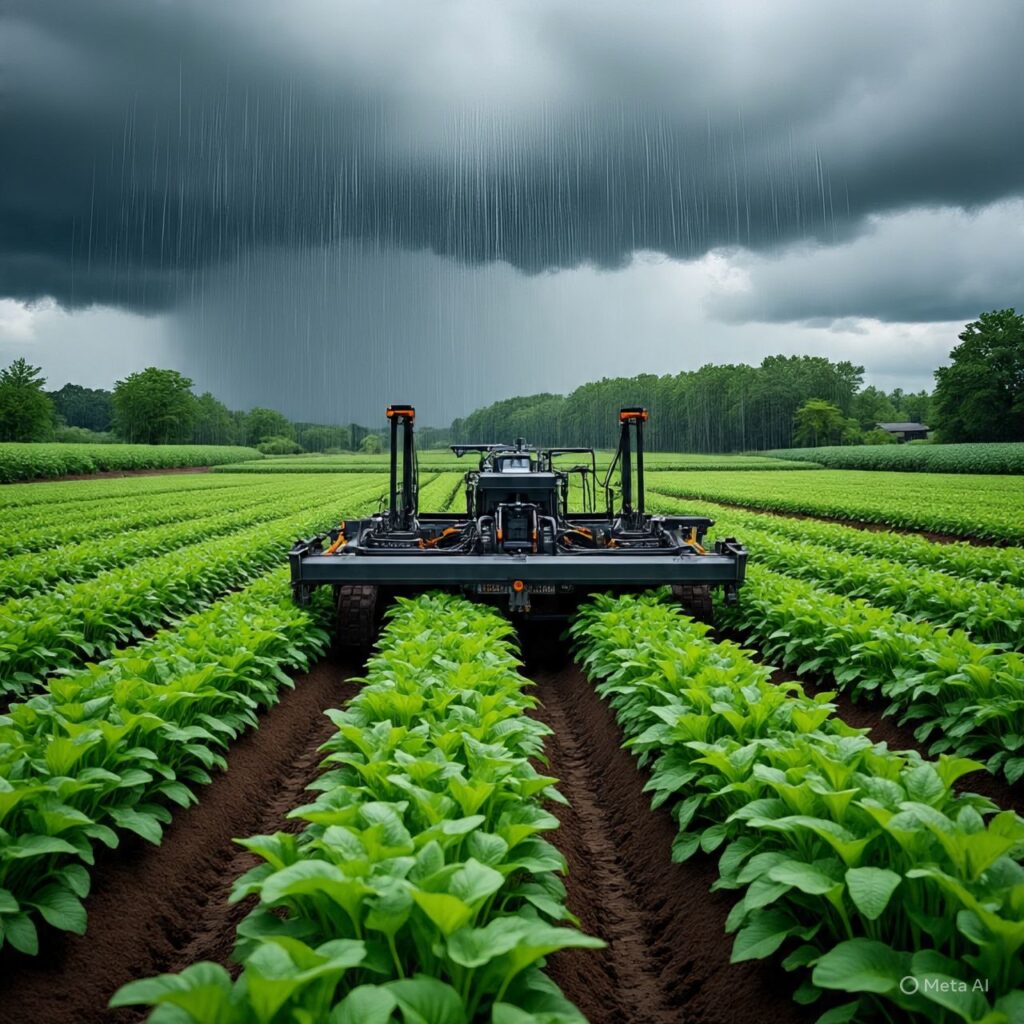
For Indian farmers, the weather has always been an unpredictable partner — sometimes kind, often cruel. With climate change intensifying, this unpredictability has only worsened. Once predictable monsoons now arrive with erratic patterns — sudden cloudbursts, heavy downpours, and unseasonal rainfall events are leaving fields waterlogged and crops destroyed.
For small and marginal farmers who depend on every acre for their annual income, excessive rain is not just water — it’s a threat to survival. Yet amidst these challenges, agricultural innovation is stepping in. One such breakthrough is the Raised Bed Planter Machine, an advanced yet farmer-friendly tool that is helping protect crops like maize, pulses, and oilseeds from the disastrous effects of waterlogging.
This is the story of how a simple mechanized solution is turning heavy rains into an ally rather than an enemy — and why more farmers should know about it.
The Problem: Rain That Helps and Harms
In India’s diverse agro-climatic regions, rainfall is both a blessing and a curse. For crops like maize, chickpea, mustard, peanuts, and pigeon pea, water is vital — but too much of it can be fatal. Heavy rains often lead to stagnant water in fields, which suffocates plant roots. This not only damages the crop but can also destroy soil structure and reduce fertility over time.
Standing water cuts off the oxygen supply to roots, leading to root rot, stunted growth, fungal attacks, and lower yields. In severe cases, farmers can lose entire crops overnight due to unexpected downpours.
The irony? In the same field, when rainfall is low or delayed, the lack of water stresses the plants and affects yields too. Managing both extremes has always been a tricky balancing act for farmers — until now.
Raised Bed Planting: An Old Idea with Modern Machinery
The concept of planting crops on raised beds is not entirely new. Traditionally, farmers would prepare ridges and furrows manually or with basic tools. However, this process was time-consuming, labor-intensive, and often lacked precision.
The Raised Bed Planter Machine solves all these problems with smart engineering. It combines soil shaping, seeding, and fertilizing — all in a single pass. The result? A field designed to handle both too much water and too little.
How Does the Raised Bed Planter Machine Work?
This machine, when attached to a tractor, transforms a plain, ploughed field into a well-designed landscape of raised beds and furrows. Here’s how it works step by step:
1. Preparation
Before using the Raised Bed Planter, farmers prepare the land as usual — ploughing and breaking clods to loosen the soil.
2. Attachment
The machine is mounted onto a tractor. It has blades and moldboards that lift soil into beds and carve out furrows alongside.
3. Bed Formation
As the tractor moves, the machine forms raised beds — long, narrow ridges of soil that sit higher than the surrounding ground.
4. Simultaneous Sowing and Fertilizing
While creating beds, the machine simultaneously sows seeds at the correct depth and spacing and places fertilizers precisely where they are needed — near the roots.
5. Drainage Channels
The furrows between beds act as natural drainage channels. Excess rainwater flows into these furrows and away from the root zone, preventing waterlogging.
Why Does Raised Bed Planting Work So Well in Heavy Rain?
Raised beds lift the plant roots above the saturated ground level. So even during heavy rain, water naturally drains into the furrows, not around the roots.
The furrows serve a dual purpose:
- In heavy rain, they drain away excess water.
- In dry spells, they conserve moisture, which slowly seeps back into the beds — keeping roots hydrated longer.
Benefits Farmers Are Seeing in the Field
Farmers who have switched to raised bed planting, especially for maize and pulses, report clear advantages:
✅ Protection from Waterlogging: Roots stay dry, healthy, and oxygenated even during heavy rain.
✅ Better Germination: Because the beds are loose and well-aerated, seeds sprout evenly.
✅ Uniform Crop Growth: Plants grow at the same pace, making crop management easier.
✅ Higher Yields: Healthier plants naturally deliver more produce.
✅ Reduced Fertilizer Waste: Fertilizer placed directly near the seed roots is absorbed better, saving money and improving soil health.
✅ Water Efficiency: In dry weather, furrows help store and distribute moisture, giving crops a backup source of water.
✅ Labour and Time Savings: Multiple tasks (bed making, sowing, fertilizing) are done at once — saving time and labour costs.
Which Crops Benefit the Most?
While the Raised Bed Planter can technically be used for many row crops, it is especially useful for crops that are sensitive to waterlogging or have taproot systems that need good aeration.
Top crops where farmers see big gains include:
- Maize (Corn): One of the most widely grown kharif crops — highly sensitive to waterlogging.
- Pulses: Chickpea, pigeon pea, mung bean — India’s staple protein sources.
- Oilseeds: Mustard, groundnut — both prone to root rot if fields get flooded.
- Cotton: In some regions, raised bed planting is also being used for cash crops like cotton, which requires dry roots.
An Affordable, Practical Innovation
One reason the Raised Bed Planter Machine is gaining popularity is its simplicity. Farmers do not need expensive high-tech gadgets or years of training to use it. If a farmer has a tractor — or access to a rental — they can adopt this method quickly.
Many state agriculture departments, Krishi Vigyan Kendras (KVKs), and cooperatives are now conducting training camps to demonstrate how the machine works in local conditions.
In fact, a single machine can be shared by multiple farmers in a village through cooperative societies or custom hiring centers — further lowering costs.
Why It’s a Climate-Smart Practice
As climate risks grow, resilient farming practices are the need of the hour. Raised bed planting is recognized globally as a climate-smart practice. Here’s why:
- Adapts to Extreme Weather: Handles both floods and droughts.
- Improves Soil Health: Better aeration and less compaction.
- Reduces Erosion: Beds and furrows guide water flow gently, preventing topsoil loss.
- Enhances Input Efficiency: Less fertilizer runoff means lower costs and less environmental impact.
In a way, it’s a low-tech, high-impact answer to an unpredictable climate.
How Governments Are Supporting Adoption
Realizing the benefits, many state governments are including the Raised Bed Planter under their farm mechanization subsidy schemes. Farmers can get financial assistance for buying or renting these machines.
Training workshops are run at block and district levels where farmers see live demonstrations. Success stories are shared to inspire confidence. Some states are integrating these machines into their Smart Agriculture Missions.
Stories from the Ground: Transforming Lives
Take the example of maize farmers in Bihar and Uttar Pradesh. Traditionally, heavy rain would flood their low-lying fields. Today, with raised beds, they report significantly lower crop loss, healthier harvests, and higher income.
In parts of Rajasthan, where mustard is grown extensively, farmers adopting this technology are seeing better yields even during unseasonal rains.
For pulses — a crucial protein source for India’s growing population — raised bed planting is helping reduce dependency on imports by increasing domestic production.
Steps for Farmers to Get Started
For farmers interested in adopting this method, here’s a simple roadmap:
- Assess Your Crop and Soil: Identify whether your crop is sensitive to waterlogging and if your land is prone to flooding.
- Contact Local KVK: Reach out to your nearest Krishi Vigyan Kendra for guidance and demo sessions.
- Access the Machine: Check if your village has a custom hiring center, cooperative, or SHG that rents out farm machinery.
- Plan Your Sowing: Align your sowing time with local weather patterns and ensure the field is well-prepared.
- Learn the Technique: Attend training to operate the machine efficiently — correct depth and spacing matter.
- Monitor Results: Track your yield and share feedback with peers and local agri-officers to help spread awareness.
Looking Ahead: A Resilient Farming Future
The Raised Bed Planter is a shining example of how simple innovations can solve complex problems. By adapting to the unpredictability of monsoons, Indian farmers can protect their crops, save money, and secure their livelihoods.
As more farmers switch to this method, India’s overall farm productivity can improve, import dependence can reduce, and the nation can move closer to self-reliance in pulses and oilseeds — key pillars of food security.
Heavy rains will always come. But with the right tools, they don’t have to wash away a farmer’s dreams.
Conclusion
Indian agriculture is standing at a crossroads — climate challenges on one side, technology and innovation on the other. The Raised Bed Planter Machine is proof that practical, farmer-friendly solutions exist to tackle the harshest tests of nature.
By embracing this simple yet effective technology, farmers can transform a seasonal threat into an opportunity for better yields and higher incomes. The dream of prosperous, resilient farming communities is possible — one raised bed at a time.


 By












