

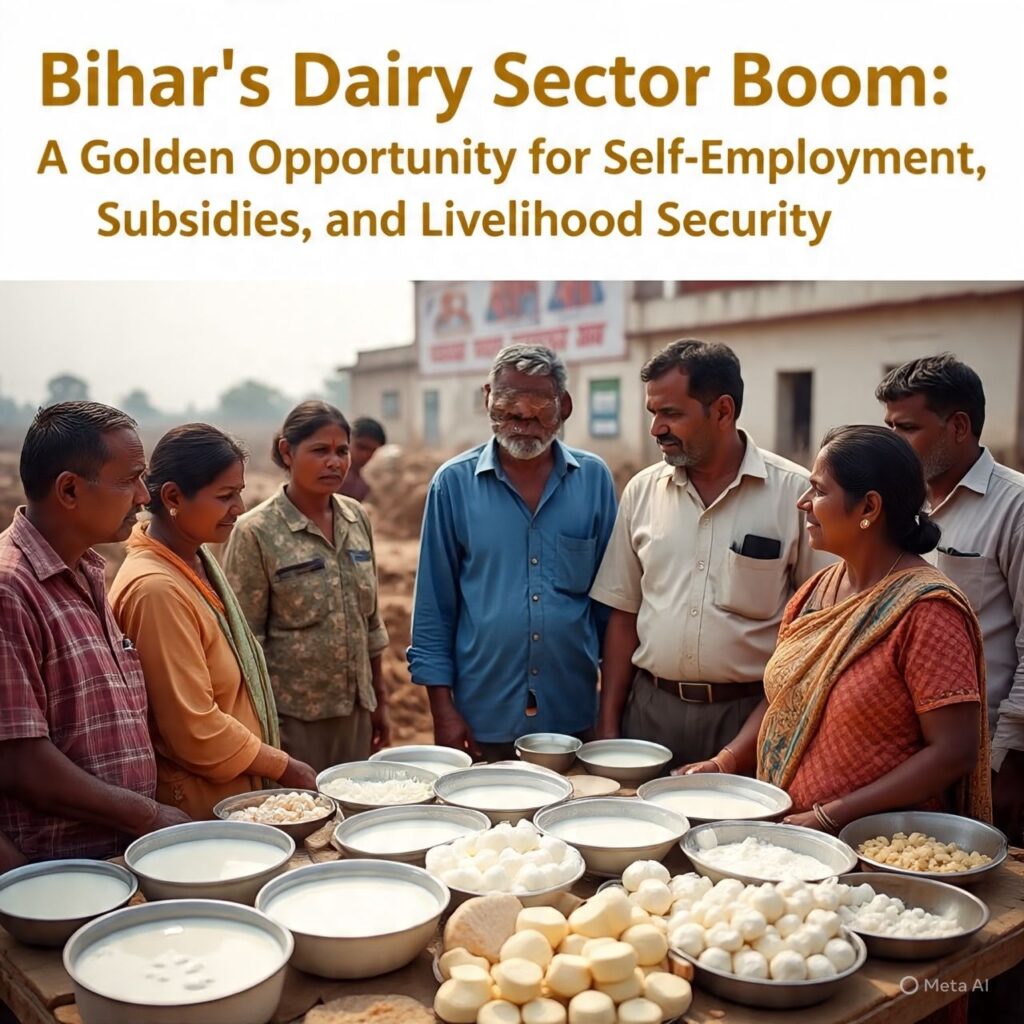
Bihar, a state traditionally rich in agriculture and livestock rearing, is charting a fresh path toward rural prosperity. In a country where millions still depend on agriculture for their livelihood, dairy farming stands out as a steady source of income for small and marginal farmers. Recognizing this, the Bihar government has rolled out three major dairy-focused schemes to boost milk production, empower unemployed youth, and transform the livestock economy at the grassroots.
Through the Desi Cow Rearing Promotion Scheme, the Comprehensive Buffalo Rearing Scheme, and the Integrated Bovine Development Scheme, the state is offering substantial subsidies — ranging from 50% to 75% — along with easy credit to establish modern dairy units. This initiative is not only designed to create sustainable self-employment but also to enhance the state’s milk output, bridging the demand-supply gap and boosting the rural economy.
Let’s explore how these schemes work, who they benefit, and why this could be a game changer for Bihar’s farmers and young entrepreneurs.
Why Dairy Farming Matters in Bihar
Livestock is an inseparable part of rural life in Bihar. A large percentage of the population in villages already keeps cows or buffaloes for milk. However, most farmers practice traditional methods, keeping only one or two animals and lacking modern knowledge of dairy management.
This means low milk yields, poor animal health, and limited income. The state’s new push aims to change this by encouraging organized dairy farming with improved breeds, better fodder management, scientific rearing, and assured marketing.
By giving financial support and modern training, the government wants to convert small farmers into small dairy entrepreneurs. Not only does this create jobs but it also helps meet the ever-growing demand for milk and milk products in both rural and urban Bihar.
An Overview of Bihar’s Three Major Dairy Schemes
1. Desi Cow Rearing Promotion Scheme
This scheme specifically promotes indigenous cow breeds known for good quality milk and better adaptability to local climate conditions.
Under this scheme:
- Farmers can set up dairy units with two or four high-yielding indigenous cows or heifers.
- For a two-cow unit, the estimated cost is ₹1.74 lakh.
- For a four-cow unit, the estimated cost is ₹3.90 lakh.
- Extremely backward classes (EBC) and Scheduled Castes/Scheduled Tribes (SC/ST) get a subsidy of 75% of the total cost.
- Other beneficiaries get a 50% subsidy.
Through this scheme, the government hopes to preserve local cow breeds while boosting the income of marginalized communities.
2. Comprehensive Buffalo Rearing Scheme
Buffaloes are a backbone of India’s dairy industry. Their milk has high fat content, which fetches a better price in the market. Bihar’s Comprehensive Buffalo Rearing Scheme focuses on this potential.
Under this scheme:
- Farmers can buy one or two advanced breed buffaloes.
- For one buffalo, the estimated cost is ₹1.21 lakh.
- For two buffaloes, it is ₹2.42 lakh.
- SC/ST farmers get up to 75% subsidy, while other groups get up to 50%.
- This means, for SC/ST farmers, the subsidy amounts to ₹90,750 for one buffalo and ₹1,81,500 for two buffaloes.
- For other categories, it is ₹60,500 and ₹1,21,000 respectively.
This financial aid significantly lowers the upfront cost, encouraging farmers to expand their herds and run profitable small-scale dairies.
3. Integrated Bovine Development Scheme
This broader scheme covers more extensive dairy units, offering support for not just cows or buffaloes but for larger, more commercial setups.
Farmers can establish dairy units with:
- 2 animals: Cost estimated at ₹1.74 lakh
- 4 animals: Cost estimated at ₹3.90 lakh
- 15 animals: Cost estimated at ₹15.34 lakh
- 20 animals: Cost estimated at ₹20.22 lakh
Subsidy structure:
- EBC and SC/ST groups get 75% subsidy for 2 or 4 animal units.
- Other categories get 50% subsidy for the same.
- For larger units (15 and 20 animals), all categories receive 40% subsidy.
This tiered structure allows small farmers to start with manageable herd sizes and expand gradually.
Online Applications Make It Simple
One of the standout features of these schemes is the simplified, fully online application process. Interested beneficiaries can apply on the dedicated state portal dairy.bihar.gov.in. The deadline for applications is July 25, 2025, giving farmers and rural youth ample time to gather documents and plan their dairy venture.
By going digital, the government has removed layers of bureaucracy and middlemen, ensuring that the real benefits reach the grassroots quickly.
Who Can Apply?
These schemes are open to:
- Small and marginal farmers
- Rural youth seeking self-employment
- Women’s self-help groups (SHGs)
- Dairy cooperatives
- Entrepreneurs with interest in livestock farming
The focus on SC/ST and EBC groups shows the government’s intent to uplift socially and economically weaker sections through inclusive growth.
Why Subsidies Matter So Much
Establishing a dairy unit is capital-intensive. Costs include:
- Purchasing high-quality animals
- Building sheds
- Arranging fodder and feed
- Hiring labor
- Veterinary care
- Equipment like milking machines, chaff cutters, and storage tanks
Without subsidies, most small farmers cannot afford these upfront costs. The generous subsidy component — covering up to three-fourths of the cost for weaker sections — makes modern dairy farming accessible for thousands who would otherwise remain stuck in subsistence-level livestock rearing.
Current Response: Thousands Already Onboard
The response so far is promising.
As of now:
- Under the Desi Cow Rearing Scheme, 1,999 applications have been received for two- and four-cow units.
- The Integrated Bovine Development Scheme has seen 3,389 applications so far, covering two, four, fifteen, and twenty-cattle units.
- The Comprehensive Buffalo Rearing Scheme has attracted 933 applications, with most farmers opting for two buffaloes.
- Importantly, out of the total 6,321 applications received so far, 2,238 have come from women — a significant sign that women in Bihar see dairy as a viable source of livelihood and empowerment.
How This Will Impact Rural Bihar
The ripple effect of these schemes can be transformational:
- Boost to Milk Production: With better breeds and scientific management, milk yields will rise, helping meet the rising demand in urban markets.
- Stable Rural Income: Dairy farming provides daily income through milk sales — a steady revenue stream compared to seasonal crops.
- Women Empowerment: Women traditionally handle milking and cattle care. Subsidies and SHG participation help women control assets and income.
- Employment Creation: As dairy units grow, they create jobs for animal caretakers, veterinary services, transporters, and local fodder suppliers.
- Value-Added Opportunities: Better dairy units open doors for processing — like paneer, ghee, curd, or flavored milk — creating rural micro-enterprises.
Why the Focus on Indigenous Breeds?
India’s native cattle are naturally hardy, disease-resistant, and well-adapted to local conditions. However, their milk yield is lower compared to exotic breeds. With selective breeding, proper nutrition, and better animal husbandry practices, native breeds can deliver respectable yields while preserving biodiversity and traditional knowledge.
The Desi Cow Rearing Scheme aligns with this goal. It promotes indigenous cattle while boosting farmers’ incomes and reducing dependence on imported breeds.
Challenges That Remain
While the schemes are promising, a few practical challenges need attention:
- Fodder Shortage: Availability of green fodder year-round is a concern. Promoting silage and fodder banks will be critical.
- Veterinary Infrastructure: Farmers need accessible veterinary care, vaccination, and breeding services.
- Cold Chain and Market Linkages: Milk needs efficient collection, chilling, and marketing to prevent spoilage.
- Financial Literacy: Many rural families still hesitate to take loans. Awareness and handholding are vital.
A Path Towards Atmanirbhar Bihar
By focusing on dairy, Bihar is pushing ahead with India’s broader vision of Atmanirbhar Bharat (self-reliant India). As the schemes mature, the state could emerge as a major dairy hub in Eastern India, supplying fresh milk and value-added products to nearby states.
This, combined with digital integration through online applications, direct benefit transfers, and modern cooperatives, means the next few years could see a wave of rural entrepreneurship.
The Road Ahead
To truly unlock the dairy sector’s potential, collaboration will be key:
- Public-private partnerships can modernize chilling plants and processing units.
- Farmer Producer Organizations (FPOs) can help small farmers aggregate milk for better bargaining power.
- Skill development for youth can create trained para-veterinarians, AI technicians, and dairy managers in villages.
- Linking with GI branding for indigenous dairy products can open export opportunities.
Conclusion
Bihar’s three dairy schemes — the Desi Cow Rearing Promotion Scheme, Comprehensive Buffalo Rearing Scheme, and Integrated Bovine Development Scheme — stand as shining examples of how targeted policies can empower farmers, uplift communities, and build resilient rural economies.
For thousands of young people and women, these schemes are more than subsidies — they are a doorway to dignity, financial security, and self-reliance. The state has laid the foundation; it is now up to farmers, cooperatives, and supporting institutions to harness this opportunity and build a prosperous dairy revolution in Bihar.


 By












