

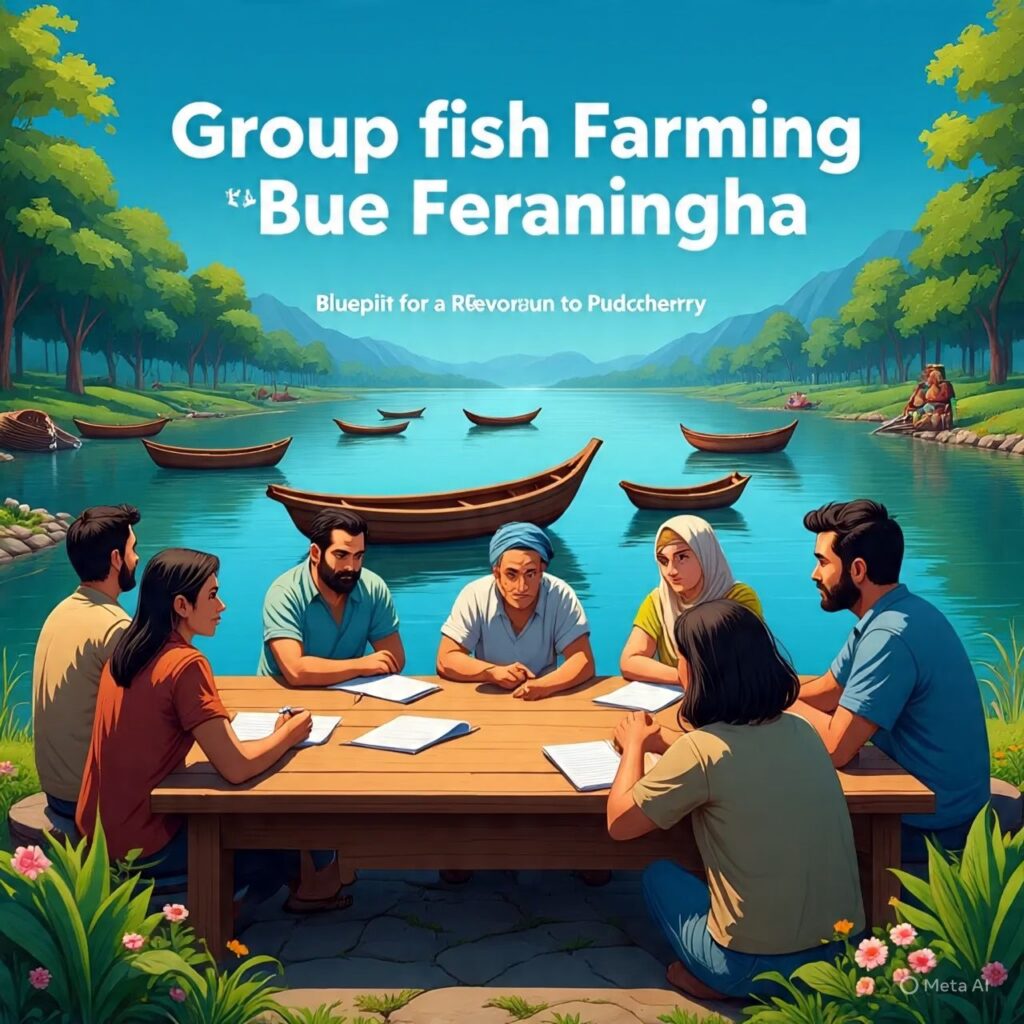
India’s vast landscape, dotted with rivers, lakes, wetlands, and an extensive coastline, has always held enormous potential for aquaculture. Over the past few years, this potential has started turning into a reality, thanks to the government’s concerted efforts to promote fish farming as a cornerstone of rural livelihoods and economic growth.
Recently, Union Ministers Prof. S.P. Singh Baghel and Rajeev Ranjan Singh laid out ambitious plans to strengthen India’s position as a global leader in fish production — a strategy that aligns with the vision of the Blue Revolution. Their roadmap promises to uplift millions of fishermen and fish farmers through group-based fish farming, technological innovation, and dedicated investment.
This article takes you through India’s evolving fish farming landscape, the government’s latest push for Group Fish Farming, and what this means for local communities from the icy streams of Ladakh to the coastal harbours of Puducherry.
Fish Farming: The Unsung Hero of Rural Livelihoods
Fish farming, or aquaculture, is not new to India. Traditional pond culture, river fishing, and coastal fisheries have sustained communities for generations. However, organized fish farming as a commercial activity has gained momentum only in recent decades.
Today, India ranks second globally in fish production, thanks to the hard work of its three crore fishermen and fish farmers. According to Rajeev Ranjan Singh, about 75% of this production now comes from inland fisheries — a remarkable statistic that highlights the importance of rivers, ponds, wetlands, and reservoirs.
Yet, India’s aquaculture story is not just about feeding the population. It is about doubling farmers’ income, diversifying rural livelihoods, and tapping into the huge global demand for quality seafood.
The Role of Innovation and Technology
Prof. S.P. Singh Baghel, Minister of State for Fisheries, Animal Husbandry, and Dairying, recently underlined the pivotal role of technology in transforming fish farming in India. The Indian Council of Agricultural Research (ICAR) has pioneered innovations and high-tech solutions that have helped boost both production and productivity.
Breakthroughs in seed quality, disease management, feed formulation, and water resource management have opened doors for fish farmers to maximize yields sustainably. More efficient breeding and hatchery techniques now ensure the year-round availability of fish seed, a major factor behind rising production numbers.
The PM Matsya Sampada Yojana: India’s Flagship Fisheries Scheme
Central to the government’s plan is the Pradhan Mantri Matsya Sampada Yojana (PMMSY) — a flagship scheme with a budget of ₹38,572 crore. This program is designed to strengthen infrastructure, support modern practices, and encourage entrepreneurship in the fisheries sector.
Speaking at the National Fish Farmers Day event in Bhubaneswar, Odisha, Minister Rajeev Ranjan Singh highlighted how PMMSY is driving transformational change. Under this scheme, new clusters and group fish farming initiatives are being launched to bring modern practices to even the remotest parts of the country.
The latest addition is the announcement of 17 new fish farming clusters, taking the total number of group-based aquaculture units in India to 34.
What Is Group Fish Farming?
Group Fish Farming, or community-based aquaculture, is a model where small and marginal fish farmers come together to farm fish collectively. This approach offers multiple benefits:
✅ Shared resources like ponds, tanks, or cages reduce individual investment burdens.
✅ Collective bargaining helps secure better prices for inputs like seed and feed.
✅ Group marketing ensures better deals with buyers, processors, and exporters.
✅ Training and extension services become more effective when delivered to organized groups.
✅ Groups can access government subsidies, insurance, and credit facilities more easily.
The New 17 Fish Farming Clusters: State-Wise Focus
The expansion of group-based aquaculture is not a one-size-fits-all plan. The government has identified clusters suited to each region’s unique ecological and economic conditions.
Here’s a snapshot of what the new clusters will focus on:
- Punjab & Rajasthan: Saline water aquaculture, turning otherwise unproductive salt-affected lands into fish farms.
- Uttarakhand, Himachal Pradesh & Ladakh: Cold water fish farming, leveraging the pristine mountain streams for trout and other high-value cold-water species.
- West Bengal: Dry fish clusters to promote value addition and processing for both domestic and export markets.
- Puducherry: Development of a modern fishing harbor to improve coastal catch and boost local livelihoods.
- Nagaland: Integrated fish farming combining aquaculture with agriculture or livestock, optimizing land use.
- Manipur: Pengba fish clusters focusing on indigenous, high-demand species.
- Assam: Riverine fish clusters utilizing the vast Brahmaputra network.
- Mizoram: Paddy-cum-fish farming, a traditional practice that optimizes water and land.
- Arunachal Pradesh: Aqua-tourism clusters to link fish farming with eco-tourism.
- Goa: Estuarine cage farming for high-value brackish water species.
- Tripura: Pabda fish clusters targeting premium indigenous species.
- Maharashtra: Fish cooperative clusters promoting collective marketing.
- Meghalaya: Organic fish clusters tapping into the rising demand for chemical-free, naturally reared fish.
Where Group Fish Farming Already Thrives
While these 17 new clusters are being added, India already has vibrant examples of group aquaculture:
- Hazaribagh, Jharkhand: Pearl farming clusters adding value beyond just fish production.
- Lakshadweep: Marine seaweed farming supporting both local livelihoods and the cosmetics/pharma industry.
- Madurai, Tamil Nadu: Ornamental fish breeding for domestic and export markets.
- Madhya Pradesh: Reservoir fisheries tapping into vast inland water bodies.
- Gujarat: Fishing harbors boosting marine catches and export.
- Sirsa, Haryana: Saline water aquaculture turning saline wastelands productive.
- Jammu & Kashmir: Trout farming in cold mountain waters.
- Karnataka: Marine cage farming off the coast.
- Andhra Pradesh: Brackish water aquaculture — shrimp and finfish both.
- Andaman & Nicobar Islands: Tuna fishing clusters.
- Chhattisgarh: Tilapia clusters for affordable protein supply.
- Sikkim: Organic fish farming leveraging clean mountain waters.
- Bihar: Wetland fisheries maximizing underutilized floodplains.
- Telangana: Murrel fish clusters promoting high-value indigenous species.
- Kerala: Pearl spot clusters, a delicacy in local cuisine.
- Odisha: Scampi clusters targeting export markets.
- Uttar Pradesh: Pangasius clusters for affordable table fish.
How Does Group Farming Benefit Fish Farmers?
India’s fisheries sector is dominated by small-scale operators. Many lack the capital or scale to invest in modern technology, seed quality, feed, and disease management on their own.
By organizing into groups, fish farmers gain:
- Lower production costs: Bulk buying of inputs.
- Better market access: Collective bargaining power.
- Improved risk management: Shared resources reduce individual risk.
- Insurance coverage: Group insurance plans are more accessible.
- Training and tech support: Easier to reach organized clusters.
The government’s push for clusters also makes it easier to provide cold storage, processing units, transport facilities, and linkages to domestic and international markets.
A Vision for Doubling Farmers’ Income
One of India’s big promises under the Blue Revolution is that fish farming will help double farmers’ income. With limited cultivable land and growing rural unemployment, aquaculture provides an excellent alternative.
Fish production is far more water-efficient than other animal protein sources like poultry or livestock. Moreover, with global demand for fish expected to rise continuously, India has an export opportunity waiting to be tapped.
Currently, India’s marine exports include shrimp, tuna, mackerel, and cuttlefish, among others. By strengthening inland and brackish water aquaculture, India can diversify its export basket with species like tilapia, scampi, pangasius, ornamental fish, and more.
Challenges Ahead
Despite its potential, India’s fish farming sector faces hurdles:
✅ Many fish farmers still rely on outdated methods.
✅ Access to quality seed, feed, and veterinary services remains inconsistent.
✅ Market linkages and cold chain facilities are underdeveloped in interior regions.
✅ Disease outbreaks can wipe out entire harvests.
✅ Climate change threatens fragile coastal and inland ecosystems.
To address these, the government’s approach combines training, infrastructure development, access to finance, and modern research.
The Role of Insurance and Financial Schemes
One vital part of the fishery plan is encouraging farmers to use insurance schemes. Fish farming is prone to risks like floods, diseases, and market fluctuations. Group insurance can protect incomes when unforeseen events strike.
PMMSY and other schemes also provide subsidies for hatcheries, feed mills, cold storages, processing plants, and export facilities. Credit schemes ensure that farmers get affordable loans to modernize their ponds or adopt cage farming.
Fish Farming’s Impact on Nutrition and Economy
India’s push for fish farming is not just about exports or rural jobs. It is also about nutrition security. Fish is a rich source of protein and omega-3 fatty acids — nutrients crucial for tackling hidden hunger and malnutrition.
Affordable, locally produced fish can improve diets for millions in both rural and urban areas. As India’s population grows and land for crops shrinks, fish farming can bridge the protein gap sustainably.
Looking Ahead: The Road to a True Blue Revolution
From the icy waters of Ladakh to the warm lagoons of Puducherry, India’s vision for Group Fish Farming is ambitious and inclusive. By supporting small farmers with technology, finance, insurance, and market access, the government aims to transform aquaculture into a robust pillar of rural prosperity.
If the new clusters succeed, they could become role models for other states and even other sectors. Just like farmers once grouped to form dairy co-operatives, fish farmers organizing into groups could unlock scale, efficiency, and resilience.
Conclusion: India’s Fisherfolk at the Centre of Change
India’s fisherfolk have always been among the hardest-working yet most overlooked communities. With focused investments, smart policies, and collective action, they now stand at the heart of the next agricultural revolution — a Blue Revolution that promises better incomes, food security, and a brighter future for millions.
As new clusters come up in Punjab, Rajasthan, Ladakh, Puducherry, and beyond, India is sending a clear signal: fish farming is not just a side activity — it is a strategic sector with the power to transform rural India.


 By












