

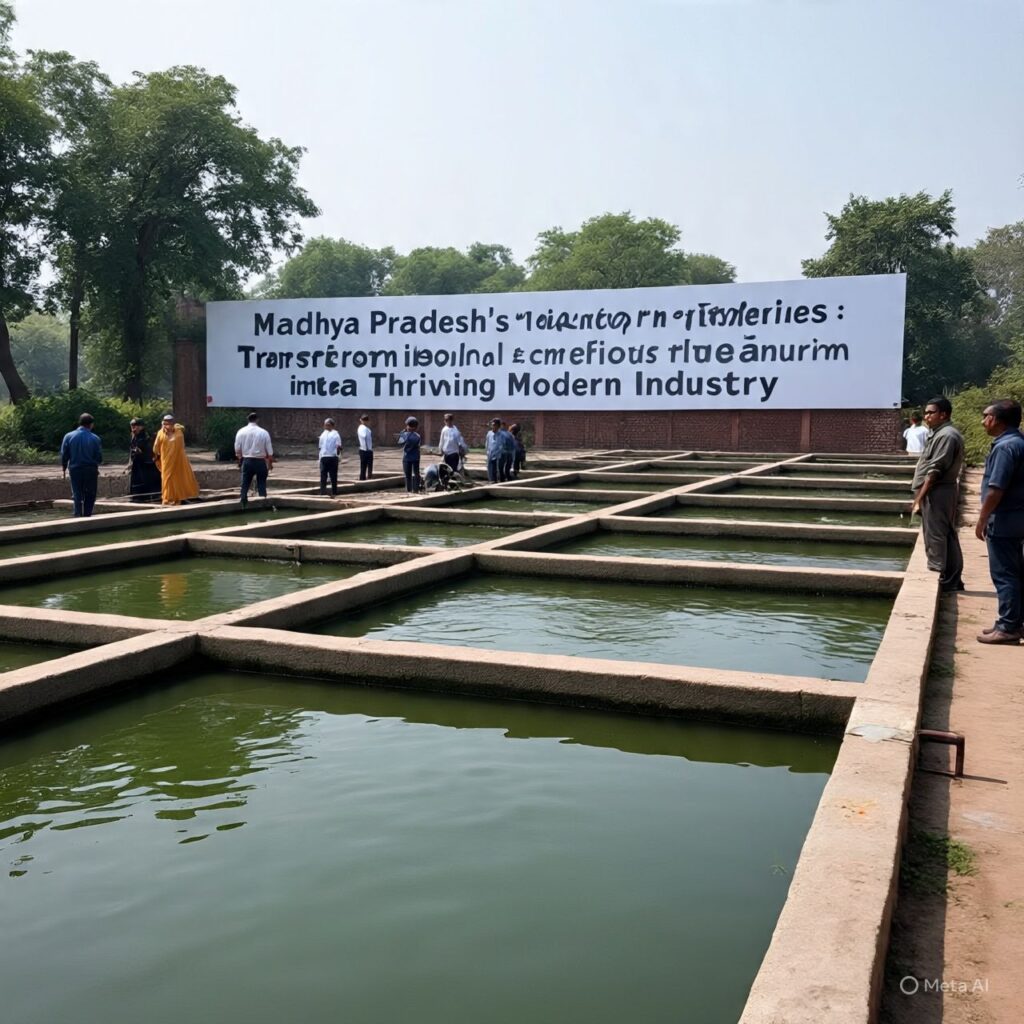
Madhya Pradesh, a state located in the heart of India, is rewriting its growth story in the fisheries sector under the visionary leadership of Chief Minister Dr. Mohan Yadav. Traditionally, the state has focused on agriculture as a major livelihood source, but in recent years, fisheries have emerged as a promising alternative for boosting rural incomes and generating self-employment.
Recognizing this huge potential, the Madhya Pradesh government has launched a series of ambitious schemes and reforms to uplift the fishing community, modernize fish production, and give fish farming the status of a recognized industry. From building world-class aqua parks to promoting smart fish parlours and providing motorbikes with ice boxes to fishers, the state is setting an example for others to follow.
This article explores in detail the new initiatives, benefits for fish farmers, the government’s future vision, and how these steps can transform the fisheries sector into an engine of rural prosperity.
Why Fish Farming Matters
Fisheries have traditionally played an important supplementary role in rural livelihoods, especially for landless families and marginalized communities. However, this sector has often remained neglected compared to mainstream agriculture.
By declaring fish farming as an industry, the Madhya Pradesh government has paved the way for organized investments, better infrastructure, and a more structured approach to marketing and processing. This not only increases production but also creates jobs, boosts exports, and helps the state achieve self-reliance in fish seed production.
Fish Farming Gets Industrial Status
One of the biggest announcements made by Chief Minister Dr. Mohan Yadav is giving fish farming the official status of an ‘industry’. This move has far-reaching implications. Just like other industries, fish farmers will now be entitled to various government incentives, subsidies, easier loans, and support for marketing their produce.
Industrial recognition also means that fish farming will attract private investments, technology infusion, and new startups. With organized fish hatcheries, processing units, and modern fish markets, the sector can unlock its true potential.
World-Class Aqua Park and Modern Hatcheries
To strengthen the backbone of fish production, the government is constructing a state-of-the-art Aqua Park in Bhopal with an estimated budget of ₹40 crore. This park will serve as a hub for modern fish farming techniques, training, research, and demonstration.
In addition, an advanced fish seed hatchery is being built with an investment of ₹217 crore. This facility will drastically reduce Madhya Pradesh’s dependence on states like West Bengal for fish seed. Local production of high-quality fish seeds will make the sector self-reliant and ensure timely availability for fish farmers across the state.
Cage Culture in Indira Sagar Dam
In another pathbreaking step, the government has initiated a massive cage culture project in the Indira Sagar Dam. With an investment of ₹92 crore, a total of 3,360 cages will be installed in the reservoir.
Cage fish farming allows high-density fish production in open water bodies without needing large land areas. This not only boosts fish output but also provides employment to thousands of fishers living around the reservoir. By utilizing existing water resources optimally, Madhya Pradesh is unlocking new avenues for fish production.
Smart Fish Parlours: Modern Retail for Fresh Fish
Traditionally, fish sales in India have been unorganized, with poor hygiene and lack of cold chain storage. To change this, the state government has launched 453 Smart Fish Parlours at a cost of ₹22.65 crore.
These parlours are modern retail outlets where fish can be sold in clean, hygienic, and appealing conditions. They help fish farmers earn better prices, attract more consumers, and expand the domestic market for fish.
Motorbikes with Ice Boxes: Preserving Freshness
Transporting fresh fish quickly to markets is crucial for preserving quality and maximizing income. Understanding this, the government has distributed 430 motorbikes fitted with ice boxes to fishers.
These specially equipped bikes enable fishers to cover longer distances and deliver fresh catch to markets without spoilage. This practical initiative reduces wastage and ensures better earnings for fish farmers.
Empowering Women in Fisheries
A remarkable aspect of Madhya Pradesh’s fisheries development plan is its focus on women’s participation. Out of over two lakh registered fish farmers in the state, a significant number are women.
By encouraging women to actively participate in fish farming, sales, and value addition, the government is boosting household incomes and promoting gender equality. Women-led fish cooperatives and self-help groups (SHGs) are being empowered to run Smart Fish Parlours, manage fish seed production, and handle processing units.
Encouraging Startups and Innovation
To modernize fish farming, the government is also pushing for the adoption of innovative technologies and startups in aquaculture. Fish farmers are being encouraged to use modern equipment like aerators, automatic feeders, biofloc systems, and Recirculatory Aquaculture Systems (RAS).
Young entrepreneurs with new business ideas in fish processing, branding, packaging, and export are being supported through training and credit facilities. This fresh wave of innovation is transforming fish farming from a traditional occupation to a high-tech industry.
Leveraging Irrigation Projects for Fish Production
Water is the lifeline of fish farming. To ensure the availability of water bodies for aquaculture, the state has expanded its irrigation network tremendously. Where irrigation used to cover about 7 lakh hectares, it has now reached 55 lakh hectares. The ambitious PKC (Parvati-Kalisindh-Chambal) project aims to expand it further to 100 lakh hectares.
This means more canals, reservoirs, and ponds will be available for fish production, directly benefiting fish farmers and increasing overall output.
Fisher Credit Card: Easy Finance for Fishers
Access to easy and affordable credit is critical for any industry’s growth. To help fish farmers meet working capital needs, the state has introduced the Fisher Credit Card.
Through this card, fishers can get loans to buy fish seed, feed, equipment, or even expand operations without financial hurdles. Flexible repayment terms make it easier for small fishers to grow their businesses sustainably.
Fisher Welfare Board: Ensuring Inclusive Growth
To implement and monitor all welfare measures effectively, the state has established a dedicated Fisher Welfare Board. This board addresses the needs of the fishing community, provides social security, and runs special welfare programs to uplift marginalized fishers.
At a state-level Nishadraj Sammelan held in Ujjain, Chief Minister Dr. Mohan Yadav highlighted the immense contribution of the fishing community, drawing inspiration from Maharaj Nishadraj, the revered figure who supported Lord Ram. The CM praised the dedication of the fishing community in serving society and the state’s economy.
Beyond Fish Farming: Vision for 2028
The government’s efforts are not limited to today’s schemes alone. A clear roadmap is in place to bring the fishing community into the mainstream economy by 2028. Alongside expansion plans, the government is driving campaigns to promote de-addiction and discourage wasteful spending among fishers to help them build stable livelihoods.
The ultimate aim is to make Madhya Pradesh the top fish-producing state in India. Through constant policy innovation, investments in infrastructure, and grassroots empowerment, the state is moving confidently towards this goal.
The Road Ahead: Building a Resilient Fish Economy
The transformation of the fisheries sector in Madhya Pradesh is not just about increasing production. It is about building a resilient ecosystem where fish farmers are equipped with knowledge, tools, infrastructure, and market linkages to thrive.
Key areas for future focus include:
- Strengthening Cold Chain Infrastructure: More ice plants, cold storages, and refrigerated transport to reduce post-harvest losses.
- Developing Export Markets: Branding and certification of MP fish products can unlock export opportunities.
- Value Addition: Encouraging processing into ready-to-cook, ready-to-eat products like fillets, pickles, or dried fish for higher profits.
- Skill Development: Training fishers in best aquaculture practices, disease management, and financial literacy.
- Sustainability: Promoting responsible fishing to conserve aquatic biodiversity and maintain water quality.
Conclusion: A Bright Future for MP’s Fish Farmers
Chief Minister Dr. Mohan Yadav’s bold initiatives are setting new benchmarks for how a state can elevate an entire community and unlock the economic power of fisheries. By integrating modern technology, financial support, women’s empowerment, and industrial status, Madhya Pradesh is showing how fish farming can go beyond being just an occupation to become a robust industry.
The journey ahead demands continued collaboration among fishers, government departments, private investors, startups, and research institutions. If implemented well, the fisheries revolution in Madhya Pradesh can serve as a model for other states aiming to empower their fishing communities.
With the right mix of policy, technology, and people’s participation, the day is not far when Madhya Pradesh will proudly lead India in fish production — creating thousands of jobs, driving exports, and bringing prosperity to its lakes, rivers, and reservoirs.


 By












