scientists, and livestock farmers to discuss strategies for strengthening indigenous breed development and genetic improvement in the livestock sector.
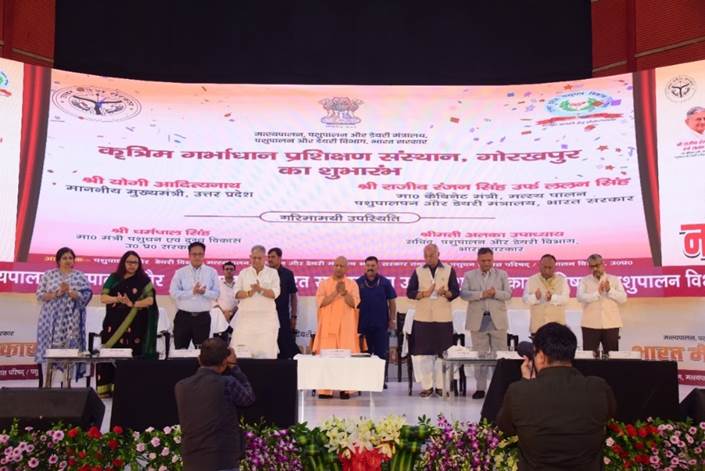
The event was chaired by Union Minister for Fisheries, Animal Husbandry & Dairying and Panchayati Raj, Shri Rajiv Ranjan Singh (Lalan Singh), with Uttar Pradesh Chief Minister Yogi Adityanath attending as the Chief Guest. Also present were Uttar Pradesh Animal Husbandry Minister Shri Dharmpal Singh and Arunachal Pradesh Animal Husbandry Minister Shri Gabriel D. Wangsu.
The workshop witnessed participation from over 700 livestock farmers, veterinarians, and senior government officials from across India. It aimed to chart a strategic path for improving the quality, productivity, and conservation of India’s indigenous livestock breeds using modern technologies.
During his keynote address, Union Minister Rajiv Ranjan Singh emphasized the critical need to improve milk productivity and livestock quality. “This workshop is a significant step in promoting advanced technologies such as In-Vitro Fertilization (IVF) and Sex Sorted Semen (SSS) in the livestock sector. These tools can revolutionize breed improvement and enhance farmers’ incomes,” he said. He also commended the role of MAITRIs (Multipurpose Artificial Insemination Technicians in Rural India) in delivering AI technology directly to farmers.
Highlighting government efforts to control and eradicate Foot and Mouth Disease (FMD), the Minister reaffirmed the Centre’s commitment to ensuring livestock health and sustainability in dairy development.
Chief Minister Yogi Adityanath praised the Centre for choosing Uttar Pradesh as the venue for this crucial workshop. He reiterated the State’s dedication to making its livestock population FMD-free and promoting breed improvement through sustainable and hygienic animal husbandry practices. “Climate, hygiene, and proper care are essential factors in enhancing livestock productivity,” he said. He also spotlighted the success of women-led milk unions in Jhansi and the Go-Seva Aayog’s work in breed development.
The event also featured the inauguration of the Artificial Insemination Training Institute in Gorakhpur and three key projects under the Animal Husbandry Infrastructure Development Fund (AHIDF):
- Gyandhara Industries Pvt. Ltd, Amethi
- Shri Chanchala Foods India Pvt. Ltd, Bareilly
- Brijwasi Keshav Milk Product, Mathura
Additionally, the launch of the Framework for the Establishment of Breeders Associations was announced, aimed at strengthening organized breeder networks and ensuring breed conservation nationwide.
Smt. Alka Upadhyaya, Secretary, Department of Animal Husbandry and Dairying (DAHD), Government of India, outlined a long-term strategy focused on productivity, regional planning, and technological advancements aligned with Sustainable Development Goals (SDGs).
The workshop included two high-level panel discussions moderated by Ms. Varsha Joshi, Additional Secretary, DAHD, and Dr. Abhijit Mitra, Animal Husbandry Commissioner. The sessions featured in-depth deliberations on breed selection, performance recording, and application of reproductive technologies to advance India’s livestock sector.
In conclusion, the workshop marked a pivotal move toward aligning India’s breed development strategies with global best practices, ensuring sustainability, improved productivity, and better livelihoods for livestock farmers across the country.

 By