

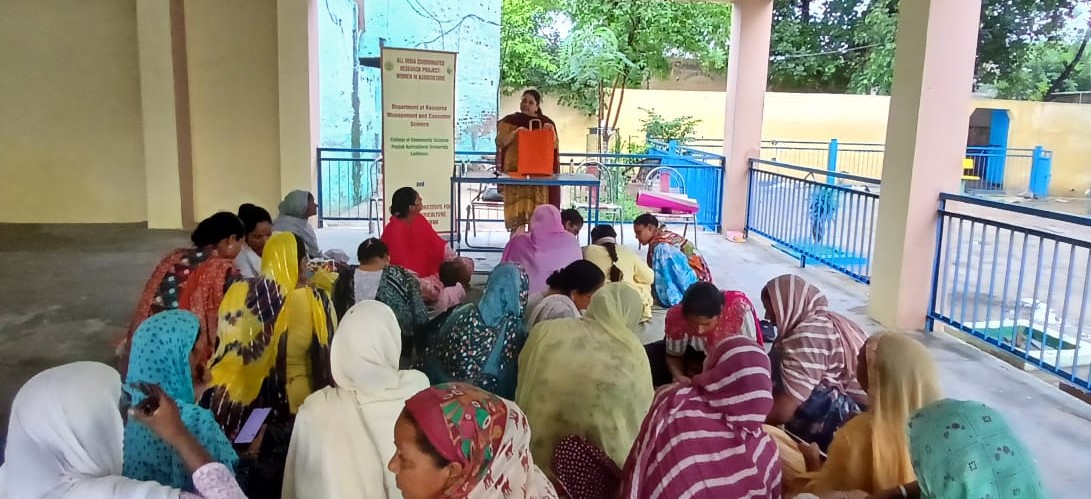
Recognizing the growing potential of agro-processing and value addition in enhancing rural income and livelihoods, the Skill Development Centre of Punjab Agricultural University (PAU) organized a five-day training programme titled “Setting up of Agribusiness.” The initiative aimed at empowering farmers and rural women with practical knowledge and skills to establish agro-processing complexes (APCs) and diversify income sources beyond traditional farming.
The training was conducted in collaboration with the Department of Processing and Food Engineering, PAU, and saw active participation from 45 farmers and rural women. The programme was held under the guidance of Dr MS Bhullar, Director of Extension Education, PAU.
Highlighting the need for innovation in agriculture, Dr Rupinder Kaur, Associate Director (Skill Development), emphasized that it is essential to expand farmers’ vision beyond primary agriculture to ensure a sustainable and resilient rural economy. “Revitalizing farming requires adopting agro-based enterprises that can add value and generate additional income for farm families,” she said.
Course Coordinator Dr Kulvir Kaur underscored the economic significance of agro-processing, noting that value-added food products contribute substantially to rural employment and entrepreneurship. She called for greater adoption of food processing techniques to help farmers realize better returns on their produce.
During the training sessions, PAU experts including Dr MS Alam, Dr Preetinder Kaur, Dr Gurveer Kaur, Dr Satish Kumar Gupta, Dr Gurnaz Singh Gill, Dr Maninder Kaur, Dr Manpreet Kaur Saini, Dr Satish Kumar, Dr Rohit Sharma, Dr Gagandeep Kaur Sidhu, Dr Khushdeep Dharni, Dr Devinder Tiwari, and Dr Prerna Kapila shared detailed insights into the setup and operation of agro-processing units. They explained the use of various machines for milling, processing, grinding, packaging, and labelling of agricultural produce such as wheat, rice, pulses, oilseeds, honey, and jaggery-based products. The experts also highlighted the profitability of such units and the scope for scaling them into successful rural enterprises.
In a dedicated session, Dr Manmeet Manav, Incharge of the AGMARK Laboratory, discussed the importance of food certification and standardization, while Dr Chandan Thakur from Indian Bank guided participants on accessing financial assistance, loans, and government subsidies for setting up agro-processing ventures.
To offer hands-on exposure, the trainees were taken for a field visit to the Agro-Processing Complex at Lakhowal. The visit, coordinated by Dr Preeti and Dr Kirandeep, allowed participants to observe practical operations, machinery in use, and the business model behind a functioning APC.
The programme concluded with a vote of thanks delivered by Mrs Kanwaljit Kaur, who appreciated the participants’ active involvement and the experts’ efforts in promoting agro-entrepreneurship.
With such targeted initiatives, PAU continues to play a key role in rural capacity-building, encouraging farm families to adopt value-added practices that not only boost income but also contribute to the long-term sustainability of agriculture in Punjab.


 By












