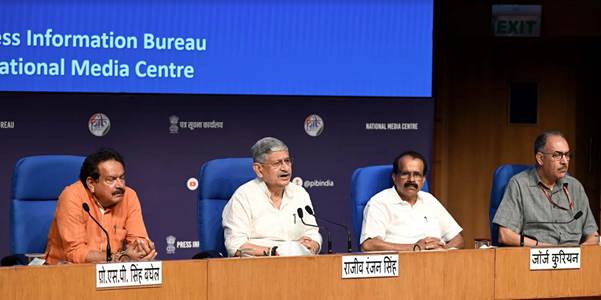
Union Minister of Fisheries, Animal Husbandry, and Dairying, Rajeev Ranjan Singh, addressed the high-level ministerial session at the Second Global Conference on Sustainable Livestock Transformation organized by the Food and Agriculture Organization (FAO) in Rome. During his address, he highlighted India’s farmer-focused livestock policies, innovations, and sustainability initiatives, while emphasizing global collaboration and policy space for nations.
Expressing gratitude to FAO and its Director-General Dr. QU Dongyu, Minister Singh noted that India takes pride in being elected as the first Vice-Chair of FAO’s new Sub-Committee on Livestock. He stated that under the visionary leadership of Prime Minister Narendra Modi, India has launched several transformative initiatives aimed at food security, improved nutrition, rural livelihoods, and poverty eradication.
According to the World Bank 2025 report, India’s welfare programs have helped 269 million people rise above extreme poverty, reducing the poverty rate from 27.1% to 5.3%. Minister Singh underscored the central role of the livestock sector in this progress, noting that it provides sustainable livelihoods for nearly two-thirds of rural households and supports millions of small farmers, especially women.
He highlighted that India’s livestock sector has grown at a CAGR of 12.77%, contributing 31% to agricultural GVA and 5.5% to the national economy. India is today the world’s largest milk producer, contributing around 25% of global production (239 million tonnes). It is also the second-largest egg producer and a leading exporter of buffalo meat.
Minister Singh emphasized that these achievements are the result of people-centered policies, global partnerships, and the resilience of farmers. He highlighted India’s 80-year partnership with FAO and reiterated India’s commitment to sharing innovations with countries of the Global South. He also stressed that the Global Plan of Action for Sustainable Livestock Transformation should serve as a guiding framework rather than a prescriptive model, and called for gradual transitions supported by financial assistance, technology transfer, and capacity building.
Key Initiatives Presented by India at FAO Conference:
- Rashtriya Gokul Mission: Benefits over 92 million indigenous breed animals and supports 56 million farmers through conservation and genetic improvement.
- World’s Largest Animal Vaccination Program: Over 1.2 billion vaccines administered annually; India emerging as a global hub for vaccine production and export.
- National Digital Livestock Mission – India: Digital IDs for 353 million animals and 94 million farmers; facilitates traceability, disease detection, and safety.
- Livestock Infrastructure Development Fund: USD 3.5 billion to promote investment in dairy, feed plants, meat processing, and breeding.
- Maitri and e-Help Programs: Training local resource persons to provide reproductive services; empowering women in animal health services.
- One Health Approach: Recognizes interconnections between human, animal, and environmental health; promotes sustainable financing for transboundary diseases.
- Antimicrobial Resistance (AMR): India supports global commitments and has implemented a national action plan.
- Pandemic Preparedness: Strengthened animal health security with USD 25 million support from the G20 Pandemic Fund.
- Women-Led Dairy Sector: Women constitute 70% of India’s dairy workforce, symbolizing the White Revolution.
- International Day of Milk: Jointly proposed by India and Ireland and supported at the FAO conference.
Minister Singh concluded by reaffirming India’s commitment to making the livestock sector more sustainable, inclusive, and resilient. He called on all countries to prioritize policy autonomy, partnerships, and resource collaboration to build a fair and sustainable global agricultural system.

 By
By