

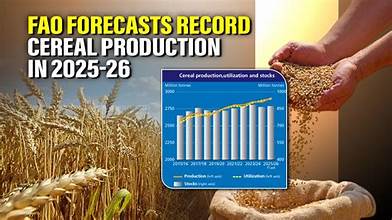
The Food and Agriculture Organization (FAO) has slightly raised its forecast for global cereal production for the 2025–26 season, projecting output to reach nearly 3.04 billion metric tons — the highest level ever recorded. The revised estimate reflects improved harvest expectations in several key producing regions, helping ease concerns over climate-related stress and supply uncertainties in global food markets.
According to the latest FAO assessment, stronger-than-expected crop conditions in parts of Asia, South America, and Eastern Europe contributed to the upward revision. Favorable rainfall, improved soil moisture, and expanded planting areas in several countries have supported better yield prospects for major cereals including wheat, maize, rice, and barley.
The improved outlook comes at a critical time for global agriculture, as climate change, geopolitical tensions, and rising production costs continue to create uncertainty in international food systems. Earlier concerns regarding prolonged droughts, heatwaves, and disrupted fertilizer supplies had raised fears of lower global grain production. However, recent weather improvements in some agricultural regions have partially offset those risks.
Maize production is expected to remain one of the key drivers of global cereal growth. Higher yields in countries such as Brazil, the United States, and Argentina are helping strengthen global feed grain supplies. In South America, favorable weather conditions during key crop development stages have improved productivity expectations after earlier dryness concerns.
Global wheat production is also forecast to remain stable despite weather-related challenges in certain parts of Europe and Central Asia. Improved crop conditions in Russia, Canada, and some Black Sea producing regions have supported the overall outlook. Meanwhile, rice production is expected to hit a new record due to expanded cultivation and improved monsoon forecasts across major Asian producers including India, Vietnam, and Thailand. (reuters.com)
FAO analysts noted that larger cereal supplies could help stabilize international food prices after months of volatility driven by energy market disruptions and geopolitical tensions. Increased grain availability may also improve global stock levels and strengthen food security in import-dependent countries.
Despite the optimistic production forecast, experts warn that significant risks remain. Extreme weather events linked to climate change continue to threaten agricultural systems worldwide. Heatwaves, irregular rainfall patterns, floods, and droughts could still affect crop development during the remaining growing season. Agricultural economists caution that weather conditions during harvesting periods will play a crucial role in determining final production outcomes.
Another major concern is the ongoing disruption in fertilizer and energy markets caused by geopolitical conflicts, particularly in the Middle East. Rising input costs could limit fertilizer use in some developing countries, potentially affecting yields during future planting cycles.
The FAO also emphasized that while global cereal production may reach record levels, food access and affordability remain uneven across many regions. Several low-income countries continue to face food insecurity due to inflation, conflict, and economic instability. International organizations are urging governments to strengthen agricultural resilience and invest in climate-smart farming practices to sustain long-term food production.
Industry experts believe the record cereal forecast offers temporary relief for global food markets, but they stress that maintaining stable production in the future will require continued adaptation to climate challenges, improved trade cooperation, and stronger support for farmers facing rising environmental and economic pressures.


 By
By











