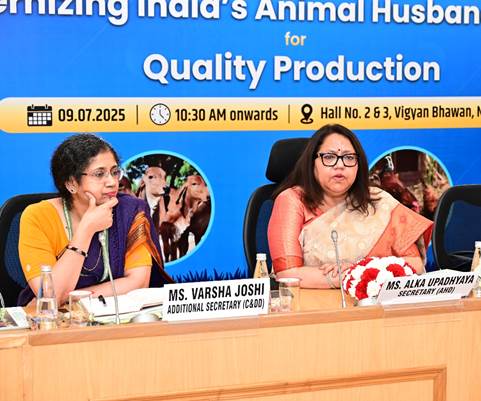
The Department of Animal Husbandry and Dairying (DAHD), under the Ministry of Fisheries, Animal Husbandry and Dairying, Government of India, organized a national-level workshop at Vigyan Bhawan, New Delhi on the theme “Modernization and Quality Production in India’s Livestock Sector.” The event was part of the six departmental meetings being held under the Fourth National Conference of Chief Secretaries and emphasized the theme: “Transforming Agriculture, Horticulture, Dairy, Fisheries and Processing through Technology and Innovation.”
The workshop was chaired by Ms. Alka Upadhyaya, Secretary, Department of Animal Husbandry and Dairying, and witnessed participation from key stakeholders including representatives from central and state governments, the National Dairy Development Board (NDDB), leading milk cooperatives, and various industry partners from the livestock sector.
Livestock Sector: A Major Contributor to India’s Agricultural Growth
In her keynote address, Secretary Alka Upadhyaya highlighted that the livestock sector is a major source of cash income for farmers and contributes around 30.7% to India’s total agricultural Gross Value Added (GVA). She emphasized the need for technological innovation, quality improvement, and strong coordination between national and state-level institutions.
Ms. Upadhyaya also underlined the importance of promoting more Farmer Producer Organizations (FPOs) in the livestock sector to ensure inclusive development. Acknowledging ground-level challenges, she reiterated the department’s commitment to developing a modern, resilient, and globally competitive livestock infrastructure.
Need for Quality Feed and Skilled Workforce
Delivering the welcome address, Ms. Varsha Joshi, Additional Secretary (Dairy Development), outlined the workshop’s objectives and reiterated the importance of quality feed in improving productivity. She noted India’s strong position in milk, egg, and meat production but pointed to the growing need for modernization in areas such as breeding, disease surveillance, and skill development.
Regional Sessions for Inclusive Policy Input
The workshop featured four regional sessions, each focusing on specific challenges and opportunities in different parts of India:
- Northern Region: Jammu & Kashmir, Ladakh, Punjab, Haryana, Uttar Pradesh, Uttarakhand, Himachal Pradesh
- Western Region: Gujarat, Madhya Pradesh, Maharashtra, Goa, Rajasthan
- Southern Region: Andhra Pradesh, Telangana, Tamil Nadu, Karnataka, Kerala, Andaman & Nicobar Islands, Puducherry
- Eastern and North-Eastern Region: Arunachal Pradesh, Assam, Manipur, Meghalaya, Mizoram, Nagaland, Sikkim, Tripura, Jharkhand, Odisha, West Bengal, Chhattisgarh, Bihar
During these sessions, state representatives discussed region-specific challenges such as improving productivity, controlling animal diseases, and promoting sustainable livestock practices. States also shared successful initiatives and outlined future plans tailored to their local needs.
Toward a Joint National Action Plan
The concluding session brought together suggestions from all states and Union Territories to formulate a draft joint action plan. Participants agreed that stronger inter-governmental collaboration is essential to drive impactful reforms in the livestock sector. Key recommendations included increased adoption of technology, decentralized planning, and empowering local institutions for better implementation.
The workshop marks a significant step in India’s journey toward building a modern, quality-driven, and inclusive livestock sector that meets both domestic demand and global standards.

 By