

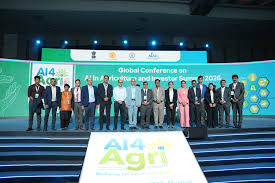
The U.S. National Science Foundation (NSF) has announced the inaugural cohort of AI-ENGAGE Awards, a landmark $2.4 million multilateral initiative aimed at transforming global agriculture through artificial intelligence and emerging technologies. Developed in partnership with leading research agencies in Australia, India, and Japan, the programme seeks to deploy advanced digital tools to enhance farm resilience, productivity, and climate adaptability worldwide.
Under the initiative, cross-border research teams will work on AI-driven solutions that address some of agriculture’s most pressing challenges—from climate-induced crop stress to resource optimization and sustainable land management. Projects will focus on applying machine learning, robotics, sensor networks, and data analytics to develop real-time decision-support systems for farmers.
The collaborative structure of AI-ENGAGE reflects a growing global consensus that agricultural innovation requires coordinated efforts. The involvement of India, Japan, and Australia broadens the programme’s geographic relevance, ensuring that research outcomes are applicable across diverse farming environments—ranging from smallholder systems in Asia to large commercial farms in the Pacific and the U.S.
NSF officials said the initiative is designed not only to fund cutting-edge research but also to accelerate technology deployment at the farm level. Emphasis will be placed on building scalable, low-cost tools accessible to farmers of all sizes, especially those operating in climate-vulnerable regions.
Experts note that global food systems are under increasing pressure due to rising climate variability, labour shortages, and the need for higher productivity with lower environmental impact. By leveraging AI, the AI-ENGAGE platform aims to pioneer new pathways for precision agriculture, early-warning systems, crop monitoring, and autonomous field operations.
The launch of these awards marks a significant step toward establishing a shared international innovation ecosystem for agriculture. As projects move forward, policymakers and researchers anticipate that the initiative will help unlock a new generation of smart farming technologies capable of strengthening global food security in the decades ahead.


 By
By











