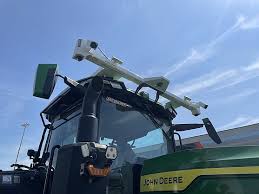
The 2026 Farm Progress Show in the United States highlighted the rapid transformation taking place in modern agriculture, with leading farm equipment manufacturers showcasing new tractors, planters, precision-agriculture systems and automation technologies designed to improve productivity, efficiency and sustainability.
Major manufacturers including Fendt, Case IH and Kubota used the event to demonstrate how agricultural machinery is evolving beyond conventional horsepower and mechanical performance. Increasingly, manufacturers are focusing on automation, precision technology, data-driven farming and connectivity to help farmers make better decisions while reducing input costs.
Automation Takes Centre Stage
One of the strongest themes at the 2026 Farm Progress Show was the growing role of automation in farm operations. Manufacturers showcased technologies designed to automate or simplify tasks such as planting, field preparation and machine guidance.
These systems can use sensors, positioning technologies and machine data to improve accuracy and reduce operator workload. For large-scale farms, automation can also help address labour shortages while allowing machinery to operate more efficiently during critical planting and harvesting windows.
Fendt Showcases Next-Generation Machinery
Fendt, part of the AGCO group, presented advanced tractor and agricultural technology solutions aimed at improving precision and operational efficiency. Its latest technologies demonstrate the industry’s move toward highly connected machines capable of integrating field data, guidance systems and automated functions.
The company continues to focus on combining machine performance with digital agriculture, giving farmers greater control over operations and helping optimise fuel, labour and input use.
Case IH Focuses on Precision and Productivity
Case IH also used the Farm Progress Show to highlight innovations in tractors, planting equipment and precision agriculture. Modern Case IH equipment increasingly integrates automation and digital systems to improve planting accuracy and field performance.
Precision planting technologies can help farmers place seeds at more consistent depths and spacing, potentially improving crop establishment and reducing wasted seed and inputs.
Kubota Expands Technology Portfolio
Kubota showcased its expanding range of agricultural machinery and technology solutions, reflecting the increasing importance of automation and connectivity across different farm sizes.
The company’s equipment portfolio demonstrates how manufacturers are attempting to bring advanced technology not only to large commercial farms but also to smaller and diversified agricultural operations.
Retrofit Technology Gains Importance
Perhaps one of the most significant trends highlighted at the show was the growing market for retrofit technology.
Instead of replacing an entire tractor or implement, farmers can increasingly upgrade existing equipment with technologies such as automated steering, precision guidance, electronic controls, sensors and connectivity systems.
For farmers, this approach can be financially attractive because it allows them to modernise machinery while continuing to use equipment they already own. Retrofit solutions could therefore accelerate the adoption of precision agriculture without requiring farmers to make the substantial investment involved in purchasing completely new machinery.
The Future of Farm Machinery
The developments showcased at the 2026 Farm Progress Show indicate that the future of agricultural machinery will increasingly depend on software, automation, connectivity and data, alongside traditional mechanical performance.
As input costs rise and farms face labour and climate-related challenges, manufacturers are competing to provide technologies that can help farmers produce more efficiently with fewer resources.
The growing availability of retrofit solutions could be equally important, allowing existing machinery fleets to participate in the digital transformation of agriculture.
Overall, the 2026 Farm Progress Show demonstrated that the next generation of farm equipment is not simply about bigger tractors or more powerful engines. The industry is moving toward smarter, connected and increasingly autonomous machines—technology that could fundamentally change how farming is carried out in the years ahead.


 By
By