

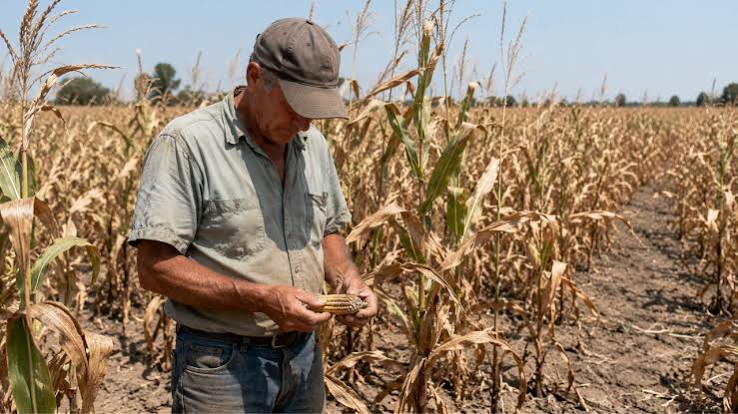
Climate change is placing an increasingly heavy financial burden on farmers worldwide, with a new international study estimating that rising temperatures and prolonged droughts are causing annual agricultural losses of more than US$20 billion. The research highlights the growing impact of extreme weather on the production of major food crops, raising concerns about future food security and the livelihoods of millions of farming families.
According to the study, climate-related heatwaves and drought have significantly reduced the yields of three of the world’s most important crops—maize, wheat, and soybean. These crops are essential for global food supplies, livestock feed, and industrial uses, making their declining productivity a matter of international concern.
Researchers found that extreme heat has become more frequent and intense over recent decades, while changing rainfall patterns have increased the occurrence of severe droughts in many agricultural regions. Together, these climate-related events reduce plant growth, limit grain development, and lower overall harvests. The combined impact is estimated to cost farmers and agricultural economies more than US$20 billion each year.
The study also presents a concerning outlook for the future. If global greenhouse gas emissions continue to rise and warming accelerates, annual agricultural losses from climate-related crop damage could increase by nearly eight times by the year 2100. Such a scenario would have significant consequences for food availability, farm incomes, rural employment, and global agricultural trade.
Scientists involved in the research emphasize that climate change affects agriculture in multiple ways. In addition to heat stress and water shortages, changing weather conditions can increase pest infestations, spread crop diseases, and reduce soil moisture. These challenges often occur simultaneously, making it more difficult for farmers to maintain stable production levels.
Developing countries are expected to face some of the greatest risks because many farming communities rely heavily on rain-fed agriculture and have limited access to advanced irrigation systems, climate-resilient crop varieties, and financial safety nets. Smallholder farmers, who produce a large share of the world’s food, may be particularly vulnerable to repeated weather shocks.
The researchers stress that adaptation measures can help reduce future losses. Expanding the use of drought-tolerant and heat-resistant crop varieties, improving irrigation efficiency, adopting climate-smart farming practices, enhancing weather forecasting, and strengthening agricultural advisory services are among the strategies recommended to improve resilience. Investments in soil health, water conservation, and precision agriculture can also help farmers cope with changing climatic conditions.
Experts note that reducing global greenhouse gas emissions remains essential to limit long-term agricultural damage. They argue that adaptation alone may not be sufficient if temperatures continue to rise rapidly over the coming decades.
The findings reinforce the growing body of scientific evidence showing that climate change is no longer a future threat but a present-day economic challenge for agriculture. As weather extremes become more frequent, governments, research institutions, and the private sector will need to work together to support farmers through innovation, climate-resilient technologies, and sustainable agricultural policies.
With global food demand expected to rise alongside population growth, protecting agricultural productivity has become increasingly important. The study serves as a reminder that strengthening climate resilience in farming is not only crucial for safeguarding farmers’ livelihoods but also for ensuring a stable and secure food supply for future generations.


 By
By











